
Retired school teacher John Chapin experienced the ride of a lifetime when the Navy destroyer he was aboard in November 2007 hit a line of typhoons north of the Philippines that sent the USS Mustin into gut-wrenching rolls.
“The bow was under water, and the waves were bouncing off the bottom of the ship,” recalled Chapin. “That destroyer was rocking and rolling until we got back to port in Japan.”
As a teacher at South Portland High School, Chapin taught American history and government in the same classroom for 36 years.
But since retiring in 2006, Chapin has embarked on an unexpected second career with the U.S. Navy that transformed the 63-year-old educator into a high-seas adventurer and world traveler.
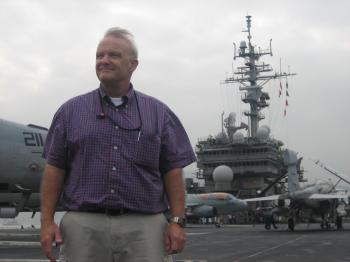
Chapin is a college instructor with PACE, or Program for Afloat College Education, which brings the classroom to sailors at sea. Chapin’s teaching assignments have taken him to Japan, Guam, Malaysia and China.
“The guy is a huge military history buff and what better way to be part of the military than to be teaching to the troops?” said City Manager Jim Gailey, who was Chapin’s student 20 years ago at South Portland High School.
This week, Chapin embarks on his third assignment as a contractor with the U.S. Navy.
He was scheduled to leave Wednesday for a three-month post aboard the USS Abraham Lincoln, an aircraft carrier patrolling the northern Persian Gulf and offering air support to ground forces in Iraq.
“Every once in a while I just have to pinch myself and hope I don’t wake up,” said Chapin, who will teach American history aboard ship.
Chapin first will fly to San Diego to undergo military training in anti-terrorism tactics and cultural education before traveling on to the Middle East.
Prior to the Navy assignments, Chapin had little experience on the water, other than kayaking or sailing in Casco Bay.
“Going to Peaks Island was my idea of an ocean voyage,” he said.
Chapin also has had no previous military experience, though he is a lifelong learner of military history.
“I’m a little apprehensive,” Chapin said Monday about the new assignment. “I actually took out my last will and testament today and plan to leave it a in a prominent place.
“But at the same time, I realize the aircraft carrier is totally surrounded by ‘force protection,’ as it’s called. Destroyers and cruisers and submarines protect it.”
Chapin’s own love of learning and dedication to South Portland students linked him to PACE.
As a history, military studies and government teacher, Chapin often brought in guest speakers to lecture to students and offer their perspectives on global affairs.
In 2005, a Marine Corps officer visited Chapin’s classroom. After the lecture, Chapin said the officer mentioned the teaching program and suggested that Chapin apply for a post.
“He said, ‘When you retire, think about it. It could be fun for you and a good way to help young people,’ “Chapin recalled.
Chapin followed his advice and contacted U.S. Sen. Susan Collins’ office to learn more about it. The staff for the Republican senator from Maine connected him to organizers at PACE.
Chapin applied for the position, underwent an extensive background check, passed a physical exam, and was signed on as a college instructor.
He now is a part-time instructor with PACE, which is part of the U.S. Navy College Program.
Chapin teaches American history and government just like he would in a classroom, except that the lessons are aboard ship and scheduled when the men and women are off-duty, such as 9 p.m.-midnight on a Saturday.
The courses are accredited by Central Texas College, and students receive credits for their work toward a college degree. Students are issued textbooks. They have homework, quizzes and exams. At the end of the course, Chapin issues their grades.
“Really, it’s the same as a classroom, except you are teaching uniformed military personnel,” he said.
Chapin said he has been most surprised by how grateful the sailors are that he is there to teach them. The courses not only enable them to further their college studies, he said, but also give them something to focus on while spending months at sea.
“Time can be a hazard on ship when there is nothing to do,” he said.
Chapin declined to give details on his salary, other than to say he is paid “a couple of thousand dollars per course” he teaches. The Navy also covers his travel expenses.
Although Chapin has had two previous teaching assignments with the U.S. Navy, this latest one will be his first in a combat area.
From October-December 2006, Chapin was sent to Japan aboard the USS Kitty Hawk, an aircraft carrier with a crew of about 5,500. The Kitty Hawk is a training carrier for pilots and does joint operations in the Pacific.
During this first deployment, Chapin traveled to Hong Kong, Nagasaki and also went on a daylong field trip into the new provinces of China.
In July 2007, he returned to Japan, this time aboard the destroyer, USS Mustin. He spent three months at sea, traveling to Guam and Malaysia. While at sea, the Mustin conducted joint exercises with U.S. allies, including India, Australia and Japan.
Friends and family do not seem surprised that Chapin has embarked on a second career of world travel after the age of 60.
“I have known John mostly through track and field, as he was a 35-year coach at South Portland High School,” said City Councilor Tom Blake.
“John was a tremendously successful coach and respected by all as a top-rate classroom instructor. This career move seems like a perfect fit for him. He likes to keep busy and loves people, history and government. Our military personnel also gains with his wit, his wisdom and his knowledge.”
Gailey echoes Blake’s comments. He said taking a course from Chapin was a memorable experience.
“John had the ability to bring reality to the classroom and through his quirky antics and his excitement about his subject, he always kept your attention,” Gailey said.
“I had him for military history and the knowledge and stories that man holds was truly a gift to his students.”
 Retired teacher takes history lessons to Persian Gulf
Comments are no longer available on this story