
For the first time in more than 20 years least terns have returned to Western Beach on Prouts Neck.
Scarborough resident Lucy Lacasse first found the birds on Western Beach in 1977. The birds remained until 1980 but then did not come back – that is, until this year.
According to Jody Jones, a wildlife ecologist for the Maine Audubon and leader of the Piping Plover and Least Tern Project, the reason why the birds returned is because the Ferry Beach dredging project created some habitat.
Over the years Western Beach had suffered from erosion and much of the sand that the birds used for habitat was washed away. But while the dredging project was under way workers placed the sand onto Western Beach, providing valuable habitat for the birds.
“It’s very exciting to have them back to Western Beach at Prouts Neck,” Jones said.
In a recent count there were 31 nests of least terns, each containing two adults and one to three eggs. It is one of the largest least tern colonies in the state and the only one of similar size is found on Crescent Surf Beach in Kennebunk. There also are two pairs of piping plovers, another protected species found on some Scarborough beaches.
“Scarborough is a really special place,” Jones said. “It’s blessed with probably more sandy beaches than any town.”
Least terns are small birds measuring about nine inches long which weigh about one ounce. The birds will defend their space and have been known to dive-bomb intruders and make a large racket to protect themselves. Least terns hunt fish and in this case use the estuaries behind the marsh or the Scarborough River as a food source.
Least terns were once common but they were hunted for hats and their eggs were collected, which significantly reduced the population. Today the birds are considered endangered in Maine.
Because the birds fly, they are harder to protect than piping plovers, which are fenced to keep them safe from predators. There are no easy fixes to protecting least terns and Jones said there is not a simple way to protect them.
One way to ensure their survival is making alternative habitat sites available. Jones said least terns will normally nest for two or three years at a site and then predators will usually force the colony to move. In fact the birds now on Western Beach were the same colony that once lived on Higgins Beach.
That colony split with some going to Western Beach and others going to Stratton Island, a private island off of Prouts Neck owned by the Audubon for conservation purposes. Jones said there are 12 nests of birds on the island.
The splitting of a single colony is not unusual when it is faced with predators, Jones said. In Maine the birds face pressure from crows, and occasionally sea gulls, owls, skunks and foxes. Another common problem are deer walking through the colony at night.
While predators are a problem for least terns and piping plovers, one of the biggest problems facing these birds is loss of habitat caused by human development.
“A lot of habitat has been lost already and we’re trying to stop this species from bottoming out in Maine,” Jones said.
Fortunately property owners are receptive to assisting the Audubon with protecting least terns and piping plovers. For example, the Prouts Neck Country Club owns Western Beach, and has been helpful in protecting the birds and their habitat.
Lacasse, who is a board member for Maine Audubon, also serves as the official piping plover monitor for the club and works to assist educating people about the birds and their habitat.
“We wanted people to understand this was good habitat and it was likely we would get birds,” she said, adding the town also has been helpful in its education efforts.
There have been some added restrictions for those using the beach and the golf course. Golfers are not allowed to retrieve balls that land in the least tern nest areas and dogs must be leashed all the time.
“The birds have to be a priority because they don’t have much of a chance,” Lacasse said. “Their nesting habitat is limited. It’s great that Scarborough can play host for these species, but with that comes the responsibility of helping them along.”
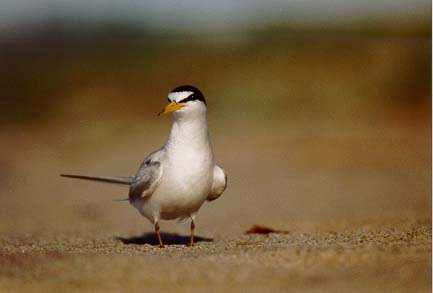 A least tern adult.
Comments are no longer available on this story