
PORTLAND—What was once the largest residential property in Portland could soon become one of its largest subdivisions and the first new development of single-family homes in several years.
For Westbrook, which lies just a few hundred feet from the land, that means further changes to the Stroudwater Street area that has historically been rural.
Camelot Farm at 1700 Westbrook St., where Peter and Mary Rogers raised most of their 11 children, is under contract to be sold to buyers who were not identified by real estate agent Craig Young and consultant Michael Barton.
“(It is a) group of local residents and business people. Our goal is to create a modern take on a traditional neighborhood,” Barton said.
The property was been on the market for more than a year, with an asking price of $2.4 million. Barton on Monday said the 45 acres could become the site of as many as 100 house lots of varied sizes.
Barton has twice met with neighbors and members of the Stroudwater Village Association, most recently on Dec. 10. He said he envisions development resembling the Deering neighborhood where he grew up, and said a request to city planning staff for a zoning change is coming.
Westbrook resident and Randall Farm owner Arthur Randall said he’s attended the Stroudwater Village Association meetings, and has concerns about the planned development. Randall Farm property begins as Westbrook Street in Portland turns into Stroudwater Street in Westbrook, immediately after the bridge over Interstate 95.
Over the last few decades, properties surrounding Randall have been sold to developers, including, most recently, the former Snyder property acquired by J.B. Brown & Sons, where Randall’s beef cattle still graze. Eventually, J.B. Brown may move forward with plans for residential development off Stroudwater Street, with a commerical development off the Westbrook Arterial.
Up until September, Randall had also been using the farmland at Camelot Farm for his cattle to graze. Randall’s father, Llewellyn “Lew” Randall, was good friends with Peter Rogers, the pair serving together during World War II.
Randall said he, like more immediate neighbors, is concerned for the added traffic the development could create on an already busy road linking Portland to Westbrook and outlying communities.
The Camelot Farm land, bordered by the Maine Turnpike and Stroudwater River, is now zoned R-1, a low-density designation for housing. Barton said developers feel an R-3 designation with medium density housing is more suitable.
Portland Planning Director Tuck O’Brien on Monday said the R-3 zone makes open space preservation easier because it allows for smaller house lots.
Barton said as much as 17 acres of open space could be preserved, with some incorporated into Portland Trails, which also has open space across Westbrook Street from the farm.
“It is a good idea to preserve some of the natural features that are on the property,” he said.
Barton said the new housing would run the gamut of the housing market, with starter homes, family homes, and homes for empty-nesters looking to downsize.
O’Brien said city staff encouraged Barton to reach out to the neighborhood to outline potential plans, but from a Planning Department perspective, the concept is a good fit.
“The notes they are hitting is what we have been wanting in Portland,” he said. “It could be a new kind of neighborhood we don’t see very often.”
The diversity of housing types, public access to open space and possibly even some athletic fields all mesh with the city Comprehensive Plan that is under development, O’Brien said.
O’Brien is the former Portland Planning Board chairman, and said this type of single-family home development is unique in the six years he has worked for the city.
“It is the first single-family subdivision that has happened since I’ve been here,” he said.
Attorney David Silk, a former Portland Planning Board member and Stroudwater Village Association member, said he is primarily concerned about the phasing and scope of the proposed housing, as well as the effects on traffic.
“How do you make something work within the fabric? It does not mean you don’t have change,” Silk said. “Hopefully everybody listens to each other and there is flexibility to make it work.”
Barton said traffic counts have already been tallied in advance of a larger study, and a team of consultants are also reviewing environmental impacts. The development would be linked to existing sewer and water infrastructure.
Adding as many as 100 single family homes to an area close to large employers such as the Portland International Jetport or Unum could also be a draw, Barton said.
“This may an opportunity for people to move back into Portland,” he said.
The R-3 zone does not require a master plan to detail the phases of construction, but O’Brien said some master planning could be incorporated into the process.
Camelot Farm was owned by the Rogers family for about 55 years, and was a working farm with cattle and horses, as well as Irish wolfhounds, basketball and tennis courts and an outdoor skating rink. Peter Rogers was a Portland attorney.
The 4,400-square-foot ranch was designed after one the Rogers family saw in California.
The home was known as a neighborhood gathering spot.
“It was never supposed to be quiet. If you had a friend over, they could always join you at the dinner table. My mom would say, ‘Just pull up another chair,’” Connie Rogers Bashian said last year.
Just over the border in Westbrook, Randall says he’s been paying close attention to other planned developments, including the Dirigo Plaza retail center and the former Twin Falls Golf Club land on Spring Street, across from Blue Spruce Farm.
Wormell Farm, at over 111 acres off Route 302, is also on the market in Westbrook.
When asked if Randall Farm would be the next large tract to succumb to the financial or development pressures, Randall said, “No way. From heaven to hell, we’re going to stick. ”
Staff writer Andrew Rice also contributed to this report.
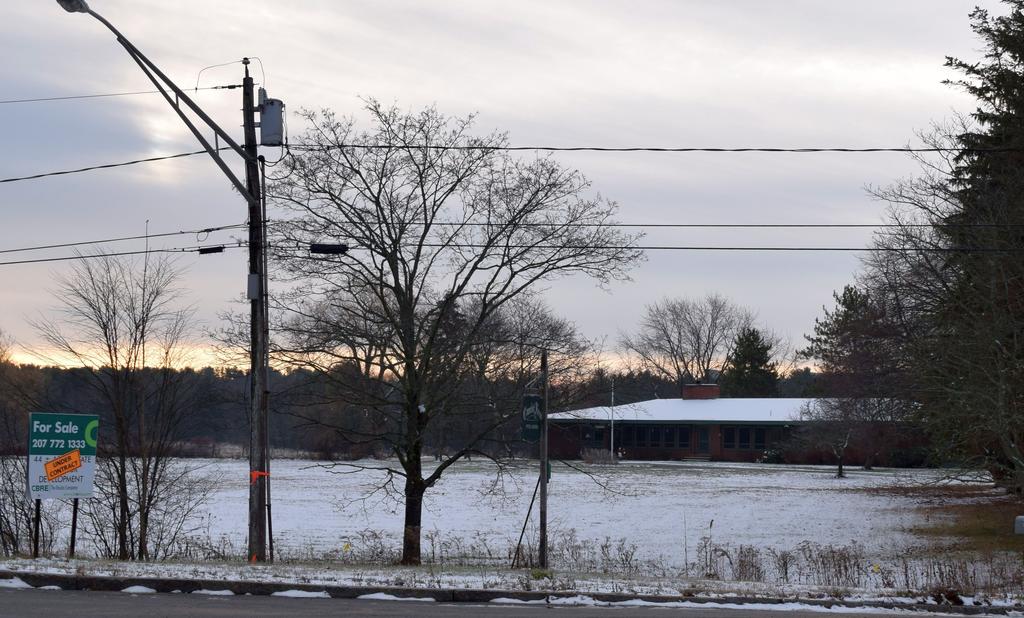
Camelot Farm in Portland, with 45 acres at 1700 Westbrook St., is under contract to be sold and could be redeveloped as a 100-lot subdivision.
Comments are no longer available on this story