
STANDISH – One of the special events to be held at this weekend’s Maine Mineralogical & Geological Society’s 29th annual Gem & Mineral Show at Saint Joseph’s College is a special unveiling of a crystal made especially for the college’s 100th anniversary.
Dr. Stephen Bridge, a theology professor at the college and gem hobbyist, crafted the 100-facet, 54-carat quartz crystal stone and will do the unveiling at the show.
The show also features more than 25 vendors, including 12 displaying jewelry, gems, rocks, fluorescent minerals, crystals, fossils and geodes. In addition, gold panning and gem-cutting demonstrations are scheduled, along with many unusual, one-of-a-kind items for sale. Children will be able to dig for treasures in the mini-mine, win prizes on the spin wheel and handle rocks and gems at the touch table.
“This is a great family event,” said Chad Cramer, the show’s coordinator. “There really is something for everyone to enjoy.”
Speakers include legendary miner Frank Perham, who will share stories of his geological discoveries and adventures on Saturday at 10:30 a.m.; Harry Blake, who will talk on how to find gold in Maine on Saturday at 2 p.m., Derek Katzenbach, who will show how to facet stones on Sunday at 10:30 a.m., and Karen Pride of Cross Jewelers, who will talk about the history of Maine tourmaline on Sunday at 2 p.m.
Bridge, a Windham resident who searches for gems with his three daughters, says the college is thrilled and honored to host the event. “This year it will be extra special, because it coincides both with Earth Day and the College Centennial,” said Bridge.
The Lakes Region Weekly recently asked Bridge about his hobby and the stone he has crafted for the show:
Q: How did you get into jewelry making?
A: Bob Prouty of Northeast Gems in Fryeburg first taught me five years ago. I had amassed a nice little collection of rough stones from my rock hounding adventures, and I was looking for something to do with them. It was mostly clear and smoky quartz, with some aquamarine and amethyst as well. Bob patiently walked me through the faceting process, and after cutting my first stone, I was hooked.
Q: What is the “Centennial Diamond” made of?
A: It’s made of flawless rock crystal, or clear quartz. It’s essentially the same material as a Herkimer Diamond. Herkimer diamonds are particularly clear quartz crystals mined in Herkimer, N.Y. This crystal didn’t come from the Herkimer area, but it was a very clear quartz crystal, much like the Herkimer ones.
Q: Where did you find it?
A: I’d rather not reveal the precise location, but I found the crystal in an East Coast mine dump. A mine dump is where the “tailings,” or leftover materials from mining excavations, are deposited. Actually, my daughters were with me, and it was one of six or seven we found that day. We just happened to be in the right place at the right time.
Q: Are 100 facets a lot for a stone?
A: Perhaps the most famous design is the “Standard Round Brilliant,” which has 73 facets. I’d guess most designs have between 30 and 80 facets. The more facets, the longer it takes to cut.
Q. How are they arranged?
A: The “Centennial Diamond” features two crosses, a tiny one hidden in the pavilion of the stone, and a more prominent Celtic Cross that graces its crown. The Celtic Cross honors the life and spirit of Catherine McAuley, an Irish nun who founded the Sisters of Mercy. It is her religious order that first established, and continues to sponsor, Saint Joseph’s College of Maine.
Q: Any limiting factors when faceting a stone?
A: The only limiting factor can be the size of the stone. Larger stones generally work better for higher facets. This stone is very large. It tips the scales at over 54 carats. Its many facets serve to effectively disperse the light, making this a very bright and “sparkly” stone.
Q: How will you unveil it at the show?
A: Thomas Johnson is a master craftsman who works in our Facilities Department. He has designed and built a beautiful wood and glass display cabinet that will showcase the Centennial Diamond (along with some other remarkable gemstones). That cabinet will stand alongside two others – a mineral specimen case and a florescent viewing cabinet – as part of the college’s contribution to the show.
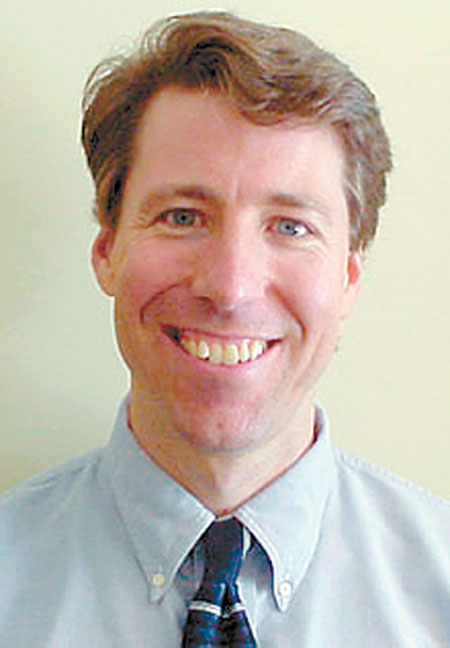 Dr. Stephen Bridge
Comments are no longer available on this story