
On parents weekend in the Lakes Region, which took place during the last two weekends, the families of summer campers from across the country and the world descend upon the area, pumping dollars into local hotels, restaurants and more.
Every year, it is the most visible manifestation of a century-long tradition that, to this day, endures along the forested shores of Sebago Lake, Panther Pond, Crescent Lake, Trickey Pond, Long Lake and others.
According to Ron Hall, executive director of Maine Summer Camps, the Lakes Region is home to the highest concentration of high-end, residential summer camps in the state. These camps – Hall estimates there are eight or nine in the area – are among the most expensive summer camps in the country, with tuition for a seven-week session running north of $11,000 in some cases. Hall estimates that the Lakes Region fields another 40 camps in the mid-level price range.
Amid continuing economic stagnation, the traditional, high-end camps of the Lakes Region continue to attract the children of the upper-middle class and the economic elite, although camp scholarship programs extend to less fortunate children, as well. It is a proud tradition, as many of the camps are owned and operated by families or former campers. Some of the children are third-generation campers.
As family structures fragment and the demands of youth athletics and education intensify, the camps have faced increasing pressure to cut down the length of the summer session. Some have yielded, while others have bucked the tide. Yet few camps have budged when it comes to the anti-electronics policy that has persisted through the years. In their zeal to build character, independence, and robust sociability, the camps have enforced strict bans on electronic devices, even as the use of gadgets has proliferated. In the view of camp directors, as the camps’ technology policies have veered ever more against the grain of technological progress, the camp experience has become even more valuable for young people.
Despite challenges with rising insurance, energy, and food costs, the camps persist year after year, reliably attracting tourist dollars, and the curiosity of educated professionals, some of whom eventually purchase real estate in Maine.
Although there are large concentrations of high-end, traditional camps in the Belgrade Lakes and Readfield areas, says Hall, the greatest concentration is situated in Standish, Fryeburg, West Paris, Raymond and Casco. Some of the earliest Maine camps were founded at the turn of the century. Denmark’s Camp Wyonogonick, the first girls’ camp in Maine, was founded in 1902. Hall said that the Lakes Region area was an appealing camp setting both because of its beauty and its proximity to New York and Boston.
“When they were first developing in Maine, most of the campers took a train from Boston to Sebago Lake Station and their boats would meet them and take them across the lake over to the Casco area,” Hall said. “Route 114, which goes from Sebago to Naples, that was just a dirt road back in the ’50s. That whole level of transportation was pretty archaic in the early years, so that it was a major endeavor to get kids from New York or from Boston to come to a camp in Maine. And I think that’s why it was a seven- or eight-week experience.”
According to Jeff Konigsberg, the owner of Camp Takajo (full-season tuition: $11,400) in Naples and Tripp Lake Camp (tuition: $11,400) in Poland, the first girl campers at Tripp Lake in 1911 arrived by horse-and-buggy.
“I think the Lakes Region has always enjoyed a very strong camp reputation because it’s such a beautiful community, Long Lake feeding into Sebago Lake is just so magnificent and so picturesque,” he said.
Lee Horowitz, a Baltimore teacher, co-founded Camp Skylemar (full-season tuition: $11,350) in Naples in 1948. His daughter, Arleen Shepherd, who directs the camp today, said that her father immediately fell in love with Naples.
“My father was a schoolteacher and a coach in Baltimore and he searched the country for the most beautiful spot he could possibly find to open a camp, and he chose Naples, Maine,” Shepherd said.
Shepherd said she has seen many camp owners sell off their properties to real estate developers through the years.
“Most of them closed because of the ability to sell your real estate for housing developments, but those who remain are directed by people who have a passion for making a positive difference for kids,” she said.
But according to Hall and Alan Kissak, the director of Kingsley Pines Camp (three-week tuition: $4,175) in Raymond, most camps in the area were sold off in the 1980s. There have been fewer sales in recent years, they said.
“In the real estate boom in the ’80s, people had to make that decision between selling it as a camp for X amount or selling it as house flats for X amount,” Kissak said.
National and international clientele
According to Ron Bancroft, a management consultant from Portland who sent his daughters to Raymond’s Camp Wohelo while he worked for McKinsey & Co. in Washington, D.C., in the 1980s, a majority of the children at these camps come from “upper-middle class” American families. Yet the camps’ reach extends beyond national borders. According to Konigsberg, Camp Takajo has campers from London, Spain, Venezuela and Lebanon. The majority of campers come from the eastern seaboard of the United States, he said.
Shepherd, who was interviewed in 2011 for a New York Times article about wealthy families flying their children to camp on private jets, said Camp Skylemar hosts campers from across the country, as well as from Spain, Mexico, China, Russia and France.
“In many cases, they want their children to learn English better, and sometimes when it’s an English speaking country, it’s an American family that their job took them abroad and they want them to have an American experience,” Shepherd said. “But the foreign families see our location and our residential camps as giving their kids the very finest option. We had a president of Mexico’s kid once. I don’t want to say celebrity, but it tends to be a family who can afford the finest.”
Bancroft said that it’s not unusual for families to buy summer homes in Maine after sending their kids to camp in the state.
“The outside connections have resulted in many people doing things like vacationing up here every year and buying a summer place up here and in some cases retiring here,” he said. “I just think there’s a nice connection.”
Cultural change felt
According to Konigsberg, the notion of shortening the summer season first emerged in response to slackening demand, as camp owners weren’t able to fill beds. In the past 15 years, he said, cultural change has led to pressure for shorter seasons.
“Everything’s changed,” he said. “You’re facing families that are choosing a shorter season because of lifestyle; you have families that are choosing a shorter season because of the economics; you have families that are choosing a shorter season because they’re being pulled by local teams.”
“Maybe there’s divorce and custody issues,” Konigsberg added. “The full-season model has been attacked from many angles.”
As team sports and school years begin earlier, Shepherd said, pressure on the full season has mounted. According to Kissak, general lifestyle preferences have contributed, as well.
“If you go way back in history, like back to the ’50s, everybody was eight weeks, and that’s actually changed a lot over the years,” he said. “They’re going to Grandma’s on the Cape, and they’re going to a specific lacrosse camp.”
“In divorce situations, oftentimes children have to spend a certain amount of time with each parent in the summer,” Kissak said. “An eight-week camp might not be an option because you have to spend at least four of those weeks in camp.”
A digital-free oasis
At Kingsley Pines Camp, children are never allowed to use any electronics, except for Apple iPods that don’t have Internet access. And those are only allowed during “siesta” time.
“Most camps basically do not allow cellphones or iPads and stuff like that,” Kissak said. “Basically, ‘unplugged’ is sort of the term that they use for kids going off to camp.”
Kissak believes that a changing world has increased the value of camp.
“It’s a change in the world, which is nowadays everybody’s on their cellphones and their sort of living their lives online,” he said. “Now parents are looking to camp as being a place where kids get away from electronics.”
According to Konigsberg, the camps’ technology policy fosters a sense of independence.
“There’s an assumption that summer camp is a place to play and develop your athletic skills,” he said. “I have always felt that summer camp is a place to play and to develop your emotional skills as well as your athletic skills. It’s teaching children life skills. It’s teaching children self-reliance. In an age of instant gratification and technology, it’s a place to slow down to the speed of life. We don’t allow electronics. We give the thumbs a rest for the summer.”
Economic impact
Across the state, Maine’s 330 camps generate significant economic activity. According to Hall, Maine camps spend $136 million annually on operating costs and $29 million on capital projects. Every year, they attract about 45,000 out-of-state visitors, who spend an average of $6.26 million.
“Maine camps spend 40 percent more than Bowdoin College’s budget, we’re 90 percent as large as the state boat building sector, and we’re approximately 40 percent as large as the annual lobster landing,” Hall said.
Local economic development officials did not have data on the impact of camps in the Lakes Region.
According to Aimee Senatore, the executive director of the Sebago Lakes Region Chamber of Commerce, the local lodging industry relies heavily on parents weekend, which is a reliable cash cow. But there is a broader impact, as well, she said.
“They’re eating at our restaurants and taking advantage of our recreational activities,” Senatore said. “There’s absolutely an impact.”
George Bartlett, the owner of Busy Bee Laundry in North Windham, said that 30 percent of his annual business comes from his relationships with six summer camps, one of which is Kingsley Pines.
“The camp laundry is a significant portion of our business,” he said. “Without it we probably wouldn’t be here.”
The only problem, Bartlett said, is that the camp season is getting shorter.
“It used to be in the old days, summer camp was eight to nine weeks,” Bartlett said. “For us business people, it has cut the season so we have to work harder during the seven weeks to get all of the work done. The kids leave, the tourists leave. It’s a pretty short summer season in Maine, I’ll tell you.”
 Campers and counselors from across the United States and several from as far away as Spain take a break from a gymnastics session on the front lawn at Camp Skylemar, one of the Lakes Region’s high-end summer camps.
 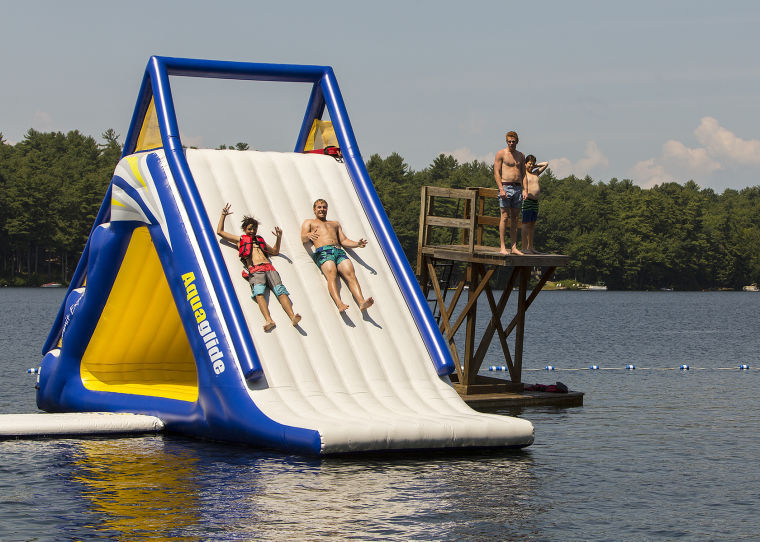 Camp Skylemar counselor Billy Hepner, right, and camper Francisco Ramirez slide into Trickey Pond on the large inflatable slide in the waterfront recreation area.
Comments are no longer available on this story