
Archie has spent the last month inside the Maine Correctional Center in Windham. He hasn’t been charged with a crime or provided a lawyer, and the state has no intention of ever giving him a trial.
But all the inmates like having him around.
Archie, a puppy of Rottweiler and German shepherd heritage, is a participant in the Paws in Stripes program at the prison. The Animal Refuge League in Westbrook has teamed up with the correctional center to allow carefully screened prisoners to take care of puppies and kittens until they are ready for adoption.
“The dogs are very comfortable, they don’t know they’re in a correctional facility,” said Susan Britt, director of operations of the Animal Refuge League. She started the program in October after hearing of the success of similar programs in other states.
Britt said the prisoners are given animals that are too young to be adopted yet or lack social skills. They stay with a prisoner, known as the primary handler, and receive around-the-clock care. The prisoners like it because it gives them something to do, the staff likes it because it keeps ruckus down and the animals love it because they receive undivided attention. The Animal Refuge League provides all the pet food and accessories.
Each primary handler has an assistant handler, so they have someone to pass the animal on to when they get a visitor, have to attend a class or need to go to court. Handlers are carefully screened to make sure they haven’t been convicted of any animal abuse, they haven’t had any discipline problems in prison and they have been keeping clean cells. Screeners also consider the nature of the offense inmates have been convicted of and what their motivation is for entering the program.
Penny Bailey, unit manager of Medium Security, said there have been no problems with any of the prisoners.
“I don’t think anybody’s even raised their voice (to the animals),” said Bailey. She became the prison’s administrator for the program after Britt pitched the idea.
Bailey said the program has improved the mood of the prison. “It brings the level of stress down,” she said, adding that it’s hard to stay angry when a puppy walks by.
“It’s not going to stop them from committing any crimes,” said Bailey. She said the program is successful at keeping the prisoners out of trouble and encouraging good social interaction among the inmates.
The animals usually stay a little more than a month before going back to the Animal Refuge League for adoption. After an animal is released, its handlers are put back in a pool of candidates to await a further assignment.
The program has four puppies enrolled right now, but has had kittens in the past.
“You had that war going on, cat-people versus dog-people,” said Bailey. She said she expected prisoners to be too macho to want to take care of kittens, but they were a sleeper hit.
“They actually begged: ‘Can we have kittens again,'” said Bailey about both the prisoners and guards. She said the guards respond well to the animals and Britt said a lot of animals from the program have been adopted by correctional staff.
Bailey said the program encourages the inmates to interact with one another and her staff.
“They’ll have a conversation about the puppy. They’ll be able to communicate with people they otherwise wouldn’t,” she said.
Inmate Tim Duncan, who is Archie’s primary handler, said the animals bring out another side of the prisoners and guards.
“You see a 250-pound (prisoner) walking around coochie-cooing in a girl’s voice,” he said, with his tattooed arms wrapped gently around Archie.
“It shows the inmates’ softer side,” said Archie’s assistant handler, Greg, who asked to be identified by only his first name.
“I think it’s in their character. The puppies just bring it out,” said Britt.
Duncan said he worked with a wide variety of animals on the outside – feathers, fur and fins – and that the program gave the other inmates all the training they need to care for the animals.
The inmates said they enjoy taking care of the animals, as it’s both fulfilling as well as entertaining.
“It makes me feel good that I can do something for someone out there,” said Duncan.
“It’s like having a good friend who doesn’t tell on you,” said Greg.
Both said they wouldn’t hesitate to turn in inmates who weren’t taking proper care of their puppy or kitten.
Bailey said that while prisoners are usually tight-lipped about other inmates who break the rules, all of the prisoners interviewed for the program said they’d do something if they saw another prisoner misfeed an animal.
Most said they’d turn the inmate in, while a few said they’d be willing to take matters into their own hands.
Arthur, an inmate who asked to be identified by only his first name, said he was shocked when he heard that Dragon, the beagle under his care, was locked in a basement in Limington for about five years with 18 other dogs.
“I mean, why would they want to do that to an animal?” he said, clearly troubled by the abuse. “They have no way of protecting themselves.”
Dragon was named Snapdragon by the Animal Refuge League, but Arthur chopped it down. Another dog was named Hyacinth when it arrived, but it was soon changed to Sid.
“We felt he’d get beaten up in prison with a name like Hyacinth,” Bailey joked.
Dragon was underweight when he arrived last month and lacked social skills. Arthur said he’s gained a good amount of weight since he’s arrived and is a lot more comfortable around people.
“What that dog has been through is remarkable,” said Scott Durgin, Dragon’s assistant handler. “His first two nights (here) were really tough.”
Durgin and Arthur said they kept each other informed as the timid, shy dog that they care for grew more social and adventurous.
Dragon likes to dig at the floor when he’s feeling stressed, Arthur said, and loves to check out all of the cells he can. Arthur said Dragon recently hopped onto another prisoner’s bed and watched the television while helping himself to an unguarded breakfast sandwich.
“Whoever does end up with him, they got a real good dog right here,” said Arthur, while scratching Dragon behind his floppy ear.
KEEP IT GOING
The Animal Refuge League seeks donations to allow the Paws in Stripes program to grow and continue. In addition to monetary donations, needed supplies for Paws in Stripes include:
* High-quality, soft-training treats for puppies
* Canned puppy and kitten food with flip-top lids in single- serving cans
* Kitten- and puppy-safe, washable toys
* Puppy and kitten nail trimmers and brushes
* Unscented, clumping cat litter
* Funding for educational animal care and training materials for prisoners.
Send or drop off donations to the shelter at 449 Stroudwater St., Westbrook 04092.
For more information, call 854-9771, or log on to www.arlgp.org.
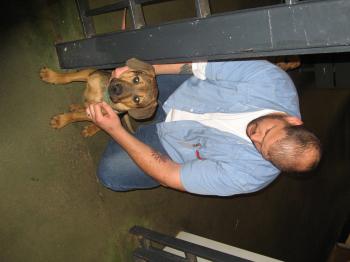 Paws1 Inmate Tim Duncan scratches Archie, the rottweiler-German shepherd pup under his care at the Maine Correctional Center in Windham as part of the Paws in Stripes program with the Animal Refuge League of Greater Portland.
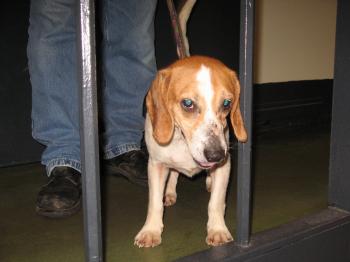 Paws2 Dragon stands between the bars in front of Arthur, his handler at the Maine Correctional Center in Windham as part of the Paws in Stripes program with the Animal Refuge League of Greater Portland.
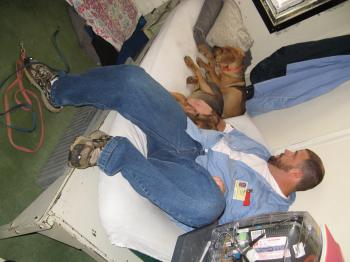 Paws3 Inmate Tim Duncan sits in his cell with Archie and Sid at the Maine Correctional Center in Windham. The dogs are being cared for by inmates as part of the Paws in Stripes program with the Animal Refuge League of Greater Portland.
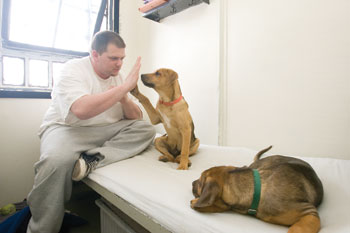 Inmate Ken Austin gets a high-five from Rumba while a more laid-back Archie relaxes on a cot.
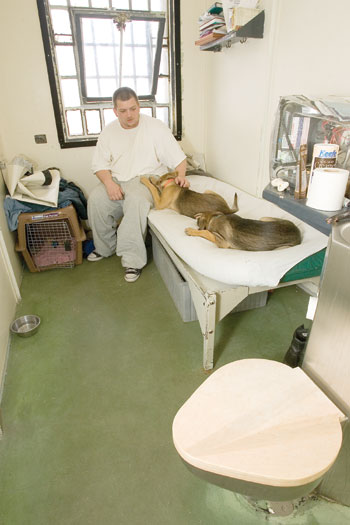 Inmate Ken Austin in his cell at the Maine Correctional Center in Windham with two rescued beagles, Rumba and Archie, that are part of the Paws in Stripes program.
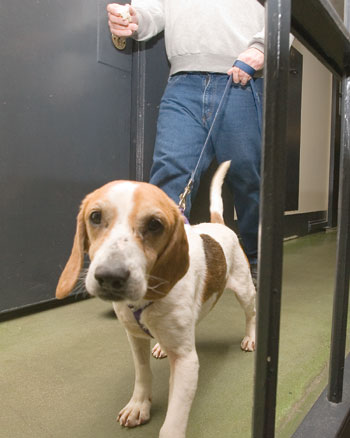 Dragon was underweight when he arrived at the prison last month and lacked social skills. His handler Arthur said Dragon’s gained a good amount of weight since then and is a lot more comfortable around people.
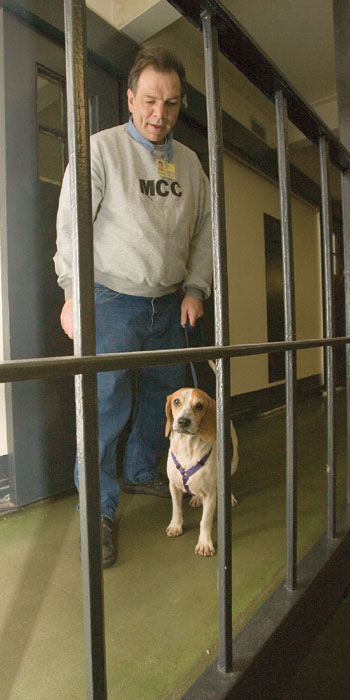 Maine Correctional Center inmate Arthur was shocked when he heard that Dragon, the beagle under his care, was locked in a basement in Limington for about five years with 18 other dogs. “I mean, why would they want to do that to an animal?” he asked. “They have no way of protecting themselves.” Arthur and Dragon are part of the “Paws in Stripes” program at the correctional center.
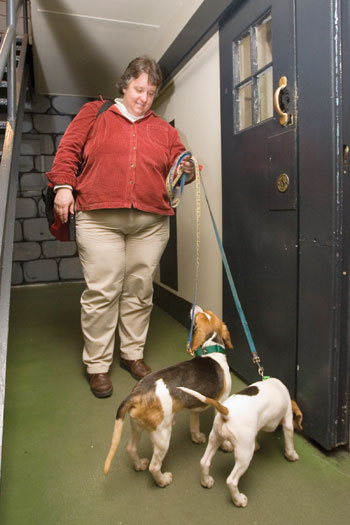 Penny Bailey, a unit manager at the Maine Correctional Center in Windham, with Carmen (white fur) and Sid. Bailey said the Paws in Stripes program has improved the mood of the prison. “It brings the level of stress down,” she said.
 Dragon and his prison caretaker Arthur explore an outdoor recreation area at the Maine Correctional Center in Windham. “Whoever does end up with (Dragon), they got a real good dog right here,” said Arthur.
Comments are no longer available on this story