
FREEPORT – A retired Freeport High School history and archaeology teacher will head up a dig later this year to find further remnants of significant findings he discovered some years back at Pettengill Farm.
Norm Buttrick will lead a group of Freeport High School history students at the 19th-century farm, owned by the Freeport Historical Society and listed in the National Register of Historic Places. The team will head out to the farm, located off Flying Point Road, once the historical society gains grant money, probably in late summer or early autumn, Buttrick said.
Christina White, executive director of the Freeport Historical Society, said that the group is seeking a grant of $8,124 for the Pettingill Farm project. It has made grant applications to Bowdoin College for a Common Good Grant, and to the Maine Community Foundation, White said.
Buttrick, who lives in Portland, said that when he last supervised a dig at the site, they found pieces of what he believes was a large wharf in the mud and moss along the Harraseeket River. Also discovered were pieces of a gundalow, a flat-bottomed boat once used to transport cargo. Both the wharf and the gundalow probably were used to transport bricks, manufactured in a brickyard at the site, he said.
People also probably fished off the wharf, he said.
He recalled revisiting the area, once the initial discovery was made.
“I waited until low tide, not too far from the salt-box home, to see if I could find any remains of the wharf,” Buttrick said. “I could see some pilings. Some of the timbers were quite large and they had a cribbing, so you knew it was a wharf.”
The gundalow operated according to the tide on the river, carrying loads of timber and bricks, probably to cargo ships in deeper water, Buttrick said.
Buttrick took a dozen or so students from his archaeology class, which no longer is offered at the school, to the Pettengill Farm in the early 2000s. Using trowels, he and the students did digs in the spring and fall.
“If any features showed up, like a wall foundation, mapping took place and artifacts were taken out,” he said. “Everything was recorded.”
The students found ceramics around the farm, which was built circa 1800. They took photographs, and made a report for their final exam.
This time, Buttrick and the students will be a little more specific in their dig, and with a project to follow.
“They will build a replica of the gundalow, and a repaired or new wharf nearby,” he said. “In order to do that, we must do an archaeological survey.”
White said that previous Pettengill Farm digs have unearthed a brickyard and kiln.
“Ultimately, we want to rebuild a portion of the wharf and we want to build the barge,” she said. “The building of the gundalow might be a year or two out.”
Pettengill Farm includes a saltbox house on 140 acres of fields, woods, ancient apple orchards and salt marsh. The society has planted historic perennials there, such as dahlias, hollyhocks, iris and phlox. The garden was recently endowed in memory of Eleanor Houston and Lawrence M.C. Smith, who donated the house and property in 1975.
A CLOSER LOOK
For information on the coming season’s events scheduled by the Freeport Historical Society, see www.freeporthistoricalsociety.org.
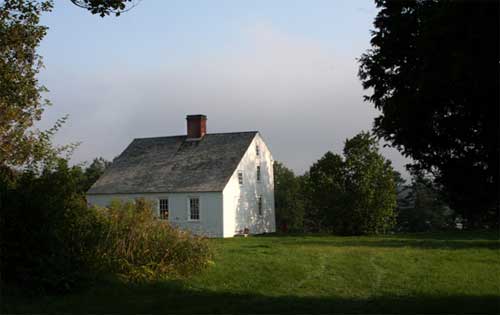 Pettengill Farm in Freeport is listed in the National Register of Historic Places.
Comments are no longer available on this story