
Dr. Calvin Vary, 55, of Windham calls his research laboratory “A well-kept secret.”
Dr. Vary is a principle investigator in the Center for Molecular Medicine at the Maine Medical Center Research Institute. As a biochemist, he studies biological and chemical interactions in living organisms.
The laboratory building is quietly tucked away in Scarborough off Route 1, unknown to most Southern Maine residents.
In the summertime, however, the research institute bristles with eager students, both high school and college, from all over the world who participate in actual research through a special program.
“I’ll take kids from Maine when I can, but we don’t get as many applicants as we would like (from here),” said Vary.
The Summer Student Research Program accepts between 10 and 12 students each year to help conduct real research in the lab. Applicants range from high school juniors to college undergraduates. The research focuses on vascular disease, bone and cancer biology, and stem cells.
“I’m mostly excited about the science, and getting kids involved,” said Vary. He said the students learn a lot of “bench skills” from working in a lab and it always interests him to see young people learn.
Interested students can go to www.mmcri.org to apply for next summer’s program. Vary said while grades are important, he cares more about the essay applicants submit, and their passion for science.
Vary said his own children, Laura, 10, Zach, 16, and Samuel, 18 are currently more interested in music and philosophy, than science.
“If I haven’t homegrown any scientists, I’ve at least inspired a lot through programs,” he said.
Vary said his entire family is accomplished musicians. He himself plays the fiddle, guitar and banjo.
A history of scientific wonder
“As a kid I was interested in biology, but I also had an interest in chemistry,” said Vary. He said when he got older he heard about the field of biochemistry and went for it.
“That was a no-brainer,” he said. He received his Ph.D. from Michigan State University and his early work centered around RNA chemistry, the biological component that take information from DNA to build protein structures.
Vary’s research has focused on hereditary hemorrhagic telangiectasia, HHT. HHT is a genetic vascular disorder that is characterized by weakness in some of the vessel walls.
HHT can also include abnormal blood vessel structure. Highly pressurized arteries carry oxygen-rich blood away from the heart and low-pressure veins carry it back. A delta-shaped network of capillaries normally join arteries and veins, and the pressure is distributed. With HHT, there can be a short circuit between arteries and veins.
Vary’s research has uncovered novel biochemical interactions between one of the proteins effected in HHT.” One of the causes of HHT is a mutation of the protein endoglin, and Vary has studied the function of normal endoglin to understand what is going wrong in HHT.
Impressive credentials
Before his current studies, Vary worked for IDEXX, formerly AgriTech in Portland ME as a research group leader and in 1991 joined the Maine Cytometry Research Institute, the precursor of the Maine Medical Center Research Institute.
“To me, it was a big risk to leave a company for an almost nonexistent research facility,” said Vary.
In 1997 he was approached by the research institute’s newly-hired fellow scientist, Tom Maciag to help form a new basic medical research program.
The institute’s 60,000 square foot building in Scarborough near the South Portland border he works in was built in 2001, and a 23,000 square foot addition broke ground on Sept. 24 of this year.
Maciag died of a heart attack in 2004, but his influence is still felt at the research institute. Many of the walls are decorated with his oil paintings and the results of his research are run deep through many of the studies.
Vary is also an adjunct associate professor at USM in Portland. In addition he is associated with the University of Maine Graduate Studies in Biomedical Sciences program, a member of the Maine Technology Institute’s Biotechnology sector board and the HHT International Foundation’s Scientific and Medical Advisory board.
Vary said new communication technology has made it possible to conduct science in the Pine Tree State.
“It used to be, you couldn’t consider going to Maine because it was so isolated,” said Vary. He said laboratories located in places like Massachusetts used to have an big advantage because of the proximity to other researchers, but advances like the Internet have changed that.
“Maine research is doing much better now,” he said. He said it’s possible for Maine to become a hub for biomedical research.
Vary said he and the dozen researchers he works with regularly have a fun working atmosphere. When the weather permits, they like to spend their lunch break outside biking or cross-country skiing.
“We’re not a bunch of stiffs and geeks,” he said.
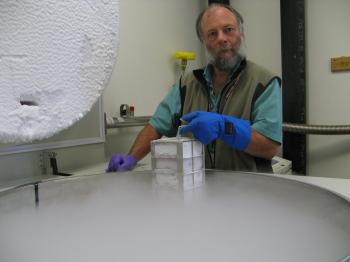 CalvinVary1-2 – Biochemist Dr. Calvin Vary of Windham pulls frozen cell cultures from a freezing unit at his lab at the Maine Medical Center Research Institute in Scarborough. Vary said he loves working as a scientist, and enjoys working with students who wish to pursue a future in research.
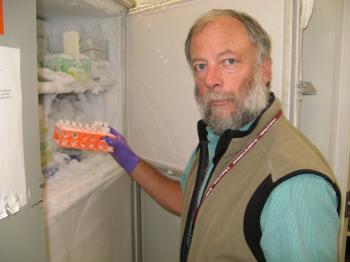 CalvinVary1-2 – Biochemist Dr. Calvin Vary of Windham pulls frozen cell cultures from a freezing unit at his lab at the Maine Medical Center Research Institute in Scarborough. Vary said he loves working as a scientist, and enjoys working with students who wish to pursue a future in research.
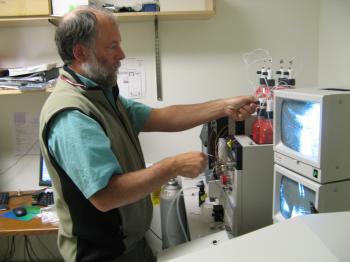 CalvinVary3: Biochemist Dr. Calvin Vary of Windham adjusts an image magnifying system at his lab at the Maine Medical Center Research Institute in Scarborough. Vary said he loves working as a scientist, and enjoys working with students who wish to pursue a future in research.
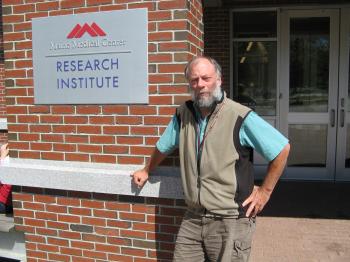 CalvinVary4 Biochemist Dr. Calvin Vary of Windham stands outside the Maine Medical Center Research Institute in Scarborough where he conducts research on blood vessel disorders. Vary said he loves working as a scientist, and enjoys working with students who wish to pursue a future in research.
Comments are no longer available on this story