
When devised as a publicity stunt 100 years ago by the publisher of the Boston Post, a family-oriented daily newspaper, the Boston Post Cane was a “walking stick” intended to be a tribute to the oldest male resident of each of many small communities throughout New England.
On Aug. 2, 1909, Edwin A. Grozier, the publisher, forwarded a gold-headed ebony cane to the boards of selectmen in 700 towns. The gold knob, or head, was inscribed with the words “Presented by the Boston Post to the oldest citizen of (specific town) – to be transmitted.” Each town’s board of selectmen was named trustee of the cane and instructed to keep it always in the hands of the oldest citizen.
The cane was to be kept by this elderly gentleman as long as he lived in town. When that gentleman passed on or moved away from town to another location, the cane was to be transferred to the next oldest resident.
J.F. Fradley and Co., a New York manufacturer, made all the canes from ebony found in the forests of the African Congo. Shipped in 7-foot-long pieces, they were cut to normal cane lengths, seasoned for six months, then turned on lathes to reach the correct thickness before being coated and polished. A ferruled tip was affixed to the bottom. The 2-inch, 14-carat gold head or knob was carved, decorated and inscribed by hand.
At one time, the Boston Post was considered the nation’s leading standard-sized newspaper in circulation. Grozier died in 1924, and the Boston Post was taken over by his son Richard. The younger Grozier failed to continue his father’s success and eventually died in a mental hospital.
At about this same time and following considerable controversy among the founders, eligibility to be considered a recipient of the Boston Post cane was expanded in 1930 to include women.
Competition from other newspapers both in the Boston area and other cities, plus news media such as radio and television, contributed to the newspaper’s decline. The assets were sold and the Boston Post ceased publication in 1957.
The custom of presenting the Boston Post Cane to the oldest citizen in a community became a regular occurrence in New England. However, keeping track of the cane following the death of a recipient sometimes presented a problem. In some cases the canes were lost, stolen, taken out of town or destroyed by accident and not returned to the Board of Selectmen.
At a ceremony Oct. 23, 1909, the first citizen of Cape Elizabeth to receive the Boston Post Cane was Whitely Jordan at age 86. Others lucky enough to also be honored were Joseph Dresser, Levi O. Verrill, John Pike, Albert F. Hannaford, Edward S. Griffin, Ephraim S. Wardwell, Moses Small, Samuel C. Gould and John T. Jenks, who died in 1942.
During the next 20 years, there were no recipients in Cape Elizabeth until Mrs. Mabel Heseltine Davis became the first woman so honored, on July 15, 1963. She was followed by Dr. Clinton A. Putnam, Robert Greene, Charles M. Hasty, Lida Williams, Elsie I. Hannaford, Nina Macomber, Linwood Dunham, Josephine F. Benoit and Leola Adams Jordan, the sixth woman.
In 1981 the Cape Elizabeth Town Council approved and updated the following guidelines:
1. The holder must have resided in Cape Elizabeth for a minimum of the last 15 years.
2. The cane may be given to a former resident living in a nursing home or with his or her family in Greater Portland if the person spent the principal portion of his or her lifetime up to that point in Cape Elizabeth.
3. Persons holding the cane or the individual’s family must notify the town clerk of any change of address of the recipient.
4. Once the cane is presented to an individual, that person will hold the cane until death, regardless of whether or not another recipient becomes eligible.
5. Upon the death of the holder, the family shall return the cane to the town clerk and it shall be presented to a new holder pursuant to these guidelines.
In between presentations, the Cape Elizabeth Boston Post Cane is kept in a vault.
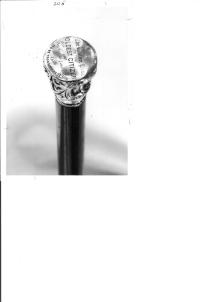 The Boston Post Cane
Comments are no longer available on this story