
Although the calendar states that autumn doesn’t begin for another two weeks, the cold nights and round, ripe apples on Randall Road in Standish say otherwise.
Each fall for the last century at Randall Orchards off Route 25, apples have been picked, sorted, bagged and pressed into cider. Along with other local crops like pumpkins and squash, the 100 acres of apples become ready for the table around the transition of the seasons.
Owner and operator Dick Randall, 68, said his is the last family-owned and managed apple orchard still operating in Standish. He said harvesting the sweet, healthy fruit is a lot of work.
“It ain’t for the feint of heart,” he said.
The apple season lasts for about two months. Each year Randall hires a crew of about a dozen Jamaican workers to travel from their homes in the Caribbean, usually the same ones each year.
“I wouldn’t be in business if I didn’t have my harvest crew,” said Randall. He said he considers the workers part of his family.
David McLarty, 54, has been coming to Randall Orchards for the last 18 years. He has a farm back home in Jamaica that he runs with his wife and two children, ages 14 and 20. They grow food crops like coffee and corn. He said the busy apple season in Maine lines up with a slow season back home.
“We love the farming,” said McLarty when asked about how life is on the orchard. He said Standish is a calm, comfortable area, but “at times it’s a little bit nippy.”
The workers live in a large bunkhouse near the apple trees on Randall’s land. McLarty said he works about 10 hours each day, seven days a week. As daylight diminishes, the number of hours McLarty and fellow farm workers can work diminishes as well.
“If they could, they’d work 12 hours a day,” said Randall. He pays his workers $9.50 an hour.
Labor on the apple farm includes a wide variety of tasks, from picking apples off the trees into baskets mounted on their torsos, driving tractors, sanitizing equipment and sorting bruised apples from unblemished ones for cider.
After work in the bunkhouse, McLarty said he likes to read the Bible, watch television and talk to his family.
“Sometimes we write letters, but we can just use the phone,” he said.
Another Jamaican worker, 40-year-old Ralston Ritchie, said a dollar in America has about the same spending power back home in Jamaica. He also owns his own farm with his wife and two teenage children. He has been working at Randall Orchards for the last seven years.
A long way to Standish
Caribbean workers have been employed in the apple business since 1943, according to Joe Young, executive director of the New England Apple Council, a nonprofit group that recruits Jamaican workers for New England apple orchards.
“That was World War II, when the country was short on men,” said Young. “And there have been Caribbean workers here ever since.”
Young said new conditions cause orchard owners to hire foreign labor.
“The reality is there aren’t a lot of U.S. workers that want to do these jobs,” he said.
“I’d love to hire Americans,” said Randall from his home on the orchard. He said it’s just not feasible. The harvest season is short, so they would need to halt all other forms of employment in preparation, and the job requires a lot of hard labor every day for two months. He said the locals who have agreed to work for him usually quit soon after they start.
Because apple harvesting requires such precise timing, Randall said he needs to make sure he’ll have enough workers to get the job done, and he’s always found his Jamaican workers to be reliable.
“They’re good, hardworking, family-oriented people,” said Randall.
Locals get dibs
Jorge Acero, employment & training specialist at the Maine Bureau of Labor Standards in Augusta, said in order to get workers from Jamaica, the orchard owners need to apply with the federal Department of Labor at least 45 days before the job starts.
Newspaper advertisements need to placed by the farm owner for the positions and the job order will be posted in the Maine Job Bank so local people can get a crack at them first.
“They don’t get very many, and those they do don’t stay very long,” said Acero.
Acero said the apple orchard owners are required by law to hire any American citizen who applies for the job, unless they can demonstrate a reason for turning them down.
This rule remains after the harvest season starts, until the season is half over, even if the position has been filled by one of the imported laborers.
Once it’s been demonstrated that there is a shortage of workers for the job, Acero said his office is able to review applications from foreign workers to grant them work visas as non-immigrant temporary foreign laborers.
Joe Young, of the New England Apple Council, said criminal and medical background checks are then performed on the potential workers. Approved workers then fly 572 miles to Miami and take a bus to Maine, and the entire trip is paid for by the orchard owner.
Randall said it costs him about $1,000 to bring each worker to Standish.
“It’s certainly cheaper if you can use local workers, the trouble is finding them,” said Young, who grew up on a family orchard in Connecticut.
Young said a lot of the orchard owners like to hire the same workers each year so they are familiar with the individual apple orchard.
Acero said once the workers, officially known as nonimmigrant temporary foreign laborers, are in the country, they cannot work anywhere else.
“They are attached to whatever they signed up for,” he said. He said 14 employers brought in 391 laborers in Maine this summer.
He said Maine potatoes and the broccoli crops in the Caribou area are harvested with the same labor method, while blueberries tend to use migrant workers who are not restrained to any one job and are not as carefully scrutinized by the state.
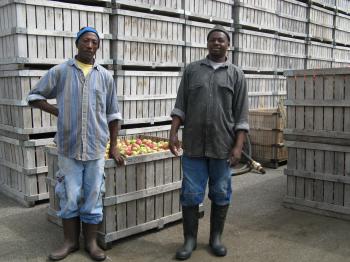 Apples1-2 From left:David McLarty, 54, and Ralston Ritchie, 40, both of Jamaica, spend the start of each fall working at Randall Orchards in Standish. They both own farms back home and said working with Maine apples gives them something to do during the slow season.
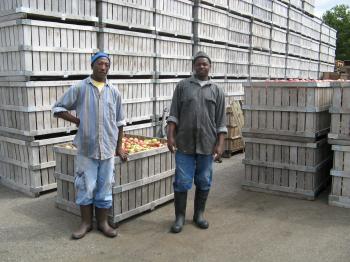 Apples1-2 From left:David McLarty, 54, and Ralston Ritchie, 40, both of Jamaica, spend the start of each fall working at Randall Orchards in Standish. They both own farms back home and said working with Maine apples gives them something to do during the slow season.
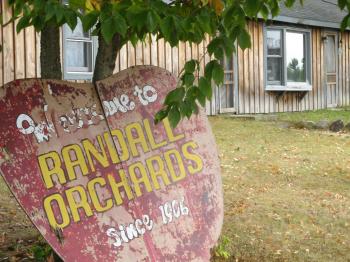 Apples3: The bunkhouse where the apple workers live during their two month stay in the harvest season.
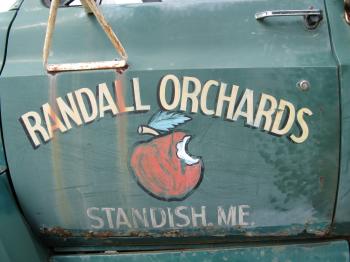 Apples4: Randall Orchards of Standish.
Comments are no longer available on this story