
SEBAGO – When November arrives, and the deer hunt is on, the orders typically start trickling in for Lakes Region-based taxidermists Gene Bahr, of Sebago, and Mark Dufresne, of Gray.
By mid-December, Bahr and Dufresne have a fair grasp on whether it’s going to be a good season or not.
This year has not been the best, they say.
Extreme weather this fall and early winter led to a weak deer harvest. That’s bad news for Maine’s 200 or so taxidermists, according to Paul Reynolds, president of the Maine Association of Taxidermists. Maine taxidermists typically field the most orders from deer hunters seeking a “shoulder mount” – a deer shoulder-and-head stuffed with a foam mannequin – to hang on a wall.
“You could put the deer as No. 1; bear as No. 2 and moose as a distant third,” Reynolds said. “The majority of their work is deer and then bears a close second.”
The Lakes Region’s two prominent taxidermists have felt the impact of the poor hunting season. Bahr’s total orders are down from about 70 last year to 45 this year, while Dufresne’s total orders are down about 25 percent.
During bad seasons, Bahr and Dufresne can rely on other aspects of their business that are not so reliant on the vagaries of the Maine hunting season. Bahr makes fish carvings out of basswood, while Dufresne fields orders from wealthy hunters who shoot exotic game in Asia, Africa and South America.
Yet the annual hunt for Maine bucks and bears is what enables Bahr and Dufresne to do taxidermy – a practice that has been employed since the Middle Ages that both men consider an art form in its own right. Despite his success in netting coveted exotic orders from across the world, Dufresne will still depend on the Maine hunt for nearly 80 percent of his business this year.
Bahr, 64, a native of Steele, Ala., moved to Maine in 1972 to work in construction. At the age of 26, Bahr moved into taxidermy full time.
Bahr said a lot of his customers often hear about him by word of mouth.
“Most people don’t know that they need a taxidermist, and they don’t know who they need to go to or anything about it,” he said. “They finally shoot that big buck, and they’re so excited and what they’re doing is looking for a way to preserve that memory. When they start asking around of course, they get recommendations.”
Bahr has his customers send their dead bucks to David Hutchins, a Sebago butcher. Unless the customer wants to preserve the entire body, Hutchins will generally cut the deer’s body off around the shoulders, and send the deer’s head and neck to Bahr, with the antlers attached.
Then Bahr measures the head, and orders a Styrofoam mannequin to place inside the deer skin, which he tans, as well. Bahr typically turns around a taxidermy order in 10 to 14 months, he said, and will charge between $500 and $700 a job.
“Taxidermy has changed so much in the 38 years since I’ve started, and of course it’s been around for quite a long time,” Bahr said. “Our methods continuously change and you have new products and new tanning solutions and things are changing all the time, and I think the mounts are becoming more realistic and alive looking.”
Dufresne, 42, began to practice taxidermy at the age of 8, while growing up in the Berkshires of Massachusetts. He attended Unity College to study wildlife biology, and built a home in Gray in 1999. In 2005, Dufresne won a prize at the World Taxidermy Championship for a life-size mount of a baby moose. He may be best known for his recreation of moose whose antlers became locked during a fight. The life-size display is featured in the L.L. Bean flagship store in Freeport.
In his Gray shop, Dufresne works next to a variety of life-sized mounts, including a Maine bear, a mountain lion from Utah, and a golden pheasant from Asia.
“When the economy really hits the skids, to survive here in Maine as a taxidermist, you’ve got to be willing to do whatever comes your way,” Dufresne said. “I’ve done peacocks and pheasants, golden pheasants, mandarin ducks – all sorts of exotic birds.”
Fortunately for Dufresne, his business is sufficiently diversified, in the case of an economic slump or a poor hunt.
“I get different clientele so I’m not as dependent on the Maine economy,” Dufresne said. “Here in Maine, we’re always struggling. There are other parts of the country where people are doing pretty good.”
What truly concerns Dufresne, a bear-hunting guide, is the failed bear-baiting referendum that appeared on the ballot on Election Day. Since Dufresne often stuffs bears for his customers who join him on bear-hunting tours, about half his total orders this year were for Maine bears. Since, according to Dufresnse, the bear-baiting ban could have wiped out that segment of his business, he took every opportunity possible to vigorously campaign against the measure.
“The things that are scary are this bear referendum,” he said. “Really a sad deal. Almost every one of my customers is concerned about it. Me as a hunting guide and taxidermist, if they take away the bear hunting, I probably wouldn’t be able to survive as a full-time business here in Maine.”
So what would Dufrense have done if the referendum passed?
“I probably would have moved out of Maine,” he said.
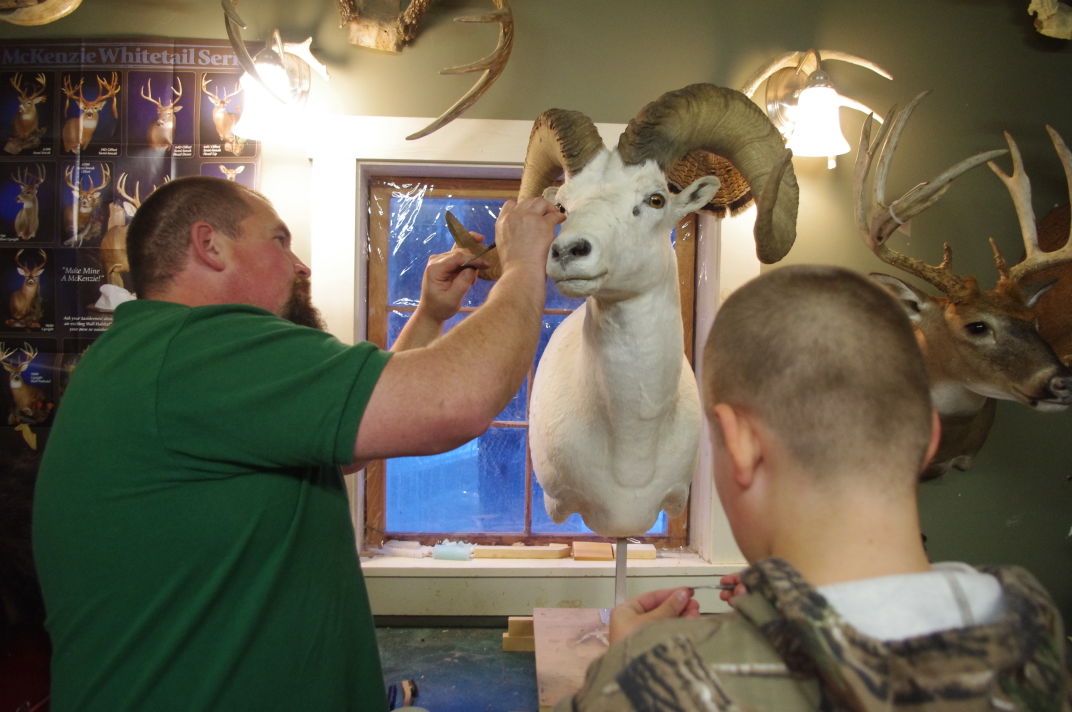 In his Gray taxidermy shop, Mark Dufresne applies the finishing touches to a ram shoulder mount.
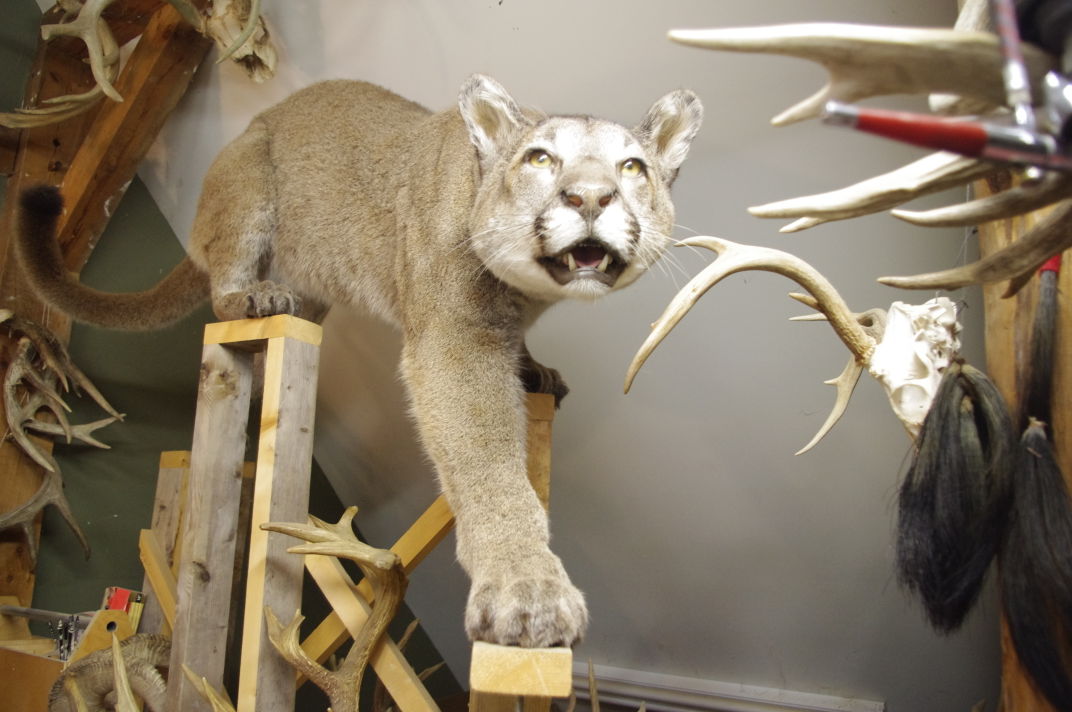 Mark Dufresne creates a variety of life-sized mounts, including this mountain lion that he hunted in Utah.
 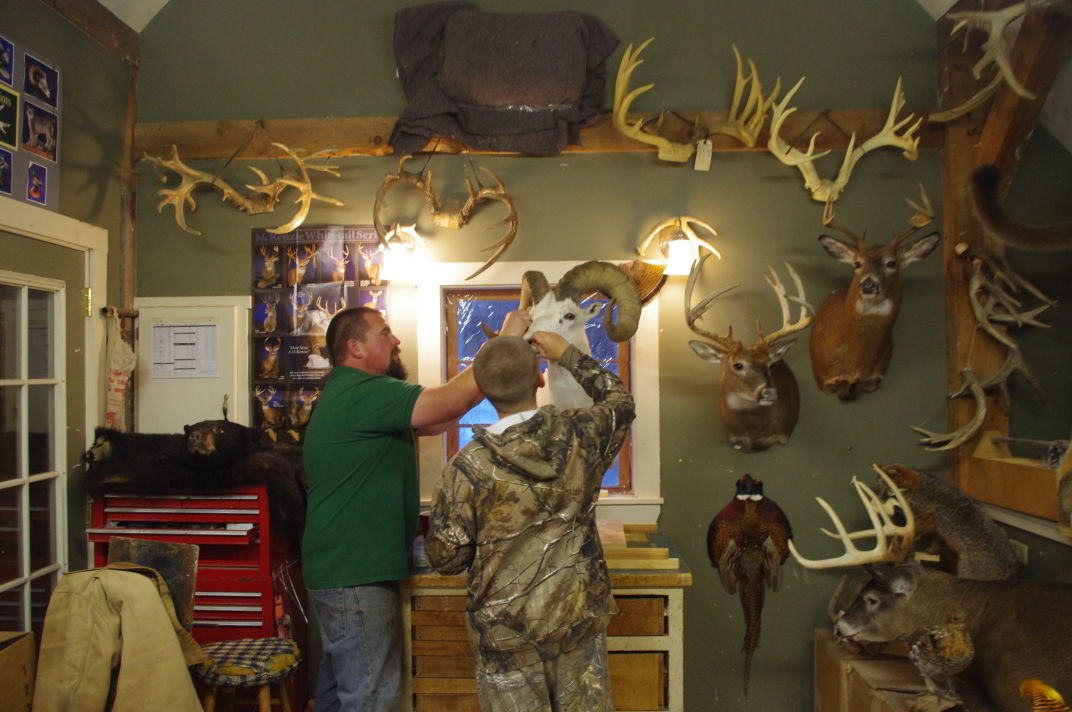 Gray taxidermist Mark Dufresne, is teaching his son, Zeb, the art of taxidermy. Dufresne learned the trade by studying manuals from the 1800s as he was growing up.
Comments are no longer available on this story