
STATE’S BEST
The 2008 Maine Truck Driving Championships winners for each category included:
State champion (highest overall score): Robert Kierstead, FedEx Ground, Scarborough.
Straight truck: Bradley Bartlett Jr., FedEx Ground, Yarmouth.
Three-axle: Jimmy Franklin, FedEx Express, Falmouth.
Four-axle: Guy Carroll III, Land Air Express of New England, Scarborough.
Five-axle: Jared Elston, FedEx Express, Windham.
Fixe-axle sleeper: Elwood Wilde, Houlton.
Tankers: Donald Mitsmenn, Cumberland Farms, Scarborough.
Flatbed: Warren Lewis Jr., Hannaford Trucking Co., Lewiston.
Twins: Robert Kierstead, FedEx Ground, Scarborough.
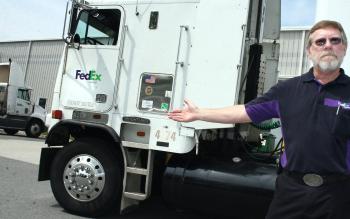
If you find yourself sharing the road some night with a double FedEx tractor-trailer with an old-fashioned, squared-off cab and a vanity plate that says CHATTA, relax.
That’s Bob Kierstead’s rig, and according to the 2008 Maine Truck Driving Championships judges, Kierstead is the best professional truck driver in the state.
A Scarborough resident and father of five, Kierstead, 63, has logged more than 2.7 million tractor-trailer miles in his 41-year career and has repeatedly blown the competition’s doors in the past 16 years, logging three state champion titles and three trips to the national finals, sponsored by the American Trucking Association.
Over the weekend of Aug. 19-23, Kiersted made what he says was his final trip to the nationals, joining 400 other top drivers from around the U.S.
He placed 12th in his division – not as high as his ninth-place finish in 1991, but nothing to sneeze at. The competition included oral interviews, tests on first aid and firefighting, and timed agility tests that involve maneuvering a double trailer on a tight, indoor course without disturbing rubber ducks and tennis balls.
“It’s extremely competitive,” said Eric Reller, a spokesman for the American Trucking Association, which has run the national finals for 71 years. “I think that people don’t have a great fundamental appreciation for all the work that goes into trucking. It’s a very skilled profession.”
Kierstead is planning to retire this year and spend time with his wife, Fran – whom he often sees only in passing when he returns from a day of driving as the sun is coming up – as well as their five adult children.
He’s looking forward to slowing down and spending more time cooking and enjoying life, but he says he expects to feel a void in his life.
“I run with a lot of the same poeple every night,” he says. “It’s going to be a huge transition for me not to go out.”
Kierstead grew up in South Portland and bought his first truck tractor at age 23. He’s had some other jobs, such as selling life insurance, but he prefers the freedom of the open road, the power of sitting high above other drivers with a clear view of the horizon and some 65,000 pounds rolling behind him.
“If you need it, a truck’s (transported) it,” he says. “We’re part of American history, the inner workings of our country. It’s vital.”
As a FedEx Ground contractor, Kierstead owns his tractor – worth about $110,000 – pays his own diesel fuel, and also owns rights to the 492-mile-a-night route he runs from Saco to L.L. Bean, Willington, Conn., and Lewiston. FedEx pays him per mile, and also gives full professional and financial support to drivers who compete in competitions like the ATA Championships. This year, FedEx sent 72 drivers – and their spouses – to the national championships.
Kierstead has always taken safety seriously, but it wasn’t until he worked for Shaw’s supermarkets in the late 1980s that he got turned on to truck-driving competitions by some of his fellow drivers. Kierstead and other drivers describe the competitions as friendly but intense, cheering wildly for the guys you know, and then you do your best to trounce them.
Kierstead spent the weeks leading up to the contest studying the American Trucking Association’s 286-page Bible, “Facts for Drivers” and reviewing CPR and safety checklists, but he didn’t stop there. Knowing that drivers would have to compete in Houston in standardized tractor-trailer units provided by the association, Kierstead made an educated guess on the model he’d be offered, rented one, and practiced for hours in the Saco FedEx terminal’s asphalt lots.
Small slashes of white spray-paint still mark his obstacle course, and his employer’s support on the local level, as well as the national one.
“(Going to the nationals) is a pretty big honor,” Kierstead said. “They (FedEx) have just been so supportive … every step on the way.”
When asked for tales of his close calls in 41 years and 2.7 million miles of driving, Kierstead hesitates. His goal, he says, is to not have close calls. He likes to cite the statistic that in accidents involving a tractor-trailer and a passenger vehicle, the auto driver is found in violation and the truck driver isn’t about 75 percent of the time.
“You try to stay out of the close calls,” he says. “As a professional driver, you almost feel like you have to control what goes on around you. People are extremely aggressive these days on a highway. As a contracted driver to FedEx, you want to be recognized (for) being a positive light.”
Kierstead adheres to the principles of the Smith System of Defensive Driving, created 56 years ago to teach professional drivers to keep the rubber side down by avoiding accidents before they have a chance to occur. According to the Smith System Web site (www.smith-system.com), its “Five Keys” are to aim high in steering, get the big picture, keep your eyes moving, leave yourself an out and make sure other drivers see you. As a professional driver controlling a very large vehicle on an often-congested highway, Kiersted says, he makes constant, systematic checks of all of his gauges and mirrors every five to eight seconds, watches traffic far ahead of him to anticipate problems, and tries to set a safe pace and stopping distance that anticipates less-than-professional moves by drivers of smaller vehicles.
Bad weather? He slows down. Really bad weather? He finds a place to pull over. That’s his job.
To stay on top when he’s behind the wheel, Kierstead says, he makes a priority of getting enough sleep and eating a healthy diet – and exercising. He keeps his arms in shape by swinging in and out of his nearly 6-foot-high driver’s seat dozens of times a day. He keeps the rest of his body in shape by running.
“Good physical condition, that’s key,” he says.
It’s key for his rig, too. At the nationals, one of the driver tests involves finding and correcting as many seemingly minor problems as possible in 10 minutes in a tractor-trailer unit that has been monkeyed with by contest staffers. They remove seals from hoses, stuff coke cans between tractor trailer tires, and leave out tiny cotter pins in key connections.
Kierstead, who has been examining every hose and tire and pin in his rig several times a night for 41 years, scored a 93 on that test.
His attention to his equipment is one of the things – other than his vanity plates and the custom chrome front bumper and visor Kierstead installed two years ago – that make his rig stand out on the road. According to Kiersted, he drives the only “cabover” FedEx truck in Maine, a seasoned 1990 Freightliner tractor with more than 1.8 million miles on it.
“Cabover” refers to the blunt-faced “cab over engine” style that has since been discontinued in favor of the more aerodynamic style of tractor with the engine in front of, rather than under, the driver’s seat.
“Pretty much everyone… from in and out of Maine can see me and pick me out,” he says.
The tractor’s veteran status and high mileage are testiment to its driver’s scrupulous maintenance regime. While an ATA spokesman didn’t have industry stats on tractor lifespan, he confirmed that 1.8 million miles and counting is pretty impressive. Kiersted says he analyzes the used engine oil every oil change and has a pretty good idea of the condition of every component under the hood.
The truck’s relatively low 285 horsepower has stood Kierstead in good stead as fuel prices have climbed. He gets about 6.8 to 7.1 miles per gallon. That’s not great for a passenger car, but it’s good for a tractor-trailer, and actually only about 1-3 miles less than some versions of the once-popular Hummer.
Kierstead’s attention to detail extends to knowing what to do in emergencies that tend to befall someone who drives for a living, such as fires and car crashes. The ATA tests truckers on firefighting basics and CPR, and Kierstead says he’s been the first person to arrive at more than a couple of car crashes over the past four decades.
Usually, he says, he just helps redirect traffic and calm the victims until professional help arrives. On one occasion, however, he did have to use his CPR training. He was waiting to pick up a trailer at a FedEx terminal at 3 a.m. and chatting on the phone when a night worker stumbled up and asked him to call 911.
The man collapsed and became unresponsive while Kierstead was dialing. He gave the man CPR for several minutes at the 911 operator’s direction before emergency workers arrived. The man survived.
Kierstead later found out the man was suffering from complications from severe stress, not a heart condition.
He shrugs.
All in a day’s work.
With another state championship and retirement beckoning, Kierstead has put both his contract with FedEx and his beloved truck up for sale. He thinks he’s found the perfect buyer for both – a guy who will take care of the truck like Kierstead does – and he’s beginning to settle with the idea of getting out of the business.
“I’m getting done … so we can enjoy some good time,” he says.
But he will keep his finger in the business a bit, do some professional driving training, perhaps, judging contests and filling in for other FedEx guys a few times a week. He also suspects that when his wife finds out where the 2009 national championships are being held – think vacation – “‘my wife will probably want me to keep trucking.”
“Some nights, when things aren’t going good, I say, ‘I should have stayed in medical school,'” he says. It’s a joke, he adds.
“(Trucking) has been a huge part of my life.”
 Top trucker downshifts toward retirement
 Top trucker downshifts toward retirement
 Top trucker downshifts toward retirement
Comments are no longer available on this story