
Like many black labs, Midnight loves playing fetch. Unlike most black labs, she also enjoys finding evidence of arson on suspects and at the scene of fires.
For more than 11 years Midnight has traveled with her handler, Rick Shepard, an investigator with Maine State Fire Marshal’s Office, to aid him in his work. She has been his companion on late nights and during long drives to investigate fire scenes all over Maine.
Next week when Shepard goes to work, Midnight will stay at home. Almost 13 years old, Midnight retired Sept. 4. Though a new fire dog named Shasta will take over for the southern district of the office, Shepard will not be her handler.
“I will forever be comparing dogs to her,” Shepard said, who himself is four years away from retirement.
Midnight was trained to identify fire accelerants, including gasoline, lighter fluid and kerosene. She even once identified a tire softener illegally used to improve traction in stock car racing.
According to State Fire Marshal John Dean, Midnight was trained in Alfred through a program operated by State Farm Insurance since 1992.
Since Shepard works at stock car races as his second job and brings Midnight with him, officials who suspected a driver was using a tire softener filled a room with tires and Midnight picked the four belonging to the driver in question.
The State Fire Marshal’s Office investigates the cause of fires and explosions, and inspects fireworks displays and mechanical rides. There are 10 fire marshals in the state, soon to be 12. Each fire marshal is assigned a geographic area, but with Midnight Shepard traveled all over the state and was on call 24 hours a day, seven days a week.
Her training used food as a reward, so Midnight ate when she worked. This meant Shepard’s job included practicing with her every day, placing drops of 50 percent evaporated gasoline in a variety of locations and feeding Midnight when she found them.
The day Midnight retired, Shepard fed her from a bowl for the first time in over 11 years. She looked at him like it was a trick, Shepard said, and was reluctant to eat.
Several days after her retirement, Shepard placed drops of gasoline on two different pieces of furniture in his home office in Casco.
When Shepard picked up a fanny pack filled with dog food and hooked a leash to Midnight’s collar, she quickly got down to business.
“Seek,” Shepard said. Midnight started scanning his office for drops of gasoline. Finding the scent, she sat in front of a filing cabinet.
“Seek,” Shepard repeated, now with dog food in his hand. Midnight pointed her nose to the spot where Shepard dropped the gasoline and then looked to her handler for food.
“Show me again,” Shepard said. “Show me better.” She pointed again and again before Shepard reached down to feed her out of his hand.
“Good girl,” Shepard praised, patting her head. When he unhooked the lease, Midnight raced around the large, open office, playful again.
“She loves to work,” Shepard said. “She will play ball until she drops of exhaustion.”
A dog is only as good as her handler allows her to be, Shepard said, emphasizing the importance of not falling into a routine in terms of where, when and how much gasoline to drop for her to find.
“The more you mix it up, the better the dog will be,” Shepard said. “This is a pretty labor intensive deal.”
Using a dog at the scene of a fire helps investigators pinpoint the best areas to take samples, Shepard said. Before dogs, Shepard said fire marshals themselves would pick up handfuls of material and sniff it to try to find accelerants.
When they worked fires together, Shepard marked each spot where Midnight pointed with a golf tee, later collecting material to send to a lab for analysis.
With a sense of smell 50,000 times greater than found in humans, a desire to please handlers, and a robust, friendly nature that makes them easy to live with, Labradoer retrievers are the preferred breed for investigating fire scenes, Dean said.
During her career, Midnight also identified suspects. In a line-up, Midnight once identified a man because of traces of an accelerant on his clothing. Though he initially denied setting two houses on fire, he later pleaded guilty to the charges.
She also worked on the triple homicide case in Old Orchard in February where 21-year-old Matthew Cushing was accused of killing his mother, brother and stepfather and setting their house on fire.
Originally from the pound, Midnight was adopted by Shepard when she was 9 months old. She was his third fire dog. In the beginning of her career Midnight completed a five-week training program and was recertified annually.
Shepard and Midnight will clearly miss each other when Shepard goes off to investigate fires without her, but he said he wants to have a few good years of retirement with her. They’ve fallen through floors together, Shepard said, and Midnight was once hit by a pickup truck at a fire scene.
Shepard will still take Midnight with him in his second career helping out at local race tracks when he retires.
“It’s been the greatest part of my job – working with her,” Shepard said. “She’s my bud. We’ve been through a lot.”
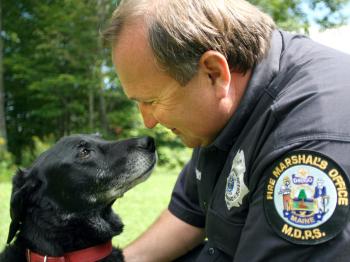 For 11 years, State Fire Marshall investigated fire scenes with Midnight, a 13-year-old black Labrador retriever. Midnight retired last week, but will soon join
Comments are no longer available on this story