
SCARBOROUGH – Long-awaited dredging projects got under way this week on the Scarborough and Fore rivers, clearing the way for shipping impacted by the slow infill of sediment.
In Scarborough, the need is especially urgent, as tidal action since the last dredging project in 2005 has shifted sediment enough that some lobster boats moored near Ferry Beach are nearly landlocked at low tide.
“It’s really dramatic,” said Town Manager Tom Hall. “At low tide you can walk from Pine Point Beach almost to the Prouts Neck Yacht Club. A lot of people do that and then have to scurry back quickly when the tide comes back in. It’s really an issue for navigation. It’s getting tougher and tougher to get a channel you can come and go from.”
What also will make it tough to come and go is work on the Fore River, from the Veterans Memorial Bridge to South Portland’s Bug Light at the mouth of Casco Bay. However, the traveling there will be toughest on commuters trying to cross the Casco Bay Bridge as the vessel Dale Pyatt, believed to be the largest rig of its kind in the nation, goes about its work.
According to spokesman for the Maine Department of Transportation Ted Talbot, the Dale Pyatt’s owner, Cashman Dredging of Quincy, Mass., “has requested, and has been granted permission for additional openings of the Casco Bay Bridge between Portland and South Portland.”
Starting Friday, Feb. 14, “random openings may occur as work requires,” said Talbot, with as many as four stoppages of traffic across the bridge in any 24-hour period.
That frequency could spike to eight openings every 24 hours starting Feb. 26. That disruption will be short-lived however, as the majority of the dredge work will take place away from the bridge after Feb. 26.
In both South Portland and Scarborough, dredging is scheduled to be completed by March 15, to avoid conflicts with lobster fishing.
And, when fishermen go out in search of lobster, they’ll probably find them in different places. That’s because, since December, Deputy Harbor Master Lance Hanna has been hard at work moving the bottom-feeders out of harm’s way.
The U.S. Army Corps of Engineers plan to “sequence” work to minimize the impact on the lobsters, but has to attempt to actually move as many as it can due to Clean Water Act permitting rules. About 3,000 lobsters were expected to make the trip, although Hanna reported catching fewer than 100 through the end of January. What he found instead was nearly 30,000 of the invasive green crab that has been popping up locally of late. The few lobsters found were taken to “an undisclosed location” on the far side of Fort Gorges. Hanna then strung lobster traps across the harbor to prevent the lobsters from wandering back into the dredge zone. The crabs were allowed to die and unceremoniously dumped.
The Portland Board of Harbor Commissioners managed the lobster relocation at a budgeted cost of $90,000. Although required of the Army Corps, the relocation cost is a local match, split evenly among Portland, South Portland and the Maine Department of Transportation.
South Portland’s $30,000 portion will be taken in equal parts from its undesignated fund balance and unused reserve funds as part of the 2014 Capital Improvement Projects budget approved by the City Council.
When the Army Corps awarded the $9.2 million dredging project to Cashman last August, Corps Project Manager Jack Karalius said work would start Nov. 1 and take “three to five months to complete.”
“The work of this project consists of mechanically dredging the Portland Harbor 35-foot channel. About 700,000 cubic yards of sediment will be removed,” said Karalius, who works for the Corps’ New England District in Concord, Mass.
Additionally, said Karalius, five rock pinnacles protruding above the 35-foot mean, low-water plane, totaling about 1,500 cubic yards, will be removed by drilling or blasting. That work will occur roughly between Chandler’s Wharf and the Centerboard Yacht Club in South Portland. However, the depth of the charges will translate to little in the way of spectator sport topside. The underwater blasting will be “barely perceptible at the surface,” said Karalius.
The South Portland channel was last cleared in 1999 when about 400,000 cubic yards of material was moved, and, according to the Army Corps, natural shoaling has filled some areas of the channel to 33 feet, which “may impede deep-draft commercial vessels,” such as the oil tankers, cargo vessels and cruise ships. The channel depth was set nearly two centuries ago at 35 feet by the federal River and Harbor Act of 1836.
Material sucked up from the bottom of the Fore River will be carted out to sea and dumped in an area covering 1 square nautical mile, located 7.1 miles east of Dyer Point in Cape Elizabeth. This site has been used as a dredging depository since 1982.
According to the corps, its Disposal Area Monitoring System study “shows that the site is a low-energy environment, such that sediment deposited at this location will remain within the site’s boundaries.”
In Scarborough, however, the river bottom will be put to work, used to rebuild habitat for the endangered piping plover shorebird along Western and Ferry beaches.
The $1.7 million contract for the Scarborough dredge work went to North American Landscaping and Dredge Co. Inc. of Ellicott City, Md. The company is slated to dig out an 8-foot-deep shipping channel at the mouth of the Scarborough River, between Pine Point and Prouts Neck, as well as a 6-foot-deep anchorage area around the town pier at Pine Point.
“The work consists of dredging about 114,300 cubic yards of sediment, including 1 foot of allowable over-depth,” said Project Manager Michael Walsh, of the Corps’ New England District, Programs/Project Management Division in Concord, Mass. “The dredged material will be removed using a hydraulic dredge and pipeline. Disposal will be on the adjacent Western Beach as beneficial-use material.”
While work reportedly started late in South Portland because of frigid temperatures at the contractor’s previous project, in Scarborough the issue is related to debugging a brand-new boat.
That boat, however, is a fascinating piece of equipment, according to Scarborough Harbormaster Dave Corbeau. An auger at the end of a long pipe chews up the material at the bottom of the river into fine material. That sand is then pumped along the pipe in a mixture of 60 percent water, 40 percent solids until it is sprayed out onto Western Beach. The water runs off, leaving the sand, which is then piled into dunes the old-fashioned way – with bulldozers.
Unlike in Portland, the Scarborough dredging is not tied to lobsters. Instead, the contractors permit runs until April 1, the start of the plover season.
“It’s the same job, but totally different projects, with totally different permitting requirements, said Corbeau.
As in South Portland, the corps will manage the project, said Walsh, and all work will be done under the supervision of its quality assurance representative.
Material dug up from the river bottom will be used to create new sand dunes on Western Beach that could be adopted as habitat by the plover. According to Maine Audubon’s most recent annual report, a nesting pair of plovers has not been seen on Western Beach since 2010, while the last fledglings were observed in 2008. However, there was an uptick in activity following the last dredging project in 2005.
Unlike in South Portland, the Scarborough project is funded specifically from funds appropriated for relief from Hurricane Sandy, which hit the Atlantic Coast on Oct. 31, 2012.
“On a hunch, or a lark really, I picked up the phone again when I saw media coverage of the Hurricane Sandy cleanup,” said Hall, who had previously been told the Army Corps had no funds to dredge the Scarborough River, despite the obvious effect of perennial shoaling, allegedly caused by a stone jetty built in the 1950s by the Corps.
Hall asked the corps to check if Scarborough might be eligible for funds under the $17 billion Disaster Relief Appropriations Act passed by Congress in Sandy’s wake.
“To our great surprise and delight, sure enough we did qualify,” he said.
The new sand dunes to be created on Western Beach also will form a berm to shield the Prouts Neck Country Club golf course from the sea. Last March, when the last of the previous dunes washed away, two holes at the course flooded.
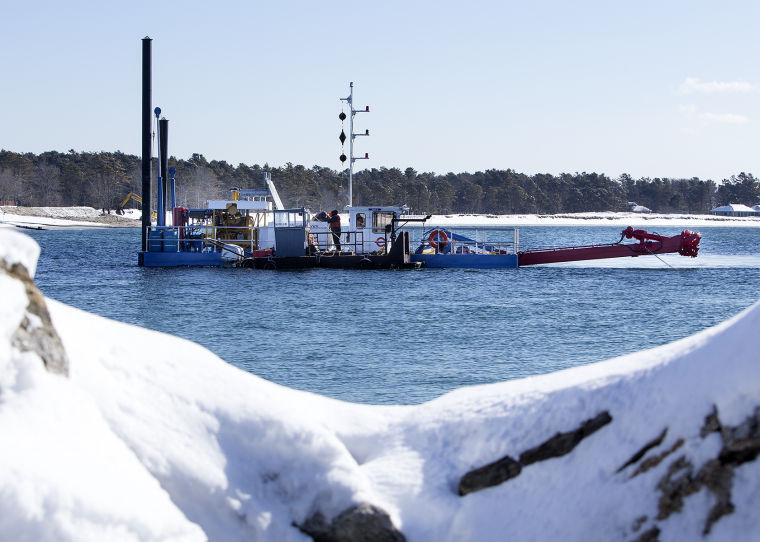 The $1.7 million contract for the Scarborough River dredge work went to North American Landscaping and Dredge Co. Inc. of Ellicott City, Md. The company began this week digging out an 8-foot-deep shipping channel at the mouth of the Scarborough River, between Pine Point and Prouts Neck, as well as a 6-foot-deep anchorage area around the town pier at Pine Point.
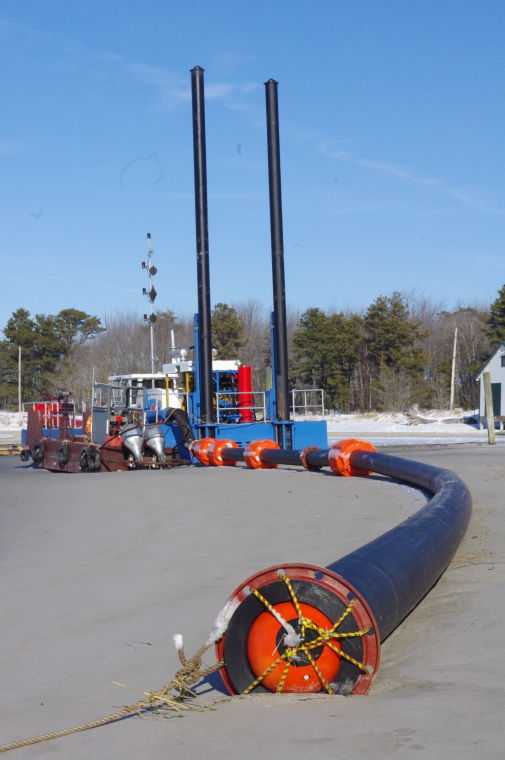 Last Saturday, the dredge removing sediment from the Scarborough River sits ready for action.
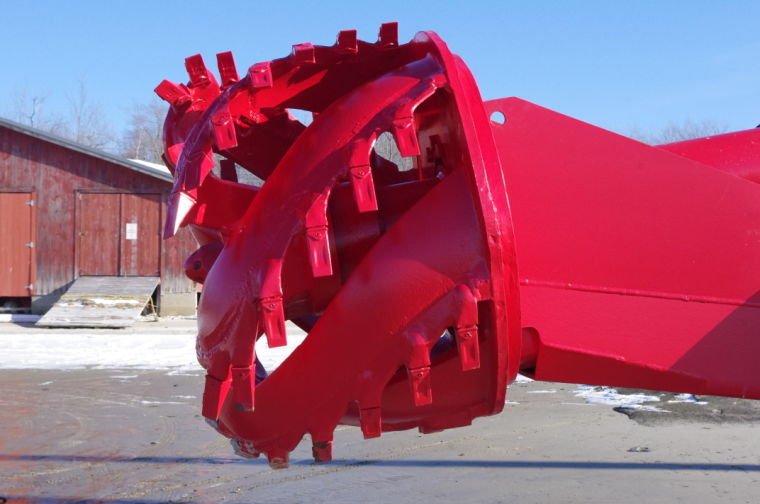 The teeth on the dredge’s auger are designed to extract sand and sediment from the bottom of the channel.
Comments are no longer available on this story