
RAYMOND – For decades, Diane Potvin, a retired health-care consultant and administrator, worked with planners to craft health-care policy at the state level.
Now, Potvin, a 55-year-old Raymond resident, is busy marshaling the “milfoil militia,” a group of environmental nonprofits that fight milfoil across Maine, in an effort to have the Legislature declare war on aquatic invasive species. Specifically, through her state representative, she is seeking a $5 fee increase to the state’s milfoil sticker program, which could generate up to an extra $500,000 in preventing the spread and eradication of milfoil.
“We have the troops in place,” Potvin said. “We just need to get them the funding to pay for the boots on the deck, which means the guys who drive the boat and haul the milfoil baskets; and the fins in the water, which are the divers and the suction harvesters; and the munitions, which includes everything from gas to insurance on the boat.”
When Potvin called up state Rep. Mike McClellan, R-Raymond, to talk milfoil last September, she had already been in the trenches for a few years. Potvin had moved to a home on the shore of Sebago Lake’s Turtle Cove in 2000, and watched milfoil slowly accumulate throughout the following decade. But in 2010, milfoil growth exploded, and Potvin had a “holy moly” moment, she said. Potvin and her husband, Gary, a student of environmental conservation at the University of Maine-Fort Kent, started donating milfoil removal equipment to the Raymond Waterways Protection Association. Then, in 2012, the milfoil situation deteriorated even further.
“In 2012, we had a very warm summer and there was just a bloom of milfoil,” Potvin said. “It looked like you could walk on it in certain areas, like sticks coming out of the water. All I know is 2012, nobody on Sebago could ever remember seeing the milfoil beds looking like sticks growing out of the water, versus long strands under the water.”
Eventually, Potvin said, she realized that she needed “to stop dealing with the small experts who are just keeping their heads above water.” It was time to approach the Legislature for a “comprehensive solution.”
In September 2013, after receiving Potvin’s call, McClellan invited her to his home, where they discussed the growth of milfoil on Sebago Lake and surrounding areas.
“She let me know how much worse it was than I thought,” McClellan said. “I found out from Diane that any eradication that was going on was being done by volunteers.”
“We just came up with an outline of the bill and the draft was due within like 36 hours,” Potvin said. “It was the first time I’d ever met him or seen his face. I’d voted for him, but I’d never seen him before.”
Although Potvin said she is no scientist, she said that her experience with health-care planning was useful when it came time to quickly draft the bill, which is now known as L.D. 1626.
“I think there are similar concepts in terms of approaching the Legislature and saying how do we problem-solve together – just knowing that I see legislators as partners, as individuals who want to partner with us and come forward and share ideas,” Potvin said. “I don’t see them as intimidating. I see them almost as co-workers who want to roll up their sleeves and work with you.”
In its current iteration, the bill would increase the price of the annual milfoil sticker fee by $5. The fee currently ranges from $10 to $44, depending on the boat’s horsepower.
According to McClellan, L.D. 1626 was one of the 99 “emergency bills” that will be voted on by the entire Legislature by April. The bill was passed, 7-6, by the Inland Fisheries and Wildlife committee, in the face of Republican opposition to the fee increase, McClellan said.
According to Peter Lowell, president of the Lakes Environmental Association, the bill would generate $500,000 in new revenues for the fight against aquatic invasive species. In a letter to supporters, Lowell wrote that the new funding from the bill would “give Maine a fighting chance to clean up its lakes before infestations spread further and become totally unmanageable.”
“L.D. 1626 is a long-overdue source of support for those working to remove hundreds of acres of invasive aquatic plants from Maine’s lakes and waterways,” Lowell wrote. “For over a decade, these groups have marshaled thousands of volunteer hours and hundreds of thousands of dollars of their own funding to clean up state-owned resources. In 2013, about $80,000 in state funding was provided to 17 groups who contributed nearly $500,000 of their own funding and match.”
Lowell also wrote that he expects that Gov. Paul LePage might veto the bill.
“I’m a Republican and so is my husband,” Potvin said. “I think if they take the time to really listen to some of their constituents, they will understand the importance of this, and that the people who would be paying the sticker fee increase will be thrilled at the value of the service that will come as a result of it.
“All the organizations are asking for is the boots on the ground, the fins in the water, and the munitions, and we can win this war,” Potvin said.
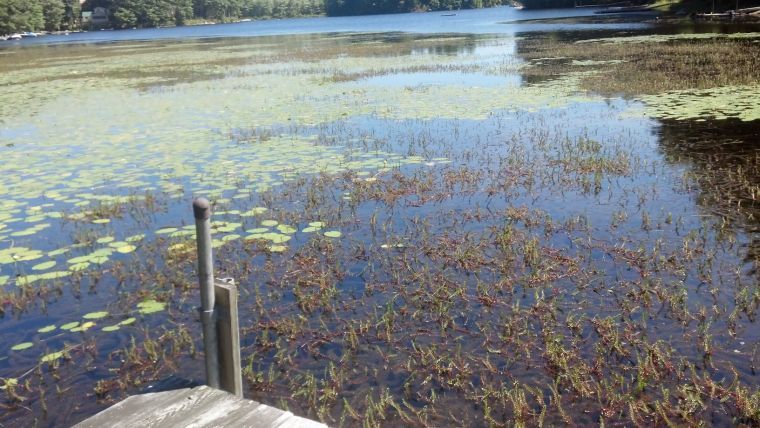 Milfoil grows in a section of Sebago Lake during a recent summer. If left untreated, milfoil can form a blanket of vegetation on a lake cutting off sunlight, lowering the dissolved oxygen fish require and creating algae blooms.
 Diane Potvin
Comments are no longer available on this story