
Many think the playing field should be leveled between inns and hotels that must be licensed and pay taxes, and those who advertise short-term rentals on Airbnb.
A legislative bill that would have required providers of short-term lodging to be licensed by the state failed in May, but opposition to these enterprises, advertised on websites such as Airbnb, is not fading.
In the height of the summer season, local inns and hotels are likely losing business to homeowners, who are cashing in on the influx of tourists by renting rooms or their whole house through Airbnb. It means extra cash to the homeowners, but it provides direct competition to hotels, inns and bed-and-breakfasts, which pay fees and taxes to be in business. There are hundreds of Freeport rentals available on the Airbnb website, one for as little as $110 a night. Airbnb is one of several websites that list and book accommodations around the world.
Sponsored by Sen. John Patrick, D-Rumford, L.D. 436 was a measure to regulate short-term rentals. Patrick’s bill would have required renters who provide overnight occupancy to the public to be licensed by the state. The bill was targeted at online rental sites and was put forth by the Maine Innkeepers Association, a trade group that represents more than 500 lodging properties across the state.
Greg Dugal, president and chief executive officer of the Maine Innkeepers Association, said the crux of the problem is not with Airbnb itself.
“Airbnb is just a platform that allows people to promote their rentals. But they should bear some responsibility for that. The real perpetrators are the short-term rental people themselves. They’re doing things that are not within their purview,” he said.
Dugal listed safety codes, water testing, compliance with the American with Disabilities Act, commercial insurance and the collection and submission of lodging taxes that many doing business on Airbnb get away without doing – thereby giving them what he calls an unfair advantage over inns, hotels and bed-and-breakfasts.
“If you’re licensed then you have to adhere to these standards, but not if you’re just renting out rooms once in a while,” Dugal said. “They’re not having to do any of the things I described. They’re undercutting the people who are doing it the appropriate way.”
Locally, there are no ordinances in place targeting short-term rentals.
There’s a difference between someone making a living in the hospitality business and someone just looking for a little added income, many on the Airbnb side of the equation would say. Nancy Salmon of Freeport, for one.
“It’s having a house guest,” said Salmon, who resides with her husband, David Webster, on Lavers Pond Road. “I appreciate that the hotels and the B&Bs have their expenses, but for us it’s not a full-time income.”
Salmon said that the desire for a little extra income prompted the couple to list a bedroom with a private bath on Airbnb. The property is listed as a “home on lake, quiet neighborhood.” The listed price is $80 a night and $490 a week. Renters get a private bath and access to the deck, kitchen, sunroom and living room.
Salmon said that she loves the idea of welcoming people into her home.
“You get to know people you wouldn’t have come to know otherwise,” she said.
Salmon and Webster came to appreciate arrangements made through Airbnb in their travels.
“I really like the notion of staying in someone’s house,” she said. “When I went to Cuba I stayed in an extended family’s house. I love being part of someone else’s family.”
During a stay in a Connecticut home, on the other hand, the owner was not around.
“We’re not leaving the house,” she said.
Chris Ferreira of Damariscotta, who rents out his family home in South Freeport on the website, attended the legislative hearings for L.D. 436. The legislation was “hard to swallow,” Ferreira said.
“They were slick in their presentation,” Ferreira said. “Then the Airbnb people came out and spoke, and there were a hell of a lot more of them.”
Ferreira debunked the notion that a “level playing field” is needed between those who rent their spaces through Airbnb and traditional enterprises.
“I say that’s bull,” he said. “If I want to rent more than three different rooms according to the law, then I need to have a sprinkler system. I pay my taxes. I play by the rules as the laws are written right now. If they win out, I won’t be able to do this and I will have to sell my home.”
Ferreira said he has been quite successful renting the South Freeport home, which goes for $185 a night. On average, Ferreira said, he is able to rent it 20 to 30 percent of the time. Relatives stay there some of the time, and sometimes he winds up staying there, Ferreira said.
The Airbnb fee is 3 percent of his proceeds, he said.
Chip Gray, general manager of Freeport’s landmark hotel, the Harraseeket Inn, said that the unregulated aspect of people renting their property through such platforms concerns him the most.
“There’s a fairness issue, and then there’s the safety issue,” Gray said. “There’s a lot of regulations that have good reason. Something could happen someday.”
Gray said he hears much talk of Airbnb.
“Basically what you’ve got is a whole new pool of overnight rentals floating around out there on Airbnb. Now, there’s thousands of them. People who want to pay their real estate taxes put their places on Airbnb.”
Gray said that people who rent their homes through the website probably hurt bed-and-breakfasts more than they do hotels, because the experience is similar.
The Harraseeket Inn, Gray pointed out, itself uses Airbnb, as do other hotels and B&Bs.
Monica Kisson, who co-owns White Cedar Inn Bed and Breakfast on Main Street in Freeport with her husband, Rock Nadeau, won’t go so far as to say that Airbnb and similar sites are hurting their business. Kisson is adamant, however, that the playing field should be level.
“It’s sort of a tossup,” Kisson said. “Either they get licensed or I don’t have to get licensed and inspected. If someone is doing this for a living, they should be licensed and regulated,” she said.
Tobi Baron, who owns James Place Inn on Holbrook Street with her husband, Robin, said that Airbnb is hurting the B&B’s business.
“It has definitely had an impact on business,” Baron said. “We welcome competition, but the playing field needs to be level. The rest of us have to play by the rules, and I am really puzzled by the fact that our governor and the Legislature have done nothing about this.”
Baron said that people who stayed at the James Place Inn on a recent weekend had spent three days in Portland at a residence advertised on Airbnb, and planned to do the same in Camden.
“That’s three days lost by B&Bs,” she said. “I’m not quite sure how anyone can support this. It’s the underground economy going on.”
Danielle Higgins, general manager at the Hampton Inn on Lower Main Street, said so far she has not noticed a negative impact from Airbnb.
“During the summertime, there’s enough business for everyone. At some point, if hotels keep opening, it could be a different story,” she said.
Some people who rent out their homes or rooms in their homes via Airbnb own expensive oceanfront property in South Freeport. One oceanfront home is listed at $378 a night. One cottage is going for $200 a night, another for $120, and owners of an oceanfront apartment want $378 a night. Most also offer weekly rentals, and some places are available for a month.
Many visitors to Freeport prefer something within walking distance of the downtown shopping area, and there are plenty of rentals available on Airbnb that fit the bill – some at much lower prices. One studio rental in the village is going for $105 a night, and a one bedroom with a shared bath can be had for $85.
In the countryside, one homeowner two miles from town is renting a guest suit for $100 a night, and a loft on Lower Flying Point is available for $93. A room on Desert Road, near Exit 20 of Interstate 95, can be rented for $95.
Lon Cameron, a graduate student at the University of New England studying to be a physician’s assistant, testified in writing against L.D. 436. Caron is helping earn his way through school by renting a camp in Waterford through Airbnb, and his mother rents out rooms to UNE students by the same method.
Cameron rents his camp, situated next to the Crooked River, on a nightly basis for $100.
“I’m doing awesome,” Cameron said. “I’m probably renting about 20 nights a month. I’m just another guy looking to get by. I’m a working-class guy.”
Cameron said he cannot afford to install plumbing or heating in his cabin, and that’s fine with people who want to live that lifestyle for a night.
“The B&B models are not working as well,” he said. “People who come to Maine do not necessarily want that. Some people are happy with simpler things.”
Cameron, like anyone who uses Airbnb to rent their home or rooms within it, must place a great deal of trust into the renters.
“It’s very much harkening back to the day when people trusted people,” he said.
 The Airbnb photo posted by Nancy Salmon and David Webster of Freeport, who have a room in their home on Lavers Pond Road up for rent. Courtesy photo
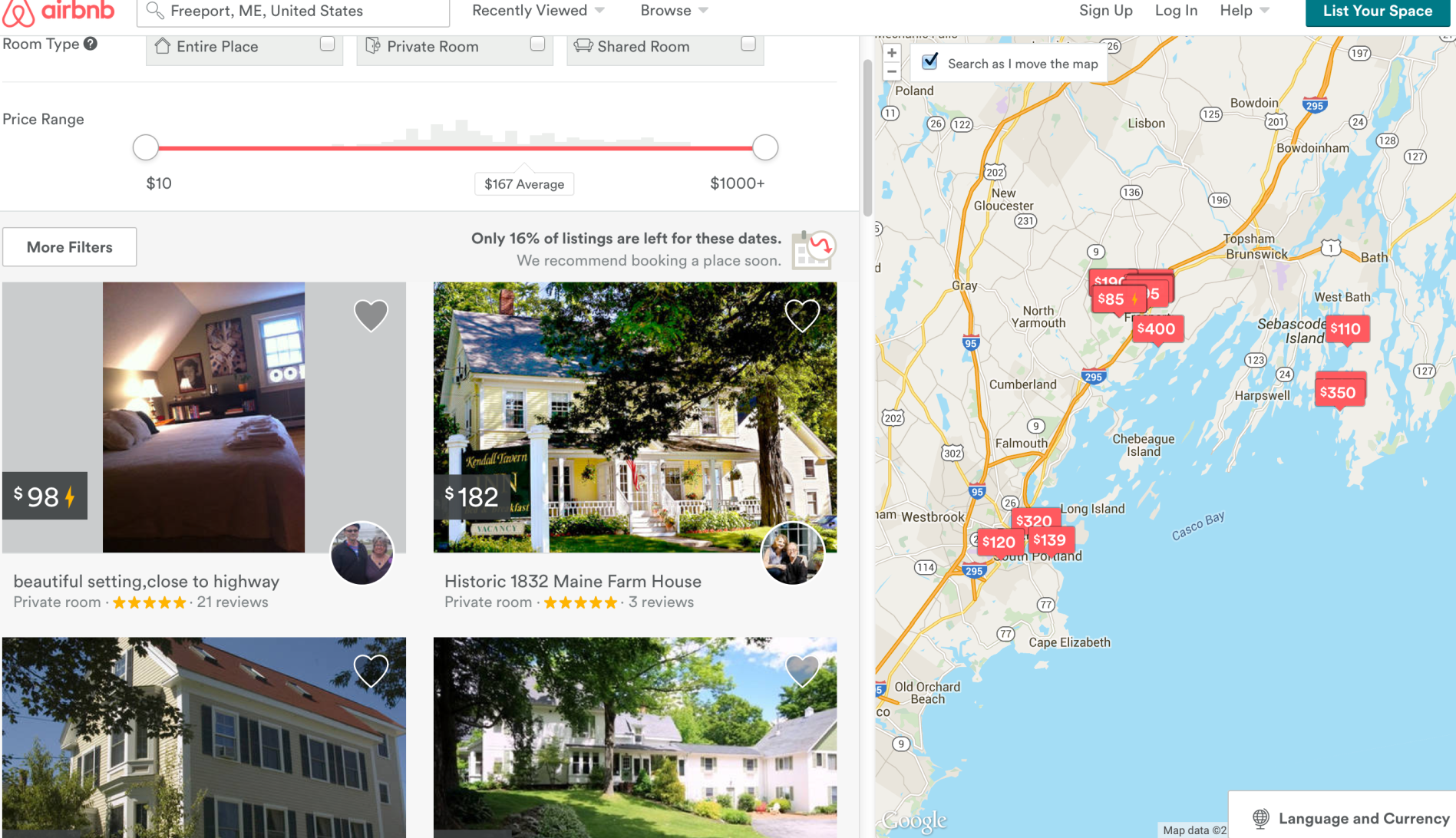 A Freeport page on Airbnb as it appeared on Monday.
Comments are no longer available on this story