
The construction of the Thomas Memorial Library in Cape Elizabeth has been a century long lesson in resourcefulness. First a one-room schoolhouse, it was converted to a library in 1919 when a former teacher, dismayed at the plans to turn it into a pigsty purchased it and donated it to the town, as a library, complete with a collection of books.
It has expanded several times. The most significant expansion was in 1986 when it spread out into the adjacent building, called the Pond Cove Annex, which was formerly a three-room schoolhouse, built upon yet another one-room schoolhouse.
“This is New England frugality at its best,” said Library Director Jay Scherma.
Longtime librarian and local historian Jane Beckwith agreed with Scherma’s analysis of the library’s construction and evolution. “It was Yankee thrift, that’s for sure,” she said.
The library will celebrate that Yankee thrift this Saturday when it throws a 20-year anniversary party for the expansion and connection of the two former schoolhouses.
The original schoolhouse, donated to the town in 1919 by William Widgery Thomas, was built in 1849, and located on Bowery Beach Road about a quarter mile from the intersection of Fowler Road. Because of declining enrollment, the Spurwink schoolhouse, as it was called, was closed in 1913.
Phineas Sprague, a coal dealer originally from Boston and the largest land-owner in Cape Elizabeth, bought the building after it closed, relocated it and planned to turn it into a pigsty.
When Thomas, a former teacher at the school, returned to Maine from Sweden, where he served as the American ambassador, he was alarmed to find the charming, yellow-clapboard building, where he performed his first job, in a state of disrepair.
Driven by a fondness for Cape Elizabeth, the place he referred to in a letter to the town as the “beautiful playground of my boyhood,” he bought the building and had it hauled, by oxen, back to the hill where it was built on Bowery Beach Road.
Thomas’s love affair with Cape Elizabeth began when he was a child growing up in Portland. The son of a banker, Thomas had an abundance of leisure time as a boy and used it regularly on walks out to the lighthouse in Cape Elizabeth where he would pick flowers for his mother, said Beckwith, a Thomas admirer.
At 18, Thomas, a student at Bowdoin College, applied to work as a teacher in the one-room Spurwink schoolhouse for the winter semester of 1857. Each morning, he commuted by horse from Portland to teach the group of 64 students, mostly adolescent boys who worked on their family farms or boats during the warmer months, said Beckwith.
In his library dedication address, Thomas, who referred to his gruff group of pupils as “scholars,” said his group of students “now and then used to put a teacher out the window,” which is why Beckwith said women were primarily hired to teach the girls, who mostly attended classes in the spring session, and men were hired to teach the boys, who mostly attended in the winter.
As a teacher, Thomas struggled with attendance and parental expectations. Students would not attend school regularly because of their responsibilities at home. A parent’s priority was ensuring the farm was maintained, not ensuring their children were in school, said Beckwith.
Despite the hardships, he left behind a small legacy, said Beckwith.
His teaching style, unorthodox for the time, brought students outside of the classroom and into the community, where he used lessons in nature to teach his students difficult math concepts. For this, he was much loved by students, but disliked by parents for trying this alternative hands on approach to teaching, said Beckwith.
Though the parents objected to his style, at the end of the year, the math scores of his students topped the students in any other district, said Beckwith. At that time, there were several one-room schoolhouses serving different areas of town.
His time teaching in Cape was short, but profitable for both students and teacher, and that paired with his childhood experiences in Cape Elizabeth impressed upon him an obligation to the town.
“All his life he wanted to do something for the town,” said Scherma.
With nostalgia and gratitude as a motivator, Thomas renovated the schoolhouse, equipped it with furniture, books and supplies and then donated it to the town, complete with the land it sat on in 1919.
Thomas wrote in his library dedication address to the town in 1919 of his fondness for Cape Elizabeth. Throughout his life, he wore many hats – teacher, ambassador, lawyer – but it was his first job as a schoolteacher, earning $35 a month, that was the most gratifying, he said.
“It was the first money I ever earned, and it was the best I ever got in my life,” he wrote
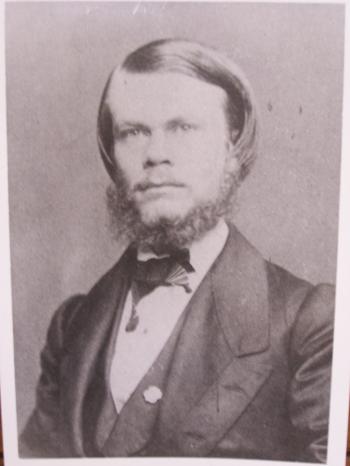 William Widgery Thomas Jr. donated the first library to Cape Elizabeth.
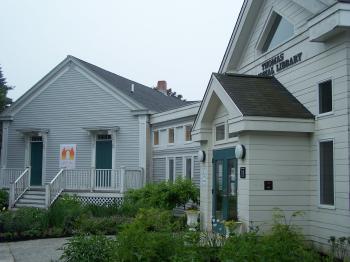 The Thomas Memorial Library today. To the far left, the original one room schoolhouse donated by William Widgery Thomas Jr. stands with two entrance doors, one for boys and one for girls.
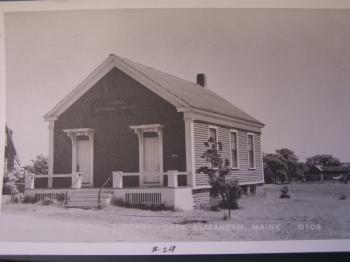 The Thomas Memorial Library in 1919. Originally a one room schoolhouse, the library was donated by a former teacher in the Spurwink School District, William Widgery Thomas Jr.
Comments are no longer available on this story