
Back in the late 1970s, a Massachusetts teacher, Philip Sadler, and his seventh- and eighth-grade students created the world’s first portable planetarium using materials scavenged from a dump. They discovered that a single fan could hold up the bubble-like structure. Now, Cape Elizabeth High School science teachers Sharon D’Orsie, Kelly Kertes and Michael Efron are preparing to use such a structure, called the Star Lab Planetarium, as a teaching tool. The Current talked with D’Orsie about the structure and its capabilities.
Q: Describe this mobile, inflatable structure. How does it work?
A: It is like a very big igloo made of lightweight, space-age, composite fabric. An electric blower inflates the bubble with air, creating a structure that is 10 feet tall and about 20 feet wide.
Students enter by crawling through a small tunnel. They will sit in a circle so that they can see displays that are projected onto the dark walls and ceiling. The entire system fits into a duffel bag and two large suitcases.
Q: How many students can fit into it?
A: We think we could easily accommodate 24 elementary school students and probably 20 high school students.
Q: How did Cape schools end up with one of these?
A: It was a generous gift from Patricia and Michael Metfah, summer Cape residents who have helped many students and projects through their Metfah Educational Foundation and are strong believers in science education. Needless to say, we science teachers are thrilled because purchasing this system would cost $14,000.
Q: When were you trained in how to set it up and use it?
A: On Dec. 11, Kerry, Michael and I were joined by several local astronomy buffs to be trained by Mike Marks of Learning Technology, who showed us how to set up the planetarium on the auditorium stage. The training took four hours. We really had stars in our eyes by then.
Q: How will you use the planetarium to teach science?
A: We see fabulous applications. Kerry and Michael are over the moon’ about the use of the tool in astronomy and earth science. The instructor can set up the projector to mimic the latitude of Cape Elizabeth at an exact time of year and time of day. With the Northern Hemisphere star module, we can duplicate the clearest of nights at any hour – during school periods. In addition, the modules for weather, ocean currents and plate tectonics eliminate the challenge of explaining three-dimensional concepts on a flat surface. We are still working on a strategy to fit it into the larger district science curriculum.
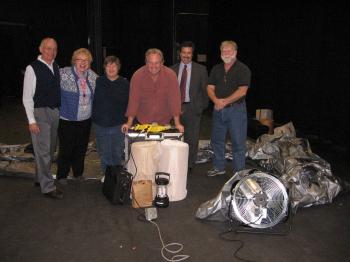 Teachers Kerry Kertes, Michael Efron, Sharon D’Orsie and several volunteer astomony buffs learn to use the StarLab Planetarium.
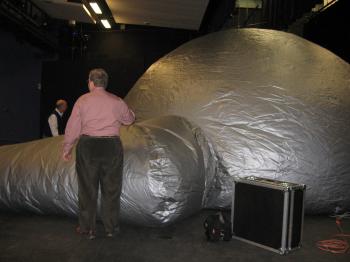 The StarLab Planetarium being inflated.
Comments are no longer available on this story