
FREEPORT – There remains ample need for enforcement of Freeport’s regulations on the harvesting of shellfish, Police Chief Gerry Schofield says. And the new chairman of the Shellfish Conservation Commission doesn’t disagree.
Schofield spoke to the Tri-Town Weekly last week regarding Tom Kay, the shellfish warden whose duties include both enforcement of the town ordinances and protection of the resource – mostly clams. The chief, who is Kay’s supervisor, said he disagrees with the notion put forth by some in the industry that enforcement is no longer a big deal.
“I think that areas that are closed would be dug, which brings up a health issue, too,” Schofield said. “He’s making sure that anybody out there harvesting is properly licensed, and that the clams are of proper length.”
The shellfish commission has used input from the Maine Clammers Association and its consultant, Sara Randall, to submit a detailed request that the town fund a shellfish coordinator, whose job would be resource protection, rather than enforcement. Some clammers have said that enforcement – and Kay’s position itself, which pays $44,206 – are no longer a major need.
But Delbert Arris, the new shellfish commission chairman, has a different perspective.
“My position is, I’m all about having Tom Kay be there as warden,” Arris said. “I’m all for that.”
Kay was on vacation last week when Schofield spoke about his duties and the history of the shellfish warden in Freeport. He did not return calls for comment by the Tri-Town Weekly’s deadline Monday.
Kay monitors the town ordinances and patrols the flats along the Harraseeket River and ocean shorelines.
“The entire shoreline of Freeport at some time or another has been dug,” Schofield said. “Tom makes sure people don’t go in where it’s been seeded for up to six months.”
Some flats, Schofield said, are closed following heavy periods of rain.
Kay also checks the diggers for their licenses.
“He’s making sure that anybody out there harvesting is properly licensed, and that the clams are the proper length, which is a minimum of 2 inches,” the chief said.
Kay brings along a bucket, sorts through some of the harvested clams and sizes them. Small clams are not to exceed 10 percent of the total take, Schofield said. Buyers, too, are aware they can be fined if they have too many undersized clams, Schofield said.
“It’s not a horrible problem any longer,” he said. “It was a bigger problem years ago. It’s enforcement.”
Schofield said that the warden program has existed since the late 1970s as the town split those duties from those of the harbor master. At the time, he said, licensing was a problem.
“We were getting bombarded by people without a Freeport license, so we needed enforcement to take care of that problem,” he said. “Also, there was no minimum length then.”
Pollution and red tide then became problems, Schofield recalled. The town authorizes Kay to close and open flats affected by red tide.
“To keep flats open, either the state or the town would monitor the flats,” he said. “We opted to do most of the testing ourselves. We can check them faster and get them back open faster.”
Kay tests the flats at high tides for the presence of pollution. He collects samples and calls the Maine Department of Marine Resources, which picks up the samples.
On May 19, Kay issued a summons to a Litchfield man on a charge of harvesting undersized clams. Schofield said that he provides warnings to clammers who might be digging too close to closed areas, or harvesting clams that are too small.
Kay uses a 23-foot skiff, moored at the town dock in South Freeport, to go about his daily routine. On a typical day, Schofield said, he goes out during low tides to monitor diggers, or high tides to monitor water quality.
“It’s a job that requires a lot of flexibility,” Schofield said. “We’ve shifted the warden’s duties over the years. Now he’s being asked to be more of a participant in the green crabs project.”
Schofield was referring to the effort to reduce the population of green crabs, which are devastating the clam population up and down the Maine coast. The town spent $100,000 last year on a study headed up by Brian Beal, a University of Maine ecologist. Beal is back with a $200,000 follow-up grant from the University of Maine studying means of combating the crabs.
“Green crabs are a statewide problem,” Schofield said. “If the Freeport studies can show something, I would hope that the state could take it over. We are willing to work with the shellfish commission to determine what the warden does, but we’re not getting the feedback that we need. There was a big influx of diggers from Brunswick and Harpswell last year. They were just digging the flats to death.”
Arris concurred with Schofield on the need for cooperation between the town and the commission.
“My goal is for us and the town to be on the same page,” Arris said. “Tom’s very good at communicating with the DMR.”
The Town Council has shown some hesitance, meanwhile, to fund a town shellfish coordinator. The shellfish commission had worked for months on a plan for a regional approach that could include shared funding from towns such as Brunswick and Harpswell, but decided in March to seek a town position. The rationale was that the town could make it happen quicker, and the time is a factor considering how quickly green crabs are eating up the resource.
Arris said that the sudden switch caught him off guard, and that he is still open to the regional concept, which the council prefers. Randall, meanwhile, is rewriting the Freeport-only proposal, which requested $90,000 in funding, Arris said.
A CLOSER LOOK
The Freeport Shellfish Conservation Commission
will meet at 6:30 p.m. on Thursday, June 12, at the Freeport Community Center, in an attempt to respond to a Town Council request to modify its $90,000 request for a town shellfish coordinator.
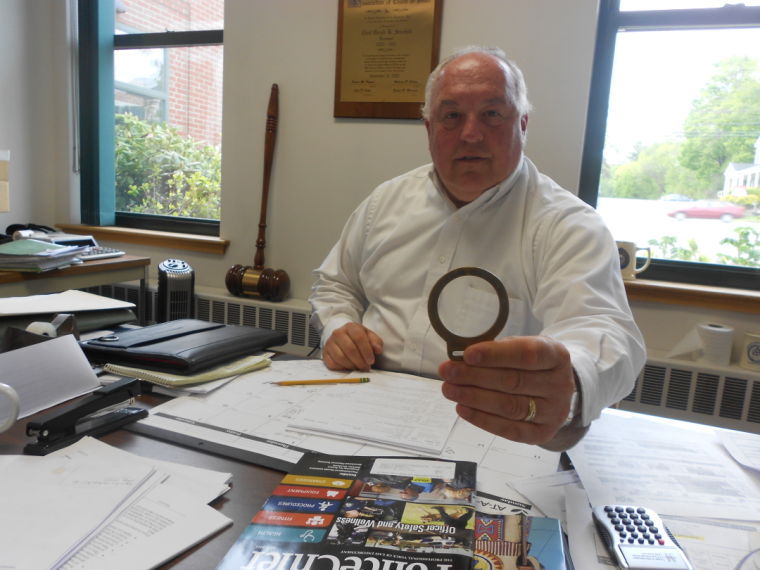 Freeport Police Chief Gerry Schofield holds up a steel loop, used by Shellfish Warden Tom Kay and clammers alike, to determine if clams meet the minimum harvest length of 2 inches.
Comments are no longer available on this story