
A federal judge is soon expected to make a final decision on a lawsuit filed by Verizon Wireless in response to Cape Elizabeth’s denial of a permit to install antennas and other equipment on a water tower on Avon Road.
Meanwhile, a few residents whose homes abut the 69-year-old structure, have requested to join forces with the town in defending against the lawsuit filed by the cellular company.
In addition, the Town Council at its Jan. 12 meeting, adopted a goal for 2015 to look at how the town can address policies regarding the town’s poor cell phone service.
Cape Elizabeth Town Manager Mike McGovern said nearly 200 people, including cell phone users complaining of spotty coverage in the area, have signed an online petition in hopes the town will allow Verizon to add antennas to the tower, as a result of the litigation.
“It’s an area the council feels there needs to be a further public dialogue on,” said McGovern, of Cape Elizabeth’s cell coverage. McGovern said the town would survey residents in the near future to identify the areas in town where service can be improved.
The council’s overall goal is to review wireless trends and practices in Cape Elizabeth and look at the long-term needs of wireless coverage in the community, McGovern said.
Neighbors aim to join lawsuit
Represented by attorney Daniel A. Nuzzi of Lewiston law firm Brann & Isaacson, Avon Road residents Brad Kauffman, Priscilla Armstrong, and Pavel Darling filed a motion to become parties to the lawsuit on Oct. 3, claiming that if Verizon’s permit was ultimately approved, the neighbors would suffer decreased property values, as well as increased traffic and noise, and there would be a negative visual impact on the nearby neighborhood.
“I fully support a comprehensive review by the Town Council to improve cell service in Cape Elizabeth,” said Kauffman.
The neighbors also argue that the cell tower plan is not permitted in the Residence A District under zoning rules. They are concerned that Verizon Wireless did not pursue a rezoning process, which would have given the community, as a whole, a chance to weigh in on the proposal for the facility. Instead, Verizon applied for a building permit, which the town denied, said Nuzzi. Verizon is still challenging that decision.
Representatives from both parties met with a federal judge, Jon D. Levy, at U.S. District Court in Portland for an hour-long hearing on Tuesday, Jan. 13, after the Current’s deadline, to discuss the residents’ motion to intervene and a motion filed by the town last fall, which asked the court to dismiss Count 2 of the lawsuit because Verizon ran out of time to pursue an appeal in Maine Superior Court, as required by state law.
Verizon’s attorney, Scott Anderson of Portland law firm Verrill Dana, on Tuesday said the judge gave no indication of his position during the hearing and was expected to rule on both motions by February.
Verizon claims the lawsuit can be addressed in one federal court proceeding because cell tower placement is “a blend of local and federal law” and “not simply a local issue.”
In order to intervene, Anderson said the neighbors “have to object to an issue that is relevant to the lawsuit, and they have to show that the town will not adequately represent their interests.”
Verizon filed its lawsuit in U.S. District Court in July alleging that the town’s Zoning Board of Appeals violated the local zoning ordinance and a federal law when it upheld the code enforcement officer’s March decision to deny the permit application.
According to Anderson, the new cell tower should be permitted under the town’s zoning ordinance because it fits the ordinance’s definition of an “Alternate Tower Structure.” In addition, the federal Spectrum Act requires municipalities to approve requests for installing equipment on existing structures, such as the 80-foot-tall water tower, provided that the proposal does not substantially change its physical dimensions, he said.
At issue before the court, said Anderson, is whether Verizon’s facility may be installed under the provisions of the Spectrum Act (Count 1) or the town’s wireless telecommunications ordinance (Count 2).
“Both the town and interveners reject Verizon’s contention that the zoning ordinance is preempted by the Federal Spectrum Act in this case,” according to the neighbors’ motion to intervene. “Interveners seek to adopt the town’s recently filed answer and motion.”
The water tower, owned by the Portland Water District, has not been used for water storage since 2007.
According to Anderson, it does, however, have an existing antenna licensed by the Federal Communication Commission, which the district uses to communicate with the town’s wastewater treatment plant.
According to the neighbors, “The tank is a rusting and a disused structure, decommissioned for years, whose removal has been contemplated by the Portland Water District. If Verizon is successful in this action, the tank will be converted into a wireless facility, and will remain standing indefinitely. If Verizon is not successful, there remains the possibility that the tank would be removed, a move that would bestow particularized benefits on interveners, as it would greatly improve the aesthetics of their neighborhood and likely result in increased property values.”
On Oct. 17, Verizon filed an opposition to the residents’ motion to intervene stating that the town of Cape Elizabeth adequately represents the neighbors’ interests in the case. Verizon also claims that the neighbors’ desire to see the tank removed “is not an adequate interest in the litigation,” said Anderson.
“The status of the tank and what happens to the tank is irrelevant,” said Anderson. “It is the tank that is the large structure – not the antennas. Because the neighbors actually want the tank gone – and stopping the wireless project is merely a means to an end – they should not be permitted to intervene.”
On Nov. 4, the neighbors filed a brief in U.S. District Court that says while abutters would benefit from removal of the tank, “interveners object specifically to Verizon’s proposed facility, not simply the continued existence of the water tank.
“If Verizon is successful in this litigation, interveners will suffer a particularized injury” such as impact to property values, increased noise and traffic, and negative aesthetic impacts “as a direct consequence,” the motion reads.
In addition, “Our clients certainly support cell phone coverage in Cape Elizabeth, but objected to the way Verizon has proceeded in this instance,” and failed to pursue the rezoning process, said Nuzzi.
“Our clients have stated that they would accept the results of such a process. Verizon itself promised to participate in a zoning or rezoning process when it initially raised the idea of installing antennas on the water tank,” Nuzzi said. “Instead of engaging in the rezoning process, as it said it would, it simply filed a building permit application.”
Verizon’s most recent brief, filed on Dec. 17, upholds that the proposed wireless facility is an “eligible facility” under the federal Spectrum Act and therefore the town is required to issue Verizon a building permit.
The main issue “has to do with whether or not this water tank qualifies as a base station” under the federal Spectrum Act, said Anderson.
According to Anderson, at the time of the town’s permitting decision, there was “uncertainty regarding interpretation of several terms in the Spectrum Act” and the town’s Code Enforcement Officer, Ben McDougal, “didn’t feel comfortable issuing the permit because the Federal Communications Commission hadn’t yet issued its rule.”
“The FCC issued the rule back in October and based on our interpretation, it answered all of the questions in our favor,” said Anderson. It concluded that the water tower is a base station, and that the proposed equipment would not substantially alter the tower, he said.
The town is scheduled respond to the lawsuit with another brief on Feb. 2, said Nuzzi.
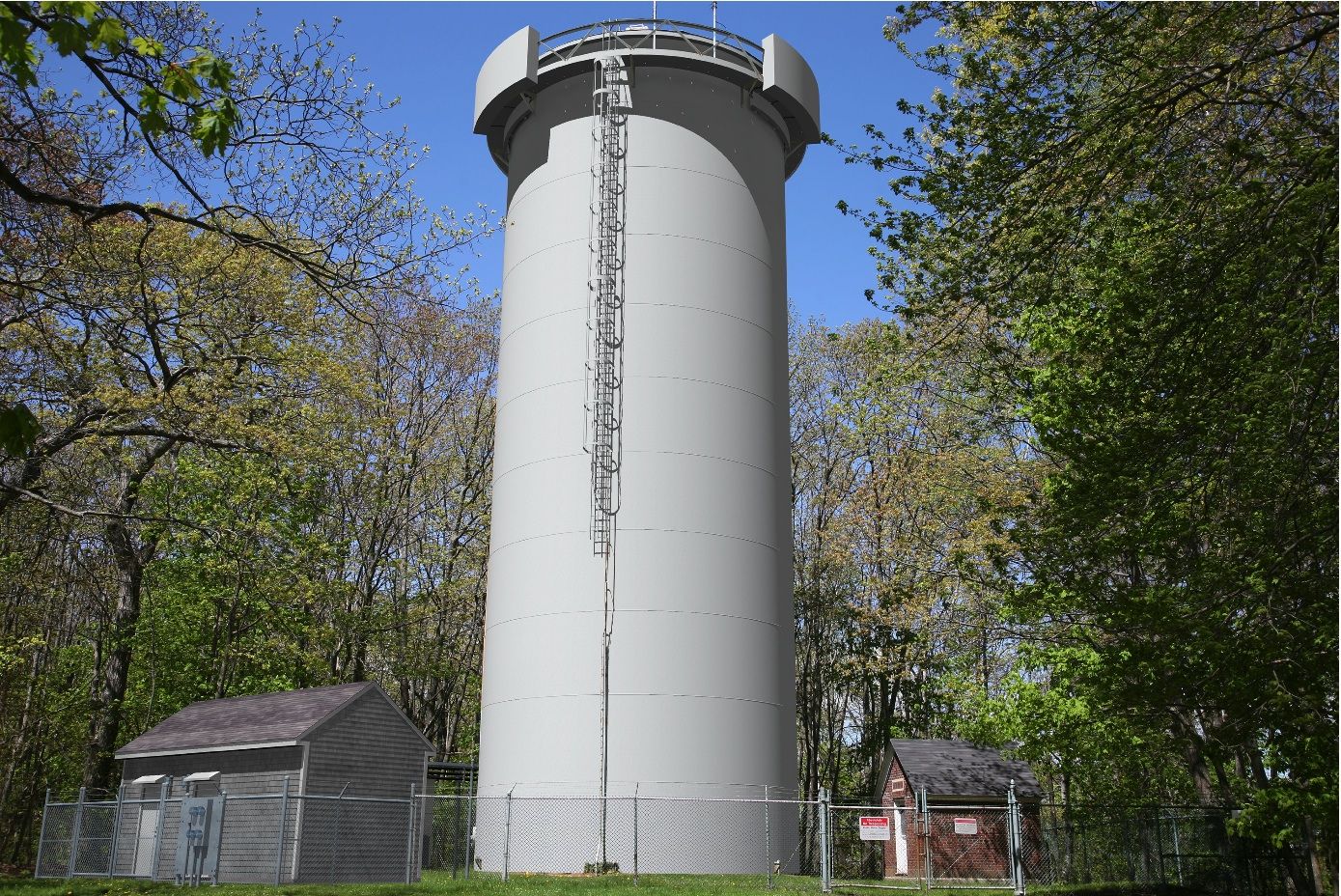 This image illustrates how the water tower on Avon Road would appear if Verizon Wireless’ proposal to install equipment on the existing tower is approved. Courtesy image
Comments are no longer available on this story