
GORHAM – With its Main Street ravaged by demolition in past decades, Gorham will begin a task next month to see whether it should develop an ordinance aimed at historic preservation in the 278-year old community.
Town Councilor Bruce Roullard, chairman of the Historic Preservation Committee that the council recently named, said all areas of the town would be reviewed to identify historic sites, which could include monuments or land parcels besides buildings.
The panel will also review the town’s building codes, looking at possible ways to help owners afford restoring historic buildings.
Roullard on Tuesday called the study long overdue. During the past half century, a number of landmarks in Gorham Village were razed to make way for gas stations and convenience stores.
“Many historic homes on Main Street were leveled,” Roullard said. “That was tragic what occurred there.”
The study was spawned by a draft of Gorham’s proposed comprehensive plan update that recommends the town protect its historical and archaeological resources. The Historic Preservation Committee will work throughout the summer and into autumn in the extensive undertaking that Roullard called “ a comprehensive study.”
The seven-member committee includes residents Janet Adams, Jane Bell, Noah Miner, Jan Labrecque, and Marla Stelk, in addition to Town Councilor Sherrie Benner and Roullard.
“I live in an old house and part of the charm of Gorham Village is its historic architecture,” Miner, a former town councilor, said on Wednesday.
He said he hopes that charm would be preserved.
Adams bought a federal-style home on South Street in 2013. In participating on the committee, Adams wants to ensure that the town balances “preserving and protecting” historic homes with “allowing people to live reasonably in them in the 21st century.”
She said she also wants to learn more about the town’s history.
The committee will hold public hearings and will make a recommendation about a potential historic preservation ordinance to the Town Council.
Earle Shettleworth Jr., director of the Maine Historic Preservation Commission in Augusta, applauded Gorham’s interest in historic preservation and would support a historic ordinance.
Shettleworth said Tuesday a number of communities have historic ordinances, and he said 10 Maine municipalities, including Portland, have adopted historic preservation ordinances that meet state and federal standards. Shettleworth said his office would provide assistance if the community seeks its help.
Labrecque, a former legislator and longtime North Gorham resident, expects to be surprised at the number of historic sites that the committee would identify.
“It’s going to be an eye-opener for me,” Labrecque said.
Gorham has historic sites in all areas.
“We still have a lot of nice buildings in town,” Roullard said.
Several Gorham landmarks are located in two official districts listed on the National Register of Historic Places by the U.S. Department of the Interior several years ago. The two are the South Street Historic District and the Gorham Campus Historic District at the University of Southern Maine.
The 9-acre South Street Historic District has 20 buildings including the town’s Baxter Museum and adjacent Baxter Memorial Library. Also in the district, the town owns the McLellan House at 77 South St., leased to the Presumpscot Regional Land Trust.
The campus district contains seven buildings on the National Register of Historic Places. One on the campus that Roullard pointed out is another McLellan House. Roullard said it is the oldest brick house in Cumberland County.
It was built by the town’s second settler, Hugh McLellan.
“It’s very nice to have in Gorham,” Roullard said.
The registered historic districts offer some level of protection. Shettleworth said any proposed project utilizing federal funds would be reviewed by his office in Augusta to determine any historical impact issue.
The Gorham committee’s study likely will uncover some interesting history. As an example of a historic site in North Gorham, Labrecque cited the former Levi Hall School that has been converted to a church. Perhaps a little known fact is that the Arctic explorer, Adm. Donald MacMillan, once taught school in the building.
Shettleworth described Gorham as an older town developed inland before the Revolutionary War.
“It’s a very historic community,” Shettleworth said.
Founded in lumbering and agriculture, Gorham took root in May 1736 when John Phinney and a son paddled their way up the Presumpscot and Little rivers, becoming the first to settle in a land grant then known as Narragansett No. 7.
For several years, early Gorham families lived in a garrison on Fort Hill.
Before the Historic Preservation Committee was formed, Town Councilor Benjamin Hartwell suggested a replica of the old fort be built there, adding that it could be utilized for educational purposes.
“I believe this would be an attraction for visitors to come to Gorham for,” Hartwell said in an email response to the American Journal.
Town Councilor Suzanne Phillips said a replica would be a “great project” involving the whole community. “The benefit of this would be to show how proud we are of Gorham’s beginnings,” Phillips said.
Today, the site is a town park, which has a view of the White Mountains, and Town Manager David Cole said recently the fort site contains 9.5 acres.
The park likely will be one of numerous sites throughout Gorham under the extensive review of the Historic Preservation Committee.
“I’m looking forward to participating in the process,” Miner said.
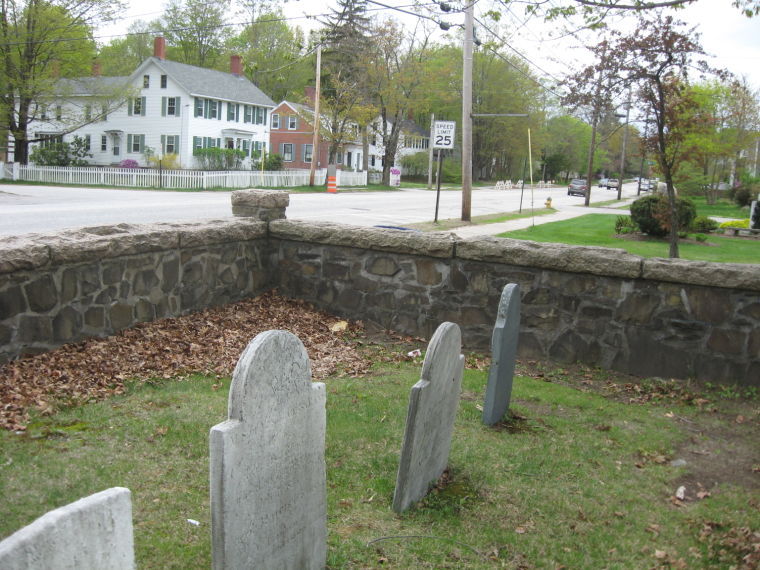 This is a view looking down South Street from the cemetery where many of Gorham’s early families are buried. A committee that begins meeting in June will study whether the town should develop a historic preservation ordinance.
Comments are no longer available on this story