
Thanks to the efforts of a local Boy Scout, Windham’s first property boundary marker should be set for another couple hundred years.
David LeClaire, 17, son of Bruce and Irene LeClaire of Brookhaven Road in Windham and a member of Boy Scout Troop 51, recently restored Windham’s Lot No. 1 marker, situated on River Road in front of the Maine Correctional Center, as his Eagle Scout community service project.
Though the marker is centuries old, it still has relevance today, said Kay Soldier, historian for the Windham Historical Society.
“It’s the most important stone in Windham,” said Soldier, who is also a columnist for the Lakes Region Weekly. “It marks the northeast corner of the first lot that was laid out. All the other lots in the town are dependent on that stone. For homeowners in Windham today, everything in their deed depends on that stone.”
In 1735, when the first lots were mapped, the original marker for Lot No. 1 was a pine tree. A multitude of long and narrow “ribbon lots” originated at Lot No. 1 and extended south to the Westbrook line and extended east to west from the Presumpscot River to what is now River Road. The pine tree burned in a lightning strike sometime in the 1800s, Soldier said. And the stone, most of which lies underground, was set in its place.
“We know when the lots were laid out, but we may never know exactly when that stone was placed,” said Soldier.
Soldier also said records show a school was to be built on Lot No. 1. However, the first structure built on it was the private home of Dr. Caleb Rea, Windham’s first doctor.
Since the historical society prizes the marker, LeClaire received a lot of help and guidance when performing his project. He had to get approval from the society before performing the renovation, and a final OK once he had completed the project in order for the Boy Scouts to award him the rank of Eagle Scout.
On Monday night at the society’s monthly meeting, the society signed off on what Soldier described as LeClaire’s “in-depth project.” He now awaits project review from the Pine Tree Council of the Boy Scouts of America.
“It was a tough project. It took a lot of work,” LeClaire said. “But that’s what the Eagle Scout project is all about. You have to first plan for the project and then show leadership in carrying it out.”
LeClaire said the community service project was the last in a list of 21 requirements for the Eagle rank. As part of the service project, LeClaire created the sign, leveled the ground around the marker, installed mulch and brickwork around the stone, erected two granite posts with a connecting chain, and planted small evergreens.
While the project was physically demanding, it was also political in nature. Working with Rep. Gary Plummer of Windham, LeClaire had to deal with various local and state agencies, including the prison, which owns the land where the stone is laid. He also had to notify the Maine Department of Transportation, since the stone is located along busy River Road.
Local police, who would be wondering what was going on, were notified, as well as neighbors, one of whom “came out to inquire what Dave was doing with the marker. He thought it was a gravestone. We set him straight, though,” recalled LeClaire’s father, Bruce.
LeClaire, a senior at Windham High School and a member of the football team, impressed historical society members with his attention to detail throughout the months-long endeavor that started in spring and ended in early summer.
“David basically had no experience in the real world, and to do what he did, you’ve got to be impressed,” Soldier said. “This is one of the most important things that could have been done, too, because it preserves what the founders considered the most important landmark.”
Historical society president Walter Lunt, who worked closely with Soldier and LeClaire on the project, was similarly impressed.
“We are highly pleased with the outcome,” Lunt said. “Our understanding of the Eagle award is that it must challenge the candidate, and calls for practice in leadership to see the project through. David seemed challenged. He was confronted with bureaucratic red tape, an endless number of contacts, time-management issues and fundraising challenges. It wouldn’t have been a leadership award unless it was challenging. All I can say is, look at the final result.”
The idea to have LeClaire improve the marker came from longtime historical society members Bill and Ruth Crane.
“My wife and I had driven by the marker many times, and finally thought that it was important enough to preserve, since all lots were designated by this historic marker, which we found to be in very bad condition,” Crane said.
After his request that the town pay for restoration was rejected at Town Hall due to budget constraints, Crane talked with Soldier and they both agreed LeClaire, who had asked Soldier if there were any projects he could help with, could do the job. The next issue was raising the several hundred dollars for materials.
“I suggested many ways for (LeClaire) to raise funds, such as asking local businesses to contribute, etc. I wrote to several that I knew personally,” Crane said.
Apparently, those requests worked. Many individuals donated to the project, as did several Windham businesses, including Genest Landscape & Masonry, Roosevelt Trail Landscape & Garden Center, Busque Construction Co. and Lowe’s Home Improvement. LeClaire received deep discounts from the businesses and paid for the rest of the materials with money donated by private individuals, mostly historical society members.
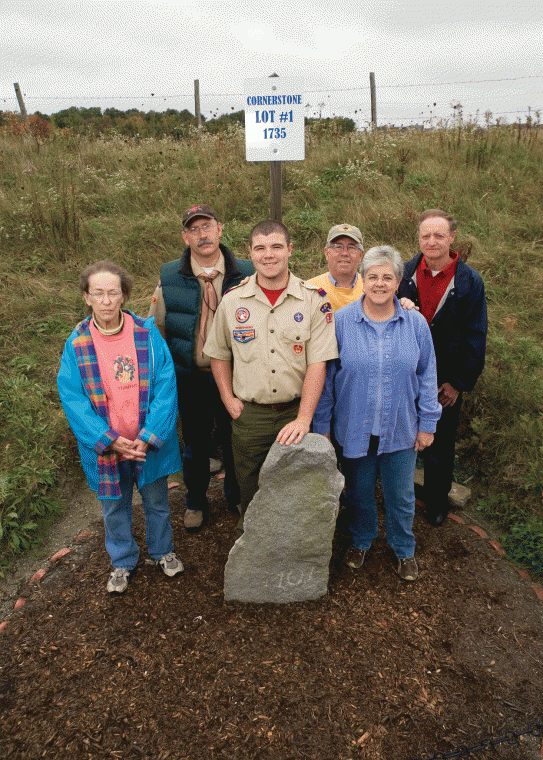 While Windham Boy Scout David LeClaire coordinated funding and performed the labor, many people helped to refurbish Windham’s original property boundary marker on River Road in front of the Windham Correctional Center. Those playing a key role in the project were, from left, Windham Historical Society historian Kay Soldier, Scoutmaster Brian Butler, David LeClaire with his father Bruce and mother Irene, and society president Walter Lunt. (Photo by Rich Obrey)
Comments are no longer available on this story