
Statistics hint that city’s downtown may be poised for a comeback.
Half a century ago, downtown Westbrook was a hub of activity.
Main Street was lined with drugstores and dress shops. There were two movie theaters, a hamburger joint and even a haberdashery.
“What you would do at the mall today, you did in downtown Westbrook then,” said Byron Dyer, 77, a lifelong resident of the city and vice president of the Westbrook Historical Society.
But the Maine Mall went up in the 1960s, and over the next decade urban renewal brought down many of the historic downtown buildings. Westbrook’s Main Street hasn’t been the same since, and the for-lease signs punctuating the downtown fac?ade don’t offer much hope that a revival is coming soon.
However, a recent study showed that Westbrook’s vacancy rate for large retail spaces, at 3 percent, is remarkably lower than that of its neighbors. With the larger lots filled, city officials are hoping that new businesses looking to locate in Westbrook will start filling in the empty spaces on Main Street.
Around the middle of the last decade, downtown started to look like it was making a comeback. The Dana Warp Mill had drawn an array of businesses and the new Disability RMS office building brought an onslaught of workers – and their lunch money – onto Main Street.
But the economic downturn brought that progress to halt. In the meantime, city staff has been working on plans and promotions to get Main Street back on track. Both they and downtown property owners are optimistic that a turnaround is imminent.
Retail restraint
The Greater Portland retail report, done by Malone Commercial Brokers and presented at a Maine Real Estate and Development Association conference last month, showed the average vacancy rate for the area was 10.8 percent – a number largely drawn down by Westbrook’s low rate.
Portland, Scarborough and South Portland all have vacancy rates hovering around the average, and Cape Elizabeth and Falmouth are at 16 percent and 18 percent, respectively, according to the report.
The study took into account multi-tenant retail spaces greater than 7,500 square feet and single tenant spaces greater than 10,000 square feet.
According to Mark Malone, vice president of Malone Commercial Brokers, Westbrook is the only community in the study that’s seen its vacancy rate drop in the recent economic downturn.
“A couple years ago Westbrook’s vacancy rate was the highest around,” he said.
That was before the rehabilitation of the Westbrook Crossing, formerly home of a Bradlees, which went bankrupt, and a Hannaford, which moved to William Clarke Drive.
When the shopping center was redone, Kohl’s and Shaw’s moved into the two large vacant lots, and Panera Bread, Ruby Tuesday, Olympia Sports and others moved into the spots across the parking lot.
Filling up that plaza accounted for most of the available retail space in the city, with the plaza on Larrabee Road and Main Street and the former Sebago Moc building on William Clarke Drive being the only other major retail centers.
Unlike neighboring Scarborough and South Portland, City Administrator Jerre Bryant said, “Westbrook hasn’t gone with that rampant development of retail space.”
There’s one project looming that could completely change that – Stroudwater Place, the huge, high-end retail development proposed by local developer Jason Snyder in 2008. Malone, who is working with Snyder, said they’ll probably start trying to attract tenants this spring and could break ground in 2011 or 2012.
But that project would be an exception to the rule in Westbrook. When times were good, the city focused instead on industrial and commercial growth, looking to companies like Calpine, a power plant, and Idexx, a manufacturer of veterinary products, for new jobs and tax revenue.
Bryant said Westbrook took that direction partially because it’s historically been an industrial city and also in order to replace the jobs lost at the Sappi paper mill with similar ones.
Those development decisions over the last two decades have resulted in a tax base made up of a mix of industries – a far cry from Westbrook’s past, when the city’s health depended so heavily on that of the paper mill.
“This is the first economic downturn in 100 or more years that hasn’t savaged the city of Westbrook,” said Economic and Community Development Director Keith Luke. “We’re no longer a one-industry, one-company city.”
Though the city suffered from the shrinking of the paper mill, the downsizing of Sappi is now affording new opportunities. Aside from the city’s easy access to the highway, according to Malone, Westbrook is more attractive now than ever because it’s no longer plagued by the stench of sulfur that spewed for decades from a pulp plant at the mill, which was shuttered in the late 1990s.
“In the past several years, Westbrook became a popular place to be,” he said.
And that popularity doesn’t appear to be dwindling, even in a bad economy.
Malone said that Westbrook’s vacancy rate is lower than it’s ever been since his company started the annual retail study about a decade ago. In the past year or two, it’s dropped about 5 percent, he said.
But that doesn’t mean the city is about to embark on a retail build out.
“Our goal is still to maintain a healthy balance,” Bryant said.
Though many companies looking to relocate in Westbrook might prefer the larger lots on the outskirts of town, Bryant said, if there are no spaces available there and they’re sold on moving to the city, they might start looking elsewhere.
“That’s going to help revitalize downtown,” said Bryant.
Ready and waiting
There are a few bright spots on Main Street, like restaurants Frog and Turtle and Fajita Grill, which draw customers from surrounding communities, filling the municipal parking lot behind them on weekend nights.
“They’ve given people a reason to come to downtown Westbrook,” said Luke.
Andy Curran, owner of the Paper Moon gift gallery on the corner of Bridge and Main streets, said he’s seen a direct benefit from the popularity of downtown eateries.
“We’re open on Sunday, and we refer to it as being open for brunch,” he said. “We have customers I know are here because they’re in town to go to the restaurants.”
Curran said he’d like to see more small, unique shops like his on Main Street.
“We just need to give them more and more reasons to stop their cars and get out,” he said.
Karen Kovich, who works at Gemini Technologies on Main Street, said she’d like to see more small stores and boutiques, too.
“There’s more restaurants that seem to be popping up, but there’s not much shopping,” she said.
But downtown still needs a few more big attractions in order to create the pedestrian traffic necessary to support smaller shops, Luke said. He’d like to see a movie theater, a Pier One, and a Trader Joe’s.
There are a few projects in the works that could spark some development on Main Street. Tim Flannery, who owns the Dana Warp Mill, has plans to convert the top two floors of that building into apartments, which would create more activity at night.
Flannery said he hopes to start constructing the 125 proposed apartments this summer and have some of them habitable by early 2011.
Westbrook Housing will soon go to the city’s Planning Board for site plan approval of new building at 917 Main St., which will have art galleries on the bottom floor and apartments for the artists above them. Luke hopes the galleries will draw pedestrians further west down Main Street, so that the building that’s home to Portland Pie Co. and, formerly, The Frame Shop “will no longer be the end of the line.”
The city is also working to put in place improvements to parking, lighting and sidewalks in order to make Main Street more attractive. A downtown streetscape plan developed last year articulates the city’s vision to add second stories and more windows facing the street on buildings like those in Westbrook Common, the outdoor mall created during urban renewal.
“All of the changes we would like to make would transform downtown Westbrook into something like Portland’s Old Port,” Luke said.
Those improvement plans are all drawn up and have been approved by city officials, but they’re at least partially dependent on redevelopment to move forward. The improved sidewalks would be constructed as a part of new projects and building improvements would need to be funded privately.
That’s why the bigger projects that would drive more development are so crucial.
Dave Elowitch, who owns the former Maine Rubber building at the intersection of Saco Street, Main Street and William Clarke Drive, said early conversations he’s had with new Mayor Colleen Hilton indicate he and the city share a vision for the site, which could help push a project forward.
Maine Rubber moved out of the downtown building more than 10 years ago, and since then, Elowitch said, he’s been looking for a project for the site.
Elowitch believes one of the important pieces to seeing the revitalization of Main Street would be to “get rid of the eyesores, including our building.”
He would like to see a local restaurant chain, like Sebago Brewing or Gritty McDuff’s, open a new location there, but so far no one’s bitten.
Hilton said she’d like to see a project there that “has strong architectural features which would help to identify that site as the western gateway into downtown Westbrook.”
She’d also like to see Saccarappa Park redeveloped, with open space preserved along the river.
In 2006, Flannery proposed a four-story, mixed-use building for the park, but that project is still on hold, he said this week.
Still, Flannery, who recently purchased another Main Street property – Leclerc’s gas station – has invested in the city for a reason.
“I believe in Westbrook. I’ve put a lot of money in downtown,” he said.
Flannery said he knows that the economy will come around and that Westbrook will be well positioned when it does.
“We could come out of this stronger than ever,” he said.
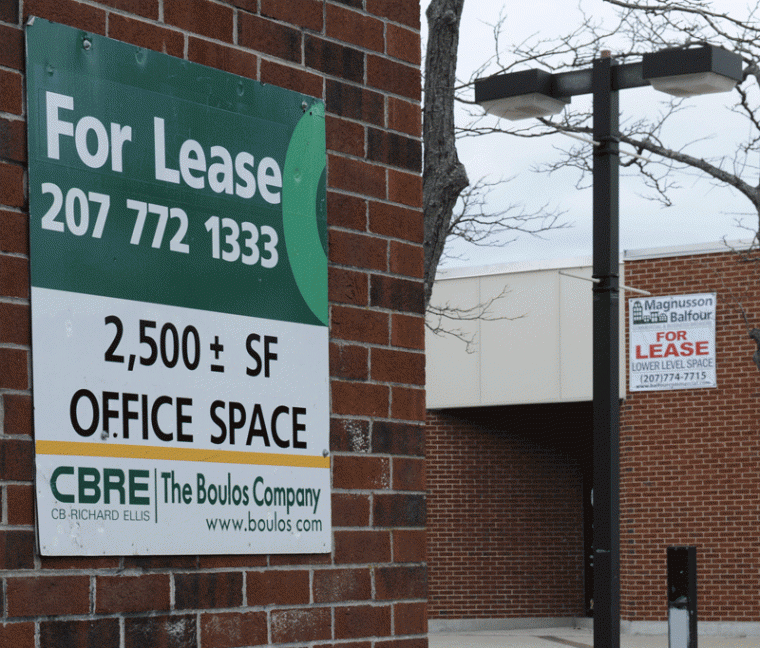 While for-lease signs dot downtown Westbrook, things are much busier across town at the Westbrook Crossing shopping area. In fact, the vacancy rate in Westbrook for larger spaces is the lowest it’s been in years. City officials believe that soon will have an impact on the downtown area. (Staff photo by Brandon McKenney)
Comments are no longer available on this story