
On a warm and cloudless Thursday morning, Derrick Daly, leading a tour of the gardens at the Inn by the Sea, sang the praises of the common milkweed.
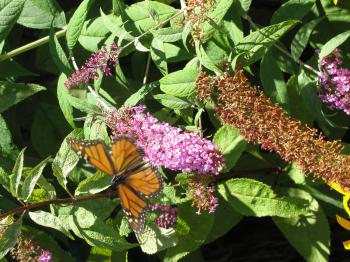
Daly pointed to one, and explained that part of his efforts to incorporate the gardens with the surrounding natural environment is letting unexpected native species survive among the planted flowers. The milkweed is important, said Daly, because it provides a home for the monarch butterfly larvae. Milkweed gives the larvae a natural protective poison.
Daly is the head gardener at the five-acre Inn by the Sea property, a position he has held for the past six years. During that time, Daly has been instrumental in mixing native plants and avoiding the use of fertilizers and pesticides at the inn.
Daly’s efforts have been influential in making the inn more environmentally friendly, an effort that recently won the inn Green Lodging Certification from the Maine Department of Environmental Protection, and a legislative sentiment of congratulations presented at the Cape Elizabeth Aug. 14 town council meeting.
“He is beyond amazing. He has made half of everything we have done here possible,” said Maureen McQuade, an owner of the inn.
Daly, who is originally from Whickoff, N.J., attended Southern Maine Community College, where he studied plant and soil technology. He also interned at the Arnold Arboretum in Jamaica Plain, Mass., a living tree museum owned by Harvard University, before coming to the Inn by the Sea. He also owns his own landscaping business.
Daly gives a free, public tour of the inn’s gardens every Thursday at 10:30 a.m. As this small tour group absorbed the sights and smells of the circular garden in front of the inn off Route 77, Daly told the group, “This garden is a testament to our compost.” He explained that he fertilized the garden with a mixture of oak leaves, oyster shells and other ocean leftovers four years ago. He said the garden has not needed fertilizers, pesticides or more compost since.
Daly said one of the first changes he oversaw in the gardens was planting indigenous plants. By using local plants, the gardens need less pesticides, fertilizer and care. Wildlife is attracted to the native plants, which also include the joe-pye weed and goldenrod. Crabapple, magnolia trees and the beach rose also dot the landscape.
He pointed to a beach rose bush, and the guests smelled the few flowers still in bloom. He grabbed a rose hip and broke it apart. The pods are high in vitamin C, explained Daly. “That’s why the Pilgrims brought them here, to prevent scurvy,” he said.
The inn also incorporated 22 nesting boxes and six bird feeders, and Daly said chickadees, house wrens, tree swallows and cardinals all eat and nest in the area.
After the hour-and-half tour, the guests praised Daly and his work on the gardens. “The gardens are beautiful,” said Lilly LeMay Bowen of Oregon City, Ore., “He is very knowledgeable about the plants.”
“It is interesting, of course, to learn what will and won’t grow in a certain area and climate,” said Joyce Burton of West Palm Beach, Fla. Burton said she has taken classes in Florida about growing native plants, and she had come to the area to visit her son and to the inn to visit the gardens.
Daly will be speaking at the New England Inns and Resorts Association meeting on green hotels in Connecticut, on Nov. 5 – 7. He will be doing a demonstration for a media fair in Manhattan using recycled materials to make scarecrows on Sept. 19.
Earlier this spring he spoke at the Maine Innkeepers Association meeting on green hotels and the Maine Parks Department about indigenous planting and fall color.
 Green pays off for inn, its guests and surroundings
Comments are no longer available on this story