
Sebago Lake is a fairly large body of water and while one can see the shorefronts from even the widest/longest section of the lake, it helps to have points of reference.
Some of these are well known among longtime lake dwellers. One such place is referred to as “the old airplane hangar.” A very large red and white barn-like structure located on the western shore in an area known as Sandy Cove, the building is indeed an airplane hangar.
It was built around 1948 by Wendall Fletcher for his Aeronka floatplane. Wendall and his wife, Irene, ran Fletcher’s bakery, which supplied pastries to locations throughout southern Maine and had large accounts with the South Portland shipyards during World War II.
When not busy with the bakery, Wendall enjoyed traveling to remote lakes in northern Maine and was an avid outdoorsman until his death in 1951. His daughter, Kay, and her husband, Abbott Mosher, have owned the property since 1959 and their daughters, Peggy and Dorothy, grew up spending summers at the large cottage behind the hangar.
The property will no doubt pass on to Peggy and Dorothy and then on to their children and so forth.
Roots grow deep in Maine, and places on Sebago are treasured heirlooms. Children grow up with wonderful memories of days spent at Grandma and Grandpa’s place on the lake and bring their children when they grow up and settle down. As Allen Jackson says in his song, Remember When, “old ones die and new are born,” these places of fond memories get passed along from generation to generation.
Indeed, my grandfather first set foot on the property I call home for five months a year in 1922 as a young mechanic newly hired by the Clark and Chaplain Ice Company to care for their fleet of White trucks, bought by Mr. Flavlin Chaplain to haul ice to the Portland Market.
I met the Moshers on a recent hot sunny July afternoon almost by accident. I had touched base briefly a week or two earlier with Peggy and broached the idea of doing a story on the hanger. She said it would be fine and I mentioned I’d be back to gather information. The day I met the family I had intended only to take the photo accompanying this story but as luck would have it, there were three generations sitting on the beach. I was out cruising on my boat, TRUDY, with my cousin Anne and her husband, Corde, and children, Calvin and Alex. With only a sailboat in sight and TRUDY capable of handling 16 passengers, I invited the entire family for a ride and we set off on a cruise northward of the western shore and then out into the middle of the Big Bay so as to show the youngest of the family how easily the hangar could be seen from miles away.
The hangar itself is an interesting building. Built to hold the plane tail-first, it has a set of railroad tracks that Wendall would secure the plane to (tail to beach). He would then engage a winch mechanism that pulled the plane out of the lake and into the building. The sides of the building are only long enough for the wings of the plane with the center section extending shoreward far enough for the tail of the plane to fit in.
When you see the building from the lake, the doors are T-shaped, with the top doors of the T folding up and the middle doors each folding to one side. It is a unique building and typical of the purpose-built architecture one finds on Sebago.
On a lake the size of Sebago and its location being so close to Maine’s major population centers, one would expect to find many more float planes than there are. In my travels around the lake, I have only encountered a handful. While none of the present generation of Fletchers/Moshers fly, a neighbor a few cottages up the beach from them has a floatplane. Interestingly, he also secures his to a trolley and pulls it up on the beach at night, tail first.
So while floatplanes may be a rarity on Sebago as a whole, they are part of the tradition of Sandy Cove begun by Wendall Fletcher some 75 years ago.
Brian Webb is a seasonal resident of Standish.
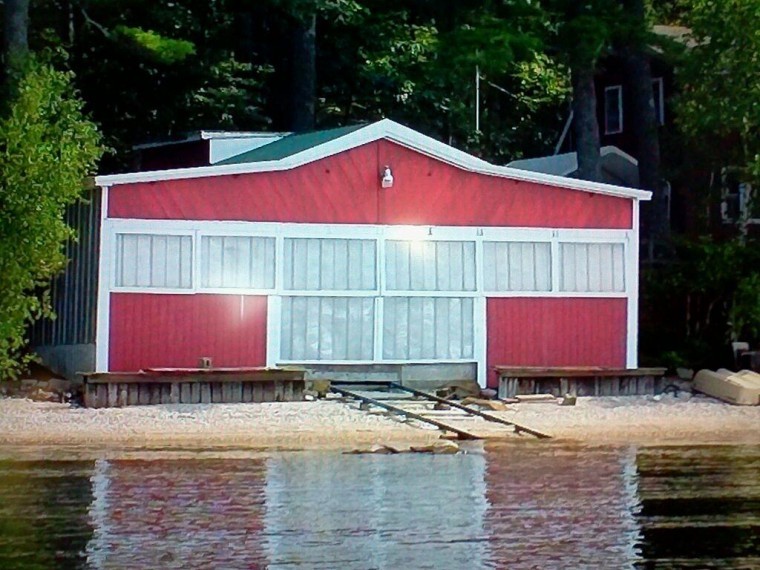 The late Wendall Fletcher built this airplane hangar on the shore of Sebago Lake decades ago. It is one of a handful of hangars around Sebago Lake. (Courtesy photo)
Comments are no longer available on this story