
SCARBOROUGH -For the first time in many years there are four pairs of piping plovers nesting on Pine Point Beach in Scarborough and several chicks have already hatched, making the newly implemented rules regarding dog access to the town’s public beaches even more timely.
Ryan Wynne, Scarborough’s new beach monitoring coordinator, has the responsibility of keeping track of the birds, which are endangered in Maine, making sure people are aware of the new rules and are following them and, in general, educating the public about how to interact with the tiny shore birds.
After a piping plover chick was killed by a dog last summer, Scarborough spent many months attempting to make changes that would better protect the birds, while still allowing some of the traditional off-leash beach access that dogs and their owners cherish.
In addition, the town has also instituted other measures, such as removing trash cans, which helps with predator control, and also stopping beach raking activities, which leaves the birds’ preferred habitat more protected, while also providing a good source of food, according to Wynne.
Along with the pairs nesting on Pine Point Beach, Wynne said there are three more piping plover pairs nesting on the adjacent Old Orchard Beach and one pair nesting on Higgins Beach. He was also hired by the Prouts Neck Country Club to keep an eye on Western Beach, which has not attracted any plovers so far this season, Wynne said.
He was aware of the issues Scarborough was facing, including a fine from the U.S. Fish & Wildlife Service for the plover death last year, but Wynne said that did not deter him from seeking the beach monitoring position, which is part time through September.
In all, Wynne called the compromise the town has reached “completely reasonable” and said the new rules that allow continued beach access for dogs also offer the piping plover “a good amount of protection.”
With his other duties, Wynne cannot be on the beaches as much as he would like so he is now relying on about 30 trained volunteers who spend some part of every day monitoring the birds and keeping track of the chicks that have already hatched.
The volunteers are also being used to educate the public, not only about the new beach access rules, but also about the importance of giving the piping plovers the space they need to ensure successful nesting and the successful fledging of any chicks.
For the most part, Wynne said, nearly everyone has been good about following the rules and not giving the monitors a hard time. He said there have been several incidents, which have solicited summonses issued by the police department, but said he’s not run into anyone who has deliberately flouted the rules.
“Most people are not knowingly going against the ordinance,” he said. “They just need to be educated.”
That certainly seemed to be the case for a couple of surfers who were on the beach during Friday’s driving rainstorm.
Wynne noticed that they’d stacked their boards right in front of one of the enclosures built to protect the nest of a piping plover pair on Pine Point. He asked the surfers to move just a few feet down from the nesting area and they happily complied.
Wynne acknowledged that with his salary and the money the town has spent on new signage and creating educational brochures, Scarborough has probably spent more than the $12,000 fine the federal government was initially intent on imposing.
But, he said, “It’s incumbent on the town to take measures to protect this endangered species. Everybody has to compromise to ensure that we can all use and enjoy the beach from the birds, to dogs to people.”
Wynne moved to Maine three years ago and lives in Portland with his wife. He received a bachelor’s degree in wildlife science and a master’s in natural resource management from the State University of New York’s College of Environmental Science and Forestry, located in Syracuse.
Prior to becoming the beach monitoring coordinator in Scarborough, Wynne was working on a climate change and forestry research grant at the Manomet Center for Conservation Sciences in Brunswick. He has also worked as the science educator at the Children’s Museum & Theatre of Maine.
He said that ideally the other communities on Saco Bay would also “get on board with piping plover protection” and that “a more regional approach is certainly needed.”
But he also said that Maine’s Department of Inland Fisheries and Wildlife and Maine Audubon are “very pleased” to have Wynne on task in Scarborough. “Just having a presence on the beaches is important,” he added.
He’s enjoyed the work so far and said it’s a great mix of working to protect wildlife and their habitat while also engaging in outreach to the community. Wynne has an office at Town Hall and said anyone with questions or comments is welcome to contact him.
Wynne said he and Town Manager Tom Hall have met with officials from the U.S. Fish & Wildlife Service recently and while there are some things the service is not happy about, overall it’s unlikely Scarborough would be required to pay the full fine for the plover chick death at this point.
Now that a new crop of chicks has hatched and are on the beaches in Scarborough, Wynne said, the time of most danger is when dogs are allowed off leash, particularly on Pine Point, as the section of Higgins Beach where the piping plovers are nesting is totally off limits to both dogs and people.
He said piping plovers generally lay four eggs with an incubation period of about 28 days. Following birth, the chicks are not able to fly for another 26 to 30 days.
And, Wynne said, because they can’t fly, the defense mechanism employed by the chicks is to freeze, which doesn’t work so well with a charging dog. Before the chicks are fully fledged is the most “critical time because they don’t run away and they can’t fly,” he added.
On Friday, as the tide encroached further and further up the beach, one of the nesting pairs and their chicks were quite active seeking food in the unraked sea wrack at Pine Point. The rain didn’t seem to bother them and they had the beach virtually to themselves – an ideal state of affairs, at least for the plovers.
A CLOSER LOOK
Anyone who would like to assist with piping plover monitoring on Scarborough’s beaches should contact Ryan Wynne, the town’s new beach monitoring coordinator at 730-4149, or use the online form at www.scarboroughmaine.org to sign up. All volunteers are asked to commit to a minimum of one hour a week.
 Ryan Wynne is Scarborough’s newly hired beach monitoring coordinator.
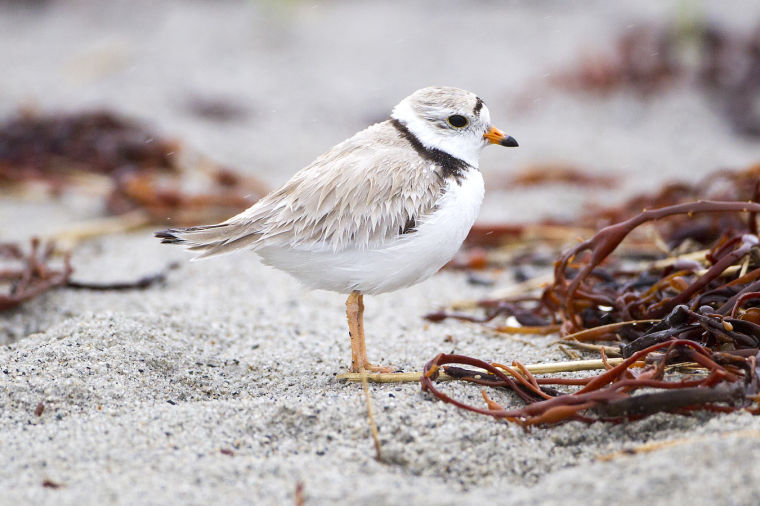 A piping plover braves Friday’s rainstorm on Pine Point Beach.
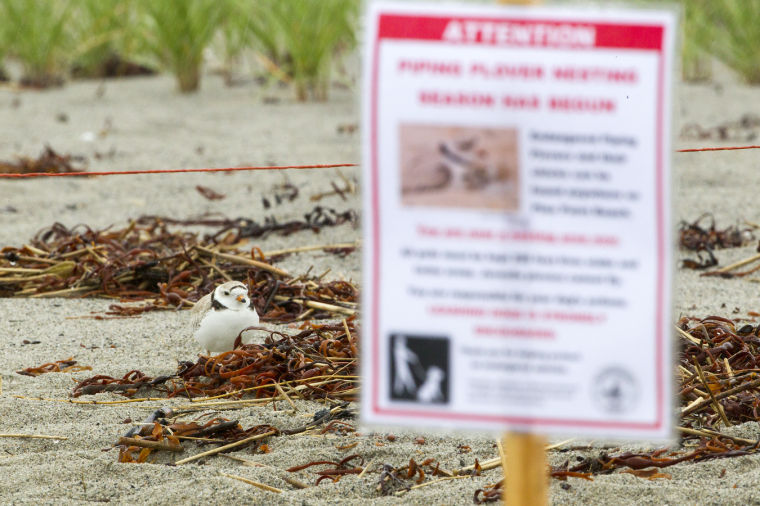 A piping plover on Pine Point Beach takes cover behind a warning sign erected by the town of Scarborough. The town has hired a new piping plover coordinator to ensure survival of the rare species.
Comments are no longer available on this story