
On warm Sunday afternoons in the 19th century, the sounds of drums, cymbals and horns could be heard emanating from the village bandstands.
The first such band in these parts was Poppenburg’s Band from New York, which was sent to join the military units stationed at Fort Preble in 1861. The general public was occasionally invited to attend outdoor concerts. After the Civil War hostilities ceased and the musicians were mustered out, other local bands were formed by civilian groups.
The first civilian band formed in Cape Elizabeth in 1872 called itself the Union Brass Band, Ferry Village. In the several years that followed, other small villages of Cape Elizabeth formed their own bands. Membership was made up of young men between the ages of 16 and 18, who eagerly practiced and diligently attended rehearsals.
Evidently their dedication paid off as they were soon appearing publicly, playing on the lawn of a house on High Street in Ferry Village, where they were so well received a bandstand was built to provide musical entertainment twice a week and for special events.
One such event took Merriman’s Band by train to Bath where they boarded the new ferry Cornelia H. for inclusion in her inaugural journey south to Portland. Alas, the waters of the Kennebec River were far from smooth causing all but two musicians to be temporarily incapacitated. However, by the time the Cornelia H. reached the harbor all had recovered sufficiently to join in the celebration.
Fees earned from playing at private parties or informal dances went toward the cost of uniforms. The first ones were purchased from Portland Light Infantry. Elaborate and uncomfortable, they were certainly eye-catching: Light blue trousers with a wide red stripe down the outside seams; dark blue jacket trimmed with dark blue cord and gold braid on the front; gold braid epaulets on each shoulder; a wide white leather belt cinched the waistline. This ensemble was topped by a tall fur hat with white plume for the musicians, a red plume for the band leader.
The Presidential campaign of 1894 meant hours spent playing and miles spent marching as all the local citizenry joined in with parades, flag-waving and other events to promote the candidates. Portland held torch-light evening parades with as many as eight marching bands participating.
Ferry Village sent men into the surrounding woods to fell the tallest and straightest pine tree for use as a flag pole. Stripped of its side branches, this tree was erected in a central location in the village. The band was hired to entertain the crowds before the flag was unfurled and raised to the tree top while the Union Brass Band played the National Anthem.
The Town House Band of Cape Elizabeth was formed in 1894 by a group of boys impressed by the musicians playing on the Cornelia H. The Town House Band provided weekly summer concerts at a bandstand erected for them at Bowery Beach (now Crescent Beach.)
The Ligonia Cornet Band at Cash Corner played weekly concerts and also participated in weekly dramas accompanied by a 50-voice male chorus specializing in old English and Welsh tunes.
The Knightville Band earned enough in performance fees to purchase lumber and build their own band room, a building situated on land above the Cape end of the bridge to Portland. The building included a large open porch providing the location for numerous concerts.
From 1895 to 1903 there were no bands at all in the recently divided town of Cape Elizabeth until the Coastal Artillery Company Band arrived at Fort Williams that year. After completing its tour of duty in Germany, the 5th Infantry together with its band arrived in 1922. The band was assigned their own barracks at the fort, on a slight hill to the rear of the base Chapel. For many years, the general public arrived in large numbers to attend outdoor concerts at the military post.
It was about this time that Ralph T. Gould, a civilian, stepped up to offer his services with those of other volunteers to organize the Cape Elizabeth Fire Department Band. It began with just 10 men attending their first rehearsal at Cape Shore Community Center, eight of whom had never played any instrument but were eager to learn. More men and boys arrived for each rehearsal until the band numbered 22, all but two were volunteer firefighters.
Public dances were held at the Town Hall to raise funds to help purchase music and one or two instruments. One room at the Town Hall was set aside for band practice.
According to documents, “The Cape Elizabeth Fire Department Band was organized to formulate a desire and appreciation of music among its members and to do what it could to assist the town of Cape Elizabeth in community affairs. The Cape Elizabeth Fire Department Band has done much to show its members and the townspeople the value of a local band in promoting fraternity in the town.”
Several concerts featuring the Fire Department Band were held in the Pond Cove and Mountain View Park areas using portable band platforms. They also entertained at town meetings, Girl Scouts, the grange, Women’s Auxiliary, high school dedication, basketball games, Memorial Day exercises, South Portland Firemen’s Field Day and the Maine Fire Chief’s Convention. In October 1933 the band members donned flannel shirts and straw hats as they rode in a horse drawn hay rack to be part of the National Recovery Act parade on Congress Street, Portland.
Text 918 words
CE Fire Dept. Band photo dated February 7, 1934
Photo of CE Fire Dept. band riding in the Hay rack , dated October 1933
Both photos courtesy of the CE Historical Preservation Society archives.
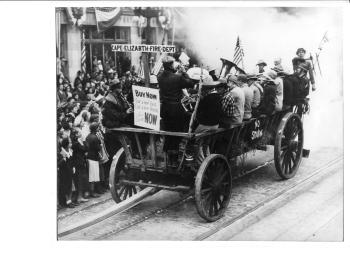 The Cape Elizabeth Fire Deptartment band rides in a hay rack in photo dated October 1933.
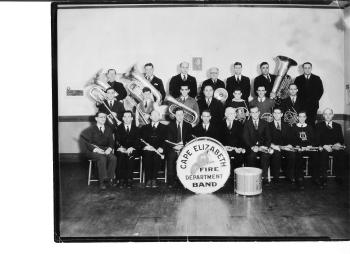 The Cape Elizabeth Fire Department Band appears in a photo dated Feb. 7, 1934.
Comments are no longer available on this story