
A Gorham veteran of World War II will receive his Army medals next week – 64 years after the war ended.
U.S. Sen. Susan Collins will present John Dumbrocyo, 85, with six medals at 9:30 a.m. on Wednesday, May 27, at the Gorham Municipal Center, 75 South St. Dumbrocyo served with the Army in Europe from 1943 to 1948.
The presentation comes just two days after Memorial Day, when the country pauses to recognize the sacrifices of U.S. soldiers.
Riding ashore in an LST, a Navy vessel, to Omaha Beach, Dumbrocyo, a member of an Army special forces unit, landed under fire a week after D-Day, June 6, 1944.
“I was scared to living hell. I was scared for a week,” recalled Dumbrocyo.
Kevin Kelley, communications director in Collins’ Washington, D.C., office said Tuesday Dumbrocyo would be presented a Good Conduct Medal, European-African-Middle Eastern Campaign Medal, World War II Victory Medal, Army of Occupation Medal & Germany Clasp, Honorable Service Lapel Button WWII, Marksman Badge & Rifle Bar.
Lester Dearborn, assistant service officer for the American Legion in Maine, said Tuesday many soldiers of that generation never received their medals. “We find it quite often,” Dearborn said.
Dumbrocyo is a longtime member of Memorial Post 197 of the American Legion in Westbrook. Dearborn met Dumbrocyo, who is partially disabled, when he sought American Legion assistance for veterans’ benefits.
From a passing remark during an interview with Dumbrocyo and his wife, Jane, Dearborn learned that a young relative of Dumbrocyo’s doing research on the Internet misinterpreted some information and believed he had spent the war in Hawaii.
“As this story unfolded, I could see this man’s heartbreak as he told of how they thought that he was basking in the sun in Hawaii as the war raged in Europe. I knew I had to do something to help clarify his service,” Dearborn said.
Dearborn reviewed Dumbrocyo’s military records. He said research showed that headquarters for Dumbrocyo’s unit was in Hawaii. But, in addition to Omaha Beach, Dearborn said, Dumbrocyo was in the Battle of the Bulge – “the whole nine yards,” Dearborn said.
On March 10, Dearborn sent a letter to a legionnaire in Gorham, Kenneth Mains, adjutant for the Smith-Wagner Post of the American Legion, to spearhead a drive to acquire the medals Dumbrocyo deserved. Mains took the letter to Collins’ Portland office.
“Mr. Mains worked with the Veterans Service Center of the American Legion to obtain these medals.” Kelley said.
Dearborn said Dumbrocyo served with a “very special” unit.
Recalling his service experiences, Dumbrocyo said he landed at Omaha Beach and waded ashore in chest-high water after leaving the LST. On the beach, he walked up “goat paths” cleared of land mines.
“It looked like Custer’s last stand,” he said, describing the scene on the beach.
As a shield, he stayed behind big trees at night. “We fired at anything that moved at night,” he said.
Dumbrocyo’s unit ate cold rations from a cardboard box. For two days, a candy bar saved for an emergency was all Dumbrocyo, who was 20, had to eat.
Sometime later, his unit, tattered and hungry, linked up in France with Gen. George Patton’s Third Army. He overheard Patton ask a captain how long it been since they had a hot meal. He said Patton ordered new uniforms, combat boots, replacements for their outdated rifles and food for them.
“He got us hot bread,” Dumbrocyo recalled.
According to Dearborn, Dumbrocyo belonged to the 114th Chemical Processing Co. In September 1944, the right side of Dumbrocyo’s body was paralyzed in France following an incident he was ordered at the time never to talk about. He still won’t. After two days in a field hospital, he was transferred to a general hospital for a month.
The right side of his face is still paralyzed.
Later that year, he rode three days in a freight car jammed with soldiers to Belgium, where the Battle of the Bulge erupted.
“It was so cold,” he said. “We had on everything we owned.”
He said guns froze and soldiers walked stiff as sticks. It was so cold tears froze on their faces.
“It was wicked,” he said putting his hands at knee level to describe the snow depth.
To make coffee, he drained water from the radiator of a jeep left running all night.
He stood guard duty and handled ammunition near the front. His feet were frostbitten. Even today, his feet swell and he has trouble walking.
“My big toes are all black,” he said.
Struck in the head by shrapnel, he was “patched up” in a field hospital on Dec. 26 and released for duty the following day.
Dearborn said Dumbrocyo enlisted in February 1943 and records show Dumbrocyo received an honorable discharge from the U.S. Army at Reims, France, on Oct. 7, 1945, and that he immediately re-enlisted for three years, discharged again in 1948.
Dumbrocyo is a native of Portland. He met his wife, Jane, in 1945 while home on furlough. They married in 1947 and have two children, five grandchildren and seven great-grandchildren.
The couple lives in their home on Ossipee Trail in Gorham. He retired at 62 from Maine Metal Finishing in South Gorham.
Dumbrocyo said he was reluctant to attend the medals ceremony, but Dearborn is glad it is happening.
“One of the benefits of my work as a service officer are the wonderful stories of humble heroes and patriots. John was no exception,” Dearborn said.
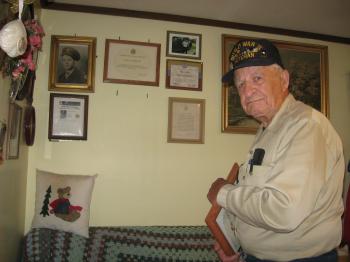 Cutline (then and now)
Comments are no longer available on this story