
SCARBOROUGH – Portland Museum of Art’s long-awaited dream of restoring Winslow Homer’s home and art studio on Prouts Neck is coming closer to a reality as the days pass.
While there is still a lot of work to be done, Tom Denenberg, chief curator at the museum, said contractors for the project have started to turn their focus on some of the more minute details of the years-long project, such as interior finishes and climate control systems.
Once restored, the studio, where the artist painted many of his most famous works from 1883 until his death in 1910, will be used to celebrate Homer’s life, encourage scholarship on his work and educate the public about the artistic heritage of both Homer and the state of Maine.
“We think the Homer studio is one of the most important sites in the history of American art,” he said. “Winslow Homer is one of the most recognizable artists, still today. He achieved a great deal of critical acclaim in his lifetime and that has continued to build after he died.”
To many art experts, Homer’s influence on Maine art, and what others thought of Maine, cannot be understated.
“Homer is a really pivotal figure in the history of art in Maine. Homer was really one of the first artists who painted Maine that had a nationwide reputation,” said Donna Cassidy, a professor of American and New England studies and art history at the University of Southern Maine.
“His work helped to shape what people thought about Maine and its hearty people,” said Cassidy, who includes a unit on Homer as part of the undergraduate American art course and the graduate course she teaches on art in American culture.
Lauren Lessing, curator of education at the Colby Museum of Art in Waterville, said although other artists have discovered the coast of Maine as a source for landscape painting, Homer was the artist who made the coast his signature subject, particularly while he lived at Prouts Neck.
The work, Lessing said, said as much about the coastal beauty as it did about American culture at the time.
“His work of this period was often described by critics of the time as rugged, manly and strenuous,” Lessing noted. “Not only were his paintings masterly renderings of rocks, waves, and sky, they were also reassuring to Americans who were anxious, in the years around the turn of the century, that American men were being emasculated by their indoor lifestyles. His use of color and brushwork, in his Prout’s Neck landscapes, is also innovative.”
When done, Denenberg said, the space will be a place for school groups to go in the fall and spring to learn about Homer, and for visiting artists and lecturers to speak about Homer and his work. It will not house any of Homer’s work; that will still be done at the museum in Portland. The studio will contain some artifacts of Homer’s, but will not be furnished like historic house museums.
Opening the studio to school groups, Cassidy said, will allow students an opportunity to get close to the area that inspire Homer throughout the last 27 years of his life.
“Homer’s art studio will help students think about his work and the places he painted,” Cassidy said. “The immediacy of being in his studio and seeing the rocky coast right in front of you will be a really important experience for students and scholars of Homer’s art.”
The museum acquired the building in January 2006 from Homer’s great grandnephew, Charles Homer Willauer, and immediately embarked on a $10.6 million capital campaign to restore the building and create an endowment to look after it once it is restored.
Currently, he said, $7.5 million has been raised. The project is expected to be completed in the fall of 2012.
Homer moved to Prouts Neck in 1883 after being familiar with that section of Scarborough from family members who lived in the area. In 1884, Homer moved his father’s carriage house 150 feet to serve as his studio. He worked with architect John Calvin Stevens to redesign the building, where he worked until he died.
Denenberg said the intent is to return the look and feel of the studio back to how it was in the early 1900s.
That, however, has not been an easy task. To get the restoration work just right, he said the museum had to be mindful of who they hired to do the work.
“Each discipline or trade that works on the project is a specialist in old houses,” Denenberg said.
In early 2007, Mills-Whitaker Architects, which has offices in Bridgton and Arlington, Mass., to design the project. Marc Truant & Associates, of Cambridge, Mass., has been hired to serve as the construction manager. The Heritage Company, based in Waterboro, has been doing copper work on the studio and will return in April to continue the copper work.
To restore the building, which was named a National Historic Landmark in 1965, the museum commissioned a Historic Structure Report, which, Denenberg said, “researched every nook and cranny” of the building. Photographs taken when Homer lived in the studio and letters written during the time period were also examined.
Restoring a historic building, Denenberg said, takes a lot more attention to scheduling, planning and craftsmanship.
“You want to make sure you have not only the right person here, but in the right order,” he said.
Before some of the finer details of the project could be completed, the building had to first become structurally sound and weather tight.
“A carriage house, when you think about it, is very lightly made,” Denenberg said. “It was never intended to be with us 150 years later.”
In doing such research, there were several things museum officials learned about Homer. Denenberg said he learned of the existence of the Checkley House Hotel, a building that stood to the west of the Homer property. This, he said, may be why much of Homer’s work done at the studio was of vistas to the east.
Denenberg said the histories of the Portland Museum of Art and Winslow Homer have been very much intertwined.
The first painting of Homer to appear at the Portland Museum of Art was “Signal of Distress” in 1893. More than 80 years later, in 1976, philanthropist Charles Shipman Payson gave the museum four oil paintings and 13 watercolors done by Homer. The museum also displays Homer’s first oil painting, “Sharpshooter,” a watercolor paint box belonging to Homer and 400 commercial illustrations given to the museum in 1991 by Peggy and Harold Osher.
“If there was one central figure at the Portland Museum of Art history,” Denenberg said, “it was Homer.”
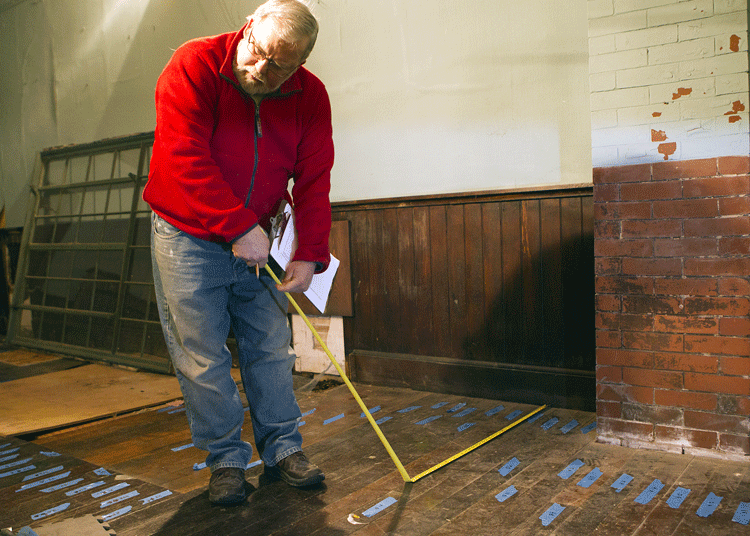 Each board in Winslow Homer’s painting room has been labeled with its own number on a piece of blue tape, to make sure the floor can be replaced in its exact location. As an added safeguard, in case a piece of tape falls off during the removal and restoration phase, craftsman Greg Payeur measures the length of each board and logs it on a sheet of paper. (Photo by Rich Obrey)
Comments are no longer available on this story