
Buxton’s Little River Flower Farm comes alive in spring.
Greeting the dawn, roosters crow and a wild drake flaps its wings in a pond at a Buxton farm, where soon, thousands of plants will bloom.
It’s a typical beginning for a spring day for Bruce and Nancy Stedman at Little River Flower Farm on Turkey Lane.
Organically grown vegetables, strawberries, herbs and flowers are produced at the 110-acre farm. The farm also provides a habitat for moose, deer, fox, coyotes, and blue heron. Turtles from the river lay their eggs on the farmland. While for most people Earth Day is April 22, “here on the farm, every day is Earth Day,” said Nancy Stedman.
Tuesday, wild honeybees seeking nectar swarmed through a weeping cherry tree in her personal garden near the farmhouse. Stedman works 11 hours each day among the plants.
“I don’t have to drive a vehicle to get to work,” she said.
Her husband handles a full-time business, Little River Landscapes, which also sells firewood.
With seedlings nurtured in greenhouses, 4 outside acres will be planted. Besides other produce, she’ll have 12,000 plants for cut flowers.
Stedman designs floral arrangements and the farm is seeking permission from the Buxton Planning Board to host weddings under a tent near one of five ponds. The farm has provided organic flowers for weddings and she sees a trend beginning for “green weddings.”
The farm is certified organic by Maine Organic Farmers and Gardeners Association. Eric Sideman, crop specialist for the association, said Wednesday the association is approved by the U.S. Department of Agriculture to certify farms as organic.
To be certified organic, farms are required to use only natural materials and to use practices that don’t pollute the soil, air or crop.
“Improve the soil on the farm, and produce a healthful crop,” Sideman said are also requirements.
Certification costs $800 a year, Stedman said,
At Little River Flower Farm, purchased products like potting soil and fertilizer are all certified organic. “We’re connected to the environment – being kind to it,” she said. “We don’t want to spray chemicals. This is an eco-system we’re taking care of.”
Weeds are picked laboriously by hand. “We don’t use any herbicides,” she said.
Instead of pesticides, the farm utilizes alternative methods to eradicate pests that feast on crops like carrots or zinnias. They recently brought in 4,500 ladybugs, which were working this week to eliminate aphids, small insects that feed on plants.
Row covers inside greenhouses help warm plants and also offer plants additional protection from insects. Free-range chickens also help rid the farm of unwanted insects like ticks and Japanese beetles.
One of two farm cats, Plum, 18 months old, also helps out, leaping into the air while roaming the farmyard to nab insects. Peeps, who is 2 years old, is the other cat that patrols the property.
A former dairy cooler comes in handy as a vat to sterilize plant containers recycled for use in three greenhouses, saving up to $600 a year. A 30-foot-by-96-foot greenhouse with 10,000 plants is heated with propane gas supplemented with a wood-burning furnace.
Garden plots outside are either “no till or light till,” she said, and the farm practices crop rotation.
Produce is marketed at Whole Foods, a national chain with a store in Portland, and Hannaford besides at the farm and through the Community Supported Agriculture program. Flowers are sold to florists and at the farm, as are vegetables.
Eggs produced by 15 hens, which aren’t fed antibiotics, are also a farm product.
“They’re in high demand,” she said about their eggs.
Stedman said some farm produce is available now, though more of it will be ready for customers June 1.
She said consumers want to buy local and they want to be healthy.
“Let the farm be your pharmacy,” eating organic produce can do a lot for your health, she said.
“People say it’s peaceful and comforting here. It’s close to nature.”
And some people even volunteer to work at the farm in the spring. “It’s very therapeutic,” she said.
To farm, the couple, who owned a printing business in Portland, left the corporate world behind. They had searched the area for a smaller, 20-acre farm. But 14 years ago, they fell in love with the farm when they found the former dairy farm with its 1815 home, ell and barn.
“When we drove in, we got goose bumps,” she said.
They sold their home in Portland to move into their restored Buxton farmhouse. Friends, Stedman said, have urged them to “come back” to Portland.
“We say, ‘No, come here,'” she said. “The outside is my office.”
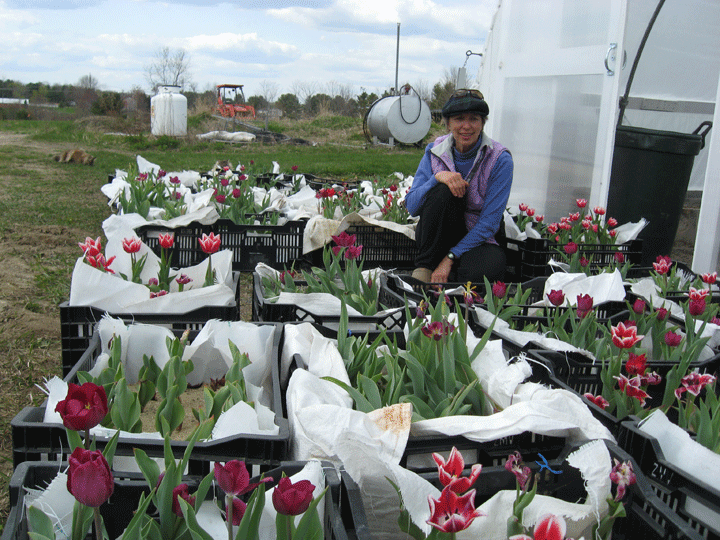 Tulips bloom this week for Nancy Stedman at Little River Flower Farm in Buxton. “People say it’s peaceful and comforting here. It’s close to nature,” she says. Organically grown vegetables, strawberries, herbs and flowers are produced at the 110-acre farm, which also serves as a habitat for moose, deer, fox, coyotes and blue heron. (Staff photo By Robert Lowell)
Comments are no longer available on this story