
FREEPORT – A Maine Department of Marine Resources statewide study to raise public awareness of the presence of invasive green crabs, which are thought to be responsible for depleting shellfish stocks in Maine, has given further credence to what Freeport clammers have known for months.
“This represents a historic day for all Maine fishermen,” said Freeport resident Chad Coffin, president of the Maine Clammers Association, during a press conference Aug. 28 at Winslow Park in South Freeport announcing the study.
The study was a coordinated effort involving 31 Maine towns from Ogunquit to Lubec to further understand the extent of the green crab invasion, which has devastated the stock of young clams. Volunteers in the individual towns set between five and 10 traps during a 24-hour period beginning Aug. 27 to collect the crabs to understand the full extent of the problem. It is an issue that has primarily plagued Casco Bay, according to Kohl Kanwit, director of public health for the Department of Marine Resources.
The results of the study will be released in the coming week.
Brian Beal, professor of marine ecology for the University of Maine, said the green crabs could be harvested, but how and to what extent was still undetermined. Officials have suggested everything from using the crabs – native to Europe and brought to America in the ballasts of ships – as lobster bait, to making the predator into a food additive. The green crab population has increased in recent years, most likely due to warmer temperatures linked to global warming, said officials.
“You can eat them,” said Beal. “But compared to Jonah or rock crabs, they aren’t as desirable.”
In 2012, the Freeport Town Council earmarked $100,000 to study the clam flats and decide on a course of action. The town is believed to be the only Maine municipality to be spearheading such an effort. The separate Freeport study began in mid-May and will end in November.
While the threat to clams is now being taken seriously, the effect on lobsters – a nearly $400 million industry in the state – could only be a matter of time.
“Lobster is also on the green crab menu, we’re finding that out,” said Coffin.
According to Beal, the state experienced a similar problem in the late 1950s, when water temperatures rose. After three consecutive cold winters, the level of green crabs returned to normal, said Jimmy Morrill, who has been a clammer for 52 years.
“I remember when it happened before, but I’ve never seen anything like this,” said Morrill, of Yarmouth. “The other day the crabs were literally crawling up my legs.”
Coffin said the problem has been known to the roughly 60 or so Freeport clammers for two years, but having the Department of Marine Resources involved further validated the looming crisis that could potentially wipe out the state’s $15 million clam industry and result in numerous lost jobs.
“If you like clams, you may be in trouble,” said Coffin. “We might be two years away from having no commercial viability in the state for hard-shell clams. The crabs have decimated hundreds of square miles of the sub-tidal area.”
Marine Resources Commissioner Pat Keliher said finding a way to make harvesting the green crab commercially viable would be a big step in the eradication. Until then, Keliher said, the best thing he could hope for was an accurate prediction from the Farmers’ Almanac, which has forecasted a bitterly cold winter this year.
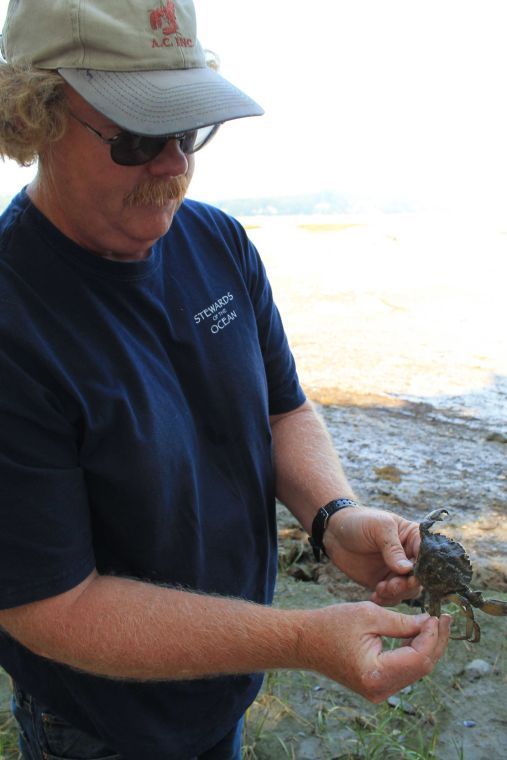 Brian Beal, University of Maine professor of marine ecology, holds a green crab on the clam flats of Winslow Park in South Freeport. Beal spoke at a news conference Aug. 28 to highlight a Department of Marine Resource’s initiative to study the crab, which has been blamed for depleting the clam stocks in Casco Bay.
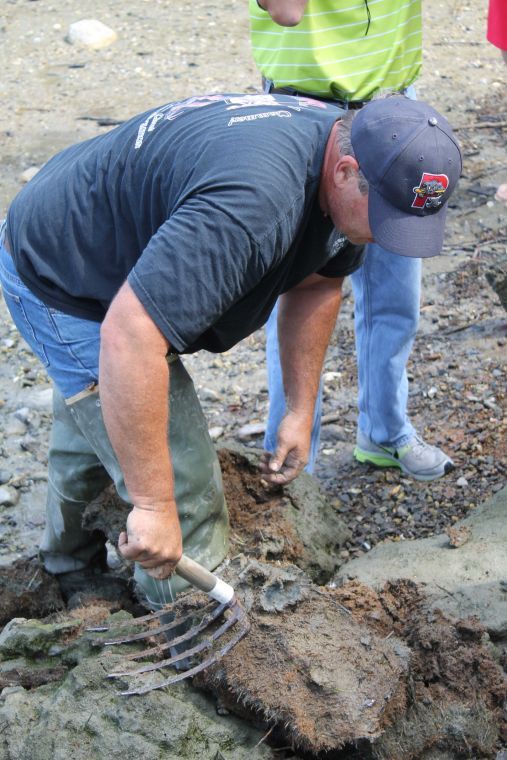 Freeport clammer Walt Coffin rakes through the clam flats at South Freeport’s Winslow Park Aug. 28 to demonstrate the presence of invasive green crabs. The crabs are blamed for the rapid decline of young clams, which has both scientists and clammers concerned.
Comments are no longer available on this story