
Albie, 15, sits alone slumped in a chair, a deserted look in her eyes. Her mother enters, hands on hips, stares at Albie disgustedly and chastises her for returning home at such a late hour.
Next, Albie’s little sister bemoans the loss of her mentor and her friend. “We never play anymore, I used to look up to you, but now all you do sleep,” she says.
Albie’s boyfriend is frustrated because she’s not responsive, her coach has kicked her off the team and her teacher said her grades are dropping. Albie is a teenage alcoholic, and drinking is ruining her life.
Fortunately, for South Portland High School student Albie Gingrich, this scene is only pretend. It is part of a series of skits performed by a student improv theater group called STOP, or “Students Teaching Other People.”
STOP performed last week at a substance abuse awareness meeting at South Portland High School. The South Portland Community Advocates for Social Change sponsored the meeting in conjunction with the Department of Health and Human Services to raise awareness of the harmful effects of alcohol abuse in teens.
Though most of the STOP kids admit it was the acting that drew them to the group, through their participation, they’ve realized the dangers of alcohol. The kids practice what they preach. Gingrich, who plays the role of the drunk in the skit, said she’s never tried alcohol. “I think it’s gross,” she said, “it does not make you cool.”
The STOP kids said their peers drink because they’re seeking acceptance and trying to be cool. However, one study of Maine students shows that most teens aren’t drinking regularly. It was reported that 60 percent of 10th graders and 51 percent of 12th graders hadn’t drank in the 30 days prior to the survey.
The STOP kids’ insight about the dangers of drinking is apparent in their off-the-cuff answers to questions that follow each skit. In character, students field questions like, “Albie, why do you drink? Mom, do you know that Albie is drinking? Coach, why did you kick her off the team, don’t you think that’s giving up? Teacher, how do you approach substance abuse in the curriculum?”
The students’ responses reveal that substance abuse education is inadequate, and parents and loved ones oftentimes don’t have the tools or understanding to handle alcohol abuse effectively.
The teacher in the STOP skit says in frustration that there just isn’t enough time in the curriculum for substance abuse education; the mom says her daughter’s dependence is awkward and disappointing; the boyfriend said nothing that he says will help her and none of them want to get her into trouble.
“She’s already in trouble,” one audience member accurately pointed out.
For Kim Johnson, director of the Maine office of substance abuse, alcohol abuse is an epidemic and only worsening. With a teenage daughter, she understands the temptation to provide kids with a safe place to drink, however, she objects to the rationale. “There is no safe place,” she said.
More kids under 21 die from alcohol-related accidents than any other cause. Johnson encouraged parents to debunk the glorification of alcohol by sharing horror stories about alcohol with their kids. “We all have them,” she said, and “despite what our kids might tell us, we have a lot of influence.”
Though the STOP kids seem immune to the allure of alcohol, they know many of their peers are not. Laura Patriquin, a sophomore at South Portland High School, said her cousin, also 15, drinks frequently. “He thinks it’s the only way to be cool,” she said. “Sometimes I’m scared he’s going to go too far.”
Many kids will go too far. The National Institute on Alcohol Abuse, the leading federal agency on alcohol abuse research, states that about 5,000 kids die each year from alcohol-related causes. Only about one third of those deaths are from automobile accidents. It is the other two-thirds, the suicides, homicides, falls and overdoses, that people don’t commonly associate with alcohol.
The STOP kids hope they can reach kids before they start experimenting with alcohol. The troupe travels around to local middle and elementary schools spreading their message.
Most recently, they performed for Scarborough and Cumberland schools. Freshman Kaylee Newcomb said as a kid she has a better chance to convince other kids not to drink. “We’re older, but we’re still kids, they really believe us and look up to us,” she said.
The STOP kids create and perform their own skits for mostly younger audiences, and address issues relevant to adolescence including bullying, peer pressure and alcoholism. Though they realize their work isn’t going to change all their peers’ behaviors, the performers are satisfied knowing they’ve helped deter younger kids from a potentially dangerous path.
“I know I don’t want to see my sister end up like some of the kids I know,” said Patriquin, “It’s kind of cool to know you can make a difference.”
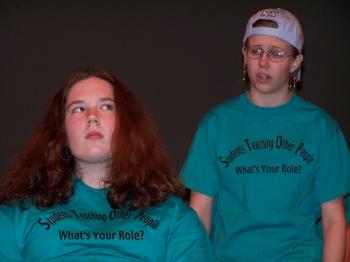 Albie Gingrich, left, and Laura Patriquin, STOP troupe members, perform a skit exposing the dangers of teenage drinking at Thursday nights “town hall meeting” sponsored by the South Portland Community Advocates for Social Change. The meeting was part of a national Department of Health and Human Services effort to address teenage drinking.
Comments are no longer available on this story