
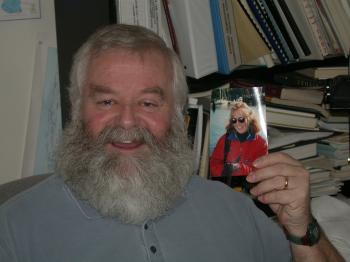
Joe Payne has a unique title. In 1991, he became one of the first “waterkeepers” in the world – a title bestowed on those who use every available resource to protect and preserve a body of water.
Payne, 58, who has been a steward of Casco Bay since 1991, was the seventh person in the world to become a waterkeeper. He and the other six waterkeepers formed the Waterkeeper Alliance, one of the fastest growing international environmental organizations.
Payne was the first employee hired by Friends of Casco Bay. The non-profit company now has seven full-time staff members and an army of volunteers that help collect water samples around the bay.
In recognition of Payne’s dedication and hard work, the Friends of Casco Bay are having a 15-year anniversary celebration on Sunday, Sept. 10, from 4 p.m. to 7 p.m. The event will take place at the Southern Maine Community College parade grounds on Fort Road overlooking Willard Beach.
Cathy Ramsdell, executive director of Friends of Casco Bay, said Payne has been a blessing to work with. “Ideologically, we are in sync,” she said, “and that saves us time.”
“We have an outstanding staff here,” said Ramsdell. “Working together is how we get things done,” she said.
The Friends of Casco Bay started in 1989 with the help of Don Perkins, the founding president. Payne, a Westbrook resident and a Portland native, said he accepted a position with the group two years later when it had only $18,000 in the bank.
The Friends of Casco Bay is a non-profit organization based on the Southern Maine Community College campus at 43 Slocum Drive. The group was formed in response to a report in 1989 called “Troubled Waters,” put out by the Conservative Law Foundation Island Institute that claimed Casco Bay was one of the most polluted estuaries in the nation, said Ramsdell. The group is dedicated to the cleanup and the protection of Casco Bay.
The organization raises money from individual and corporate support as well as from grant money through governmental organizations. Ramsdell said the current budget for Friends of Casco Bay is a little less than $700,000.
Under the guidance of Payne, the group has reopened hundreds of acres of clam flats, aided in the oil recovery from the Julie N oil spill in 1996 and recently had the bay declared a no dumping zone, stopping hundreds of ships from discharging sewage and waste when visiting the area.
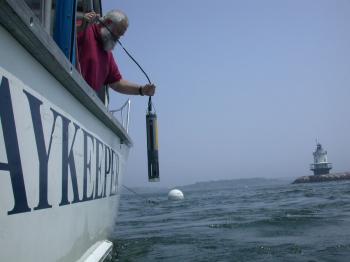
Joe Payne said his official title is Casco Baykeeper, a registered trademark, whose mission is to improve and protect the environmental health of the bay.
He said when the Friends of Casco Bay first started there was not a lot known about the bay. The first mission was to find out what exactly was the health of the bay, he said. In 1993, the group started training volunteers to take water samples, a program the Department of Marine Resources did not originally approve of because officials at the department did not believe volunteers were properly, said Ramsdell. Now the department is implementing similar models around the state.
Payne said the group has trained about 500 volunteers to take water samples in a method approved by the state. He said 60 to 80 volunteers are doing water-quality tests at one time, a number that has decreased over the years because the testing system has become more efficient.
Payne said his first goal was to open clam flats. He said when he first started with the group, 41 percent of the flats were closed, that number has dropped to 16 percent.
In 1995, Friends of Casco Bay bought a pump-out boat, to remove sewage and wastewater from boats. The boat has a 300-gallon tank and last year pumped out 11,071 boats, more than all other marinas in Maine combined, according to the Maine Department of Environmental Protection, said Payne.
Payne said the group’s efforts were rewarded in 2004 when state legislation designated the bay as a no-dumping zone, banning large boats from dumping treated sewage water and other water waste while in the bay. On July 21, the Environmental Protection Agency approved Casco Bay as a federal no-dumping zone.
Payne explained that some of the biggest cruise ships coming into the bay have about 4,500 people on board. That is like a small town dumping its sewage into the bay, he said.
The Waterkeeper Alliance now has 135 waterkeepers worldwide, said Payne. He said a waterkeeper is the same, even if they are on Casco Bay or on the Thames River, a waterkeeper uses the resources available to protect and preserve a certain body of water.
Payne said in 1999 the Waterkeeper Alliance trademarked the name waterkeeper, because businesses and other organizations were starting to use the name that was becoming synonymous with a strict water conservation group.
Raising awareness of the bay is one of our biggest goals, said Payne. “The fact that people still support us is a testament to our success,” he said.
 Fifteen years for Casco Bay Baykeeper
 Fifteen years for Casco Bay Baykeeper
Comments are no longer available on this story