
While Scarborough residents voice opinions about whether a racino at Scarborough will boost crime or the economy, farmers say what’s most important is the positive impact a racino would have on the local agricultural industry.
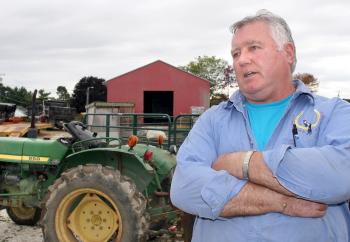
“I think a lot of people don’t see how it could affect the farms,” said Ernest Lowell, a 62-year-old blacksmith in the Scarborough area. “Maine used to be an agricultural state. Somewhere along the way we’ve lost our identity.”
Lowell, who grew up on a 220-acre farm in Gorham and owns a 3-acre farm in Saco, said he fears voting against allowing Scarborough Downs to have slot machines will hurt not only the Downs, but also farms in Cumberland and York counties that benefit from the track’s business.
According to the Maine Milk Commission, since 2000, Maine has lost 150 dairy farms, dropping from 501 to 350.
Lowell said that’s a difficult reality, but one the state is “unfortunately” facing.
“It’s sad that the rest of our agriculture is depending on slot machines at our race tracks,” he said. “It never should have been this way.”
Scarborough Downs supports agriculture by purchasing hay and feed from local farms to feed horses, using local blacksmiths and paying local farmers to house horses for racing, Flaherty said.
In the past two weeks, Scarborough residents have sounded off about allowing Scarborough Downs to install slot machines.
The issue was revived when developer Gene Beaudoin announced a plan to develop the 535-acre Downs property into a downtown-Main Street area, complete with a racino.
A law passed by statewide referendum in 2003 allows slot machines at existing harness racing tracks with local approval, but Scarborough has previously rejected proposals to build a racino associated with the Downs.
The racino question is on the ballot for the Nov. 4 election because the necessary 2,200 validated signatures seeking a referendum were collected.
In 2002, Scarborough voters overwhelmingly rejected slot machines at the Downs, but Jack Flaherty, owner of the 223-acre Flaherty Family Farm in Scarborough, said that might not be the right decision this time around.
Flaherty Family Farm produces and sells vegetables and cheese and has a large greenhouse. While a majority of profits comes from that production, Flaherty said, he does earn a significant amount of income from the Downs, as horse owners buy hay from him.
“I don’t think a yes vote will hurt at all,” Flaherty said. “It helps us out and keeping the local farms afloat also helps out the local economy.”
Still, opponents of a racino argue that allowing the track to have slot machines will negatively impact Scarborough and that the race track doesn’t have a good history of supporting local businesses or farms.
“The town has already rejected slots again and again and again,” said Fred Kilfoil, who has lived in Scarborough for nearly 40 years befor recently moving to Portland. “After the November elections in 2004, the very next day, (Scarborough Downs) had their representatives scouring all over in Gorham, Saco, Westbrook, Old Orchard Beach. Any place they thought would host a racino. Only overnight is their commitment to Scarborough.”
Jim Flaherty, who co-owns Flaherty Family Farm with his brother, Jack, said he doesn’t think slot machines would be a bad idea, but he still doesn’t know of the potential impact a yes vote would have.
“My concerns are what it will do for agriculture and I have mixed views,” he said. “If we pass this, there need to be promises made that this will eventually help out our local farms.”
Sarah Hillard, who owns the largest Standardbred farm in Scarborough, is convinced a racino at the track does support small businesses, such as hers, because money pumped into slot machines will increase the purse winnings that will ultimately trickle down into the local economy.
“I’ve seen from the racino in Bangor the increases in our purses,” she said. “We are profiting more and in turn we are able to afford things, especially with the price of everything going up now. If we can’t make enough money to support our horses, we’re going to go out of business.
“Everybody is preaching about how great small business is in Scarborough,” she said. “Well, you’re not looking at the small businesses that you are affecting.”
 Local farmers see racino as salvation
Comments are no longer available on this story