
Riding a police motorcycle safely is so critical to instructor Joseph Dell’Aquila of the South Portland Police that he once refused to certify his own lieutenant, who had botched a road skills test.
As one of only two certified police motorcycle instructors in Maine, the police sergeant just led the state’s annual training and testing of municipal officers seeking such certification themselves.
A total of six officers came from Lewiston, Scarborough, Wells, Portland and Bath last week to participate in an intensive skill-building course in South Portland.
The course, which runs for a minimum of 56 hours, ended Friday with a skills test in a vacant parking lot at the Maine Mall, where obstacle courses were set up.
The daylong classes were a crash course in handling police motorcycles, but teaching drivers to avoid accidents is the goal of training and certification.
Dell’Aquila, an instructor for eight years, said it is not unusual for a couple of drivers to flunk the test.
“I can pretty much tell at the start of training who will make it and who will not pass,” he said. “If I were to certify someone who was not qualified, I would be signing their death certificate.”
Dell’Aquila recalled that he failed his lieutenant at the South Portland Police Department when the police supervisor was unable to pass all seven driving skills tests for certification.
“Some people are naturals at this. But you learn that everyone is different,” said Dell’Aquila, dressed in jeans and a T-shirt for a day of outdoor training.
Officers must first hold valid licenses to drive motorcycles in Maine to participate in the training.
But being a veteran motorcycle driver does not guarantee an officer will pass the skills exam, Dell’Aquila said.
Sometimes having previous experience works against an officer seeking certification to drive a police motorcycle. “They may have picked up a lot of bad habits that are then hard to break.”
Last Thursday, the clouds finally cleared and the students enjoyed a few hours of outdoor class without the steady downpour of rain.
On obstacle courses created with orange cones and yellow police tape, drivers showed their agility in weaving, turning tight circles and braking to a sudden stop.
The courses were set up to simulate some of the more difficult driving challenges that motorcycle police officers face on a daily basis.
The smell of burning rubber filled the air, as the officers – one by one – accelerated their motorcycles across the parking lot and then came to a quick stop before crossing yellow police tape.
The riders’ speed was clocked as they sped up and then came to a dead stop. Dell’Aquila judged the men on how well they applied the front and rear brakes without locking up and whether they touched or crossed the tape.
“To me, he just slammed into a bus,” said Dell’Aquila, referring to an officer-student who failed to stop completely before hitting the yellow tape.
“Don’t jab it,” he ordered, suggesting that the driver “press more at the front,” referring to the brakes.
Scarborough Police Officer Brian Nappi was among the students training last Thursday for certification.
“It’s been challenging. This is a big bike,” Nappi said. “We start small each day and eventually work to bigger challenges. I’m learning to do maneuvers with the motorcycle that I didn’t think I could do.”
Dell’Aquila is teaching solo this summer. He usually team-teaches with a police sergeant from Augusta, but tough budget times led the Augusta Police Department to cut its motorcycle training program.
The Augusta officer did show up for a couple days, however, just to volunteer his services, Dell’Aquila said.
Dell’Aquila said the goal of the workshop is twofold.
First, the drivers are able to develop and hone skills that will keep them safe while weaving in and out of traffic, rushing to the scene of an accident or even leading a motorcade.
Second, passing the workshop demonstrates that they have the skills and know-how to safely patrol their cities and towns while driving a large motorcycle.
Police motorcycles are typically Harley-Davidsons that are specially designed for police duty. Harley-Davidson and Northwestern University sponsor the training and certification, held by police departments across the nation.
Dell’Aquila said it is crucial for officers to have enough expertise on a motorcycle that they are able to watch traffic and intersections instead of keeping their eyes trained on the road as they drive.
The South Portland Police Department owns two Harley-Davidsons and has nine officers certified to drive them. The department recently ended its lease on two additional motorcycles because of budget cutbacks.
Not surprisingly, Dell’Aquila is a big advocate of motorcycle patrols.
He said patrol officers on motorcycles are much more aware of what’s going on around them than those riding in cars.
He said people often have conversations with motorcycle officers when they stop at a traffic light. The only downside is not being able to transport people who are arrested.
Dell’Aquila said he has never been in an accident while driving a police motorcycle, though a vehicle once struck his parked bike when he was not on it.
He believes that lack of experience and speed are the biggest contributors to civilian accidents involving motorcycles. “That combination is dangerous, especially when taking corners,” he said.
As the officer-students went through their drills Thursday, Dell’Aquila said it looked like the intensive training was paying off. Dell’Aquila predicted that all six officers would pass the skills test Friday.
“These guys have been working outside for 10 hours a day in the pouring rain,” he said. “They’re committed. They never want to go home until they get everything right.”
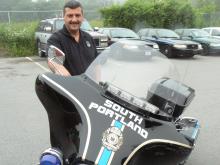 South Portland Police Sgt. Joseph Dell’Aquila is one of two trainers in Maine who certify municipal officers to ride police motorcycles.
Comments are no longer available on this story