
E-readers, tablets seen as newest way to deliver content to
students and save money
WESTBROOK – Could today’s libraries be tomorrow’s museums?
In the 22nd century, will anyone have a need for bound tomes of writing? Or will the books lie dormant on shelves and stacks, untouched by people who have easier means of acquiring the same information located within their pages?
After all, schools throughout the region are already utilizing laptops, netbooks and e-readers to break down the boundaries of education, further students’ breadth and depth of knowledge and maybe even put a little more fun into the process of learning key essentials of a 21st-century education.
“I’m a book librarian. That’s where my heart is. But I have to adjust to the times,” said Trish Brasslow, the librarian at Westbrook Middle School. Even Brasslow, a lover of books, has made budget requests for e-readers.
That is because she recognizes that today’s youth largely consume their media through electronics. That includes everything they read, whether it is something off a website or even corrections their teachers make to their homework.
Brasslow knows kids are reading less these days, and if an e-reader is more attractive than a book, she is willing to give it a shot.
“It just bothers me that we’re missing children,” she said. “I want to get kids who aren’t reading.”
According to Jeff Mao, learning technology director at the Maine Department of Education, “the idea of digital media replacing traditional textbooks is definitely part of the future. There’s definitely movement in that direction.”
Tyler Dunphy, Westbrook schools technology director, said e-readers and iPads are already becoming a standard part of the classroom experience here. They are being integrated slowly as a follow up to the implementation of laptops assigned to each student from Grade 6 onward.
“It’s standard now to have a digital version” of a text, Dunphy said. “The next step is digital only.”
Digital copies of texts are not only convenient, but also are more relevant in today’s world of constant evolution. In the past, districts would buy a set of textbooks that would often be used for years, even after the information in them became outdated. Now, Dunphy said, suppliers can update their virtual textbooks regularly.
Westbrook is still working out an approach to this issue. Devices like Apple’s iPad may be more useful than hardware like Amazon’s Kindle or Barnes and Noble’s Nook, both of which have a very specific purpose of being a surrogate book.
An iPad has the functionality of e-readers, but also has nearly limitless uses thanks to its wide array of programs, called “apps.” Showing how ubiquitous Apple devices already are, Dunphy pulled out his iPhone and showed some apps featuring flash cards and reading and speech exercises.
“It’s a technology that teachers are excited about, so they are really looking for ways to use it to assist students,” he said, noting the devices allow for individualized lessons that are particularly useful in the special education department.
In Gorham, the school district has experimented with iPads, but not e-readers. Dennis Crowe, the district’s technology director, said it is something worth having a conversation about.
“We’re going to continue to look at those to see how they fit in education,” he said.
Efforts in Westbrook, Gorham and around the region are a glimpse of education’s future, which state educators believe will be free of textbooks and where laptops and e-readers render traditional textbooks obsolete. And that future, which just a few years ago seemed like science fiction, is coming quicker than expected with advances in technology.
Maine’s efforts in modernizing the classroom were recently heralded by U.S. Secretary of Education Arne Duncan, who singled out Maine’s technology initiatives at a recent national conference held in Washington, D.C. in early November.
While announcing the release of a national education technology plan entitled “Transforming American Education: Learning Powered by Technology,” Duncan called for “applying the advanced technologies used in our daily personal and professional lives to our entire education system to improve student learning, accelerate and scale up the adoption of effective practices, and use data and information for continuous improvement.”
Mao is vice chairman of the State Educational Technology Directors Association board of directors, which hosted the November conference. He envisions a future where technology plays an even bigger role in the school day. Mao said there are times when books are better, but with the outpouring of new e-readers which realistically mimic the pages of a book and more powerful handheld devices like netbooks, he acknowledged a “shift” toward more fully utilizing digital devices that students already have access to through former Gov. Angus King’s laptop initiative begun in 2001. So far, laptop computers have been distributed to all seventh- and eighth-graders and half of Maine’s high-schoolers.
Mao sees the digital textbooks as a logical next step, one that’s made more feasible by the introduction of new devices such as the iPad and Kindle.
“A few years ago, maybe it wouldn’t have worked so easily, but there is new technology that makes you go, ‘wow, this can really work,’” Mao said.
Mao uses the example of the Battle of Gettysburg to illustrate the difference between traditional and digital textbooks. A paper textbook, he says, is limited in its presentation. There may be a few pictures, charts and perspectives on the battle. But a digital device could offer that plus embedded links offering curious students an endless supply of Internet sites addressing facets of the battle.
“Here in Maine, we would want to have a special focus on Joshua Chamberlain’s role in the battle,” Mao said. “A textbook might give you a paragraph if you’re lucky, but online content would offer much more, perhaps a map of where Chamberlain was positioned with elevation, where the guns were, where the soldiers were arrayed, perhaps re-creations of the battle in audio, video, interactive live data, blogs. The content could be endless.”
And all that content could be free, Mao says, which in a cash-strapped budgeting environment could ease the transition for traditionalists. Textbooks, Mao explained, can cost $100 or more, but online educational content is available sometimes for free.
“Yes, you can tap into free content and Maine is the most well-positioned of all the states because of MLTI (Maine’s Learning Technology Initiative) since our students already have the devices. It’s a just a matter of tapping into it,” Mao said.
In addition to the cost savings, Mao also touted the benefits of a single laptop or e-reader that could replace a cumbersome and downright heavy pile of books. One thin laptop or e-reader could replace pounds of paper, which would not only be advantageous for the environment but also for students’ backs.
“The benefits of digital media can’t be overstated,” Mao said. “Right now, we’re buying textbooks, right, but what we are really buying is, yes, the intellectual property and the paper and the binding materials used to make that textbook.”
The state is pursuing digital textbooks not because it wants the latest gadgets like those on your Christmas gift list, but because it wants Maine students to succeed, Mao said.
And if that means the definition of library may change in 100 years, then so be it.
“The role of librarians has already evolved,” said Dunphy, the Westbrook technology director. “(The library) is a media hub and really a literacy hub. And literacy is not only about reading a paper book.”
Reporter John Balentine contributed to this report.
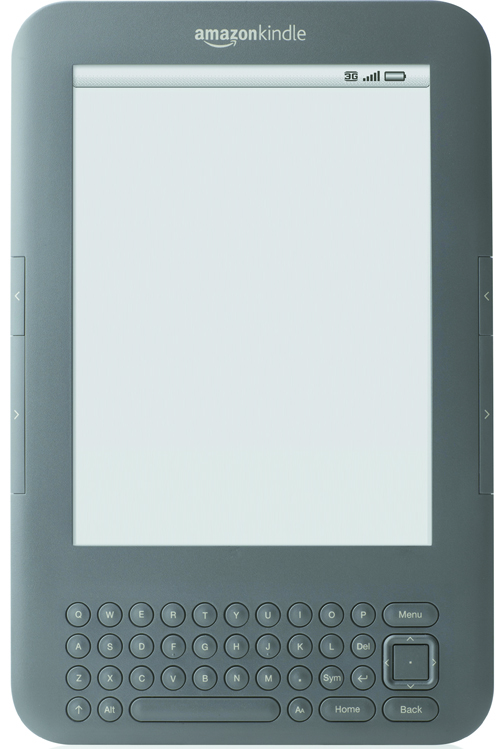 Kindle
Comments are no longer available on this story