
CUMBERLAND COUNTY – Miracles are often described as amazing and larger than life, cases of divine intervention that suspend the laws of nature and make the impossible possible.
But miracles happen every day, right in our own backyards. A one-eyed owl shows a remarkable will to live of the coast of Maine, a Raymond man’s car is crushed by an 18-wheeler, and suddenly he feels more fortunate than ever, and a family’s beloved dog somehow pulls through after a horrible accident.
Sometimes, an injury to an animal shows just how powerful is our will to survive. And sometimes it turns out that life really is a matter of inches.
‘You appreciate the time that you have’
With six years in the U.S. Marine Corps and another 16 years in the Army National Guard, including a 2006 tour of duty in Iraq, Matt Sabasteanski of Raymond has had his share of close calls.
On the afternoon of Dec. 29, 2009, however, came one of the closest calls of the 44-year-old’s life. It was the day he survived an 18-wheeler landing on the cab of his pickup truck.
Sabasteanski was driving west on Route 35 out of North Windham in his red Ford F-250, on his way to meet a delivery of windows at the apartment house he owned on Route 237 in Gorham. He quickly noticed a tan Buick up ahead whose operator was obviously impaired. Backing off a considerable distance as they drove by the Windham-Standish line and deeper into Standish, Sabasteanski fielded a call from his wife, Kristina, who was just minutes behind in another vehicle with their two children, Bowdoin, 4, and Finley, 6.
When he got to the intersection of Route 237, his intended turn-off, Sabasteanski observed the Buick’s operator weaving in and out of traffic, told his wife he couldn’t talk and instead needed to hang up and call 911. His goal was to follow the erratic Buick to the next intersection in Sebago Lake Village so he could identify the license plate number for the 911 operator.
As he was about to hang up with his wife, the Buick veered into the oncoming lane, at the spot where Sebago Lake comes into view about halfway between Route 237 and the bridge that crosses the Mountain Division Trail near Johnson Field. The operator, who police would determined had fallen asleep at the wheel, careened off the driver’s side of an oncoming tractor-trailer truck fully loaded with timber.
Sabasteanski, doing a good deed that was taking him out of his way and following at what he thought was a safe distance, couldn’t help but enter into the nightmarish scene unfolding in front of him.
“I said to my wife, ‘Oh my God, they’ve just hit a trailer truck,’ and there was a silence, and then I said, ‘Oh my God, the truck’s going to hit me,'” Sabasteanski said. “At that point I realized the truck was so large, over 100,000 pounds, a fully loaded logging truck. I had stayed far enough back but not far enough back for that truck and that weight to have time to stop.”
The truck then veered at a 45-degree angle across Route 35, careening into his relatively tiny pickup truck. Sabasteanski could see the truck driver trying to steer to avoid him, but to no avail. The truck had a mind of its own. What happened then is nothing short of a miracle.
“We collided and both vehicles came to a stop and then the load shifted and started to tip,” Sabasteanski said. “So that picked the front of the tractor off the ground, and I saw the front wheel coming at my windshield and that’s when I decided I needed to go, so I leaned over the (passenger) seat, the phone still in my hand with my wife still on it, so my wife heard the whole crash.
“I leaned across the seat, opened the passenger door, and pulled myself out as the truck was coming down on my vehicle. But the roof crushed me to the seat. I had to pull very hard to get myself out. When I got out I said, ‘I’m all right, but I have to go,’ and I hung up the phone, and I started trying to give direction behind me to stop traffic so they wouldn’t get involved.”
Sabsteanski survived, as did the Buick’s operator and the truck driver.
When he drives by the scene today – that dangerous dip in the road where the speed limit is 50 mph – Sabasteanski remembers the accident from two years ago, but he doesn’t let it bother him. His military training “kicked in,” he said, and he was more concerned about making sure the scene was secured, everyone was all right, including his family who happened to be a few minutes behind.
“I spent a year in Iraq shortly before this happened and so incidents of this nature at that point still weren’t uncommon for me,” he said. “But the first thing in my mind was my family, knowing they were shortly to arrive. So I walked back down Route 35 and found my wife and kids about 10 cars back. I gave them hugs and made sure they knew I was OK.”
While Sabasteanski, who works as the director of outdoor recreation at Pineland Farms in New Gloucester, suffered minor hip and back injuries that were eventually corrected, the accident took more of an emotional toll on his children, who saw the accident’s aftermath.
“For me, it’s fine. I’m a practical person,” he said. “But it impacted my kids a lot. My sons were much more apprehensive when I would leave, because I travel quite a bit for my job. And we noticed they had more difficulty with detachment, because it’s pretty scary for kids. At that point they were 4 and 6, and they were there at the scene and saw what had happened.”
Two years later, Sabasteanski still fields questions from friends interested in his amazing tale of survival and quick-thinking.
“It actually gets brought up from time to time, because it was such an interesting happening,” he said. “People I don’t see that often will bring it up and it’s OK. It’s not a painful reminder for me. It’s just another thing that happened and I’m thankful to have survived. I guess I’ve lived a very good life and hopefully I’ll keep on living it.
“I kiss my kids in the morning before I leave,” he continued. “I hug them when I get home. It makes you appreciate the time that you have because the time we have here is limited and you should enjoy every day. Not take it for granted because here one day gone the next.”
– John Balentine
‘I thought he was dead’
It’s been said that life can change in an instant.
For Michelle Coro, 21, and her dog, Benny, a St. Bernard who is barely a year old, that instant was the moment Benny, who was chasing a boy he wanted to play with, dashed into busy Main Street in Westbrook and was hit by a tractor-trailer truck.
The accident cracked Benny’s skull and punctured his lung, but after a few days at a local veterinary clinic and a lot of rest and medication, Benny is lucky to be alive, thanks in part to the help of good Samaritans, both on the day of the accident and in the days to follow, as Coro struggled to pay the expensive medical bills.
“I still can’t believe that he’s here right now,” Coro said, with Benny at her side, during a recent visit to her home.
Coro said she’s relieved now, but on Nov. 17, the day of the accident, she wasn’t sure Benny would make it at all. She said she was corralling him and her other dog, 2-year-old Bear, when Benny got loose from Coro’s School Street home and ran down toward Main Street.
Coro was right behind him, but she couldn’t get to him before he ran into the road.
“He just ran head-on into a truck,” she said.
The next few hours, Coro said, were a blur, starting with her seeing her beloved dog in the street, bleeding from his mouth, nose, and eyes.
“He was just laying there,” she said. “I thought he was dead.”
Fortunately, it was in the middle of the day, and several passers-by offered to help, including one man, whose name Coro still doesn’t know, who took charge and helped Benny get medical help that may have saved his life.
“He came and took my car keys for me and he drove me and my dog to the hospital,” Coro said.
The first trip was to an emergency veterinary clinic on Warren Avenue, which gave Coro her first case of sticker shock: $3,800 for full care for Benny, which she didn’t have.
Just to keep Benny overnight and stable, Coro said, cost her $1,200, which she also would not have had were it not for several generous donations, including one from the Trinity-Lutheran Church, which is across the street from Coro’s home.
“We help out a lot of people with a lot of things,” said Karen Indorf, the church’s pastor. “That’s part of our mission, to help those in need.”
That help kept Benny stable just long enough for Coro to arrange for him to go to another veterinarian in Gorham, where he got X-rays and other treatment, including breathing assistance, for four days.
“He can breathe now on his own,” she said.
The veterinarian, who Coro said called Benny a “miracle puppy,” said he’ll need follow-up care, and lots of medication, which right now involves a drawer full of pills and a special gel that Coro has to put in Benny’s eyes. Making sure Benny gets his dose-and takes it all-is a struggle most pet owners would empathize with, and Coro said she is still figuring out how to pay for some of Benny’s medical bills.
There’s an emotional toll, too. Coro said Benny is not trustful of anyone he doesn’t know, and is much more skittish than he used to be, which means Coro will have to be patient with him. Still, Coro said keeping up with – and paying for -Benny’s recovery is not a chore for her.
The alternative would have been losing Benny to that accident, and like most animal lovers, Coro’s pets, including Benny, are like family, she said.
“This is the love of my life, this dog,” she said.
– Sean Murphy
A first of its kind
Somewhere out over Casco Bay right now, there is an owl who survived, who may give birth to others, and whose survival may help others like her, simply because a few humans, including Scarborough philanthropist Eddie Woodin, cared enough to help.
A great-horned owl, nicknamed Gho (“Gee-ho”), was found one year ago, the day after Christmas, face down in a snow bank on Hope Island, off the coast of Cumberland in Casco Bay. She was weak at the time of her discovery, nearly emaciated, with head trauma that would eventually leave her blind in her right eye.
Island owners John and Phyllis Cacoulidis, who know the owl as “Hootie,” loaded her into a pet carrier and brought her across the bay to the Animal Emergency Clinic in Portland, where Dr. Mel Vassey was able to stabilize her condition. The eye damage was permanant, however, so Gho was brought to the York Center for Wildlife (CFW), in Cape Neddick.
“Some winters we can actually see 50 or 60 owls with similar injuries,” said Kristen Lamb, director for education and outreach at the nonprofit center. “Generally, we presume they come to us having been hit by cars. After all, they know what they’re doing in the wild, they don’t fly into trees.”
Lamb suspects Gho was hit on the mainland, perhaps struck while swooping to snatch some small animal as it was dashing across the highway, and, somehow, made its way back to the island, which appears to be her home base.
Founded 25 years ago, the York Center for Wildlife provides medical care and for sick, injured and orphaned wildlife – including birds, mammals and reptiles – until they can be released back into the wild. The work is daunting – with more than 1,600 animals treated per year, including up to 70 calls per day during the peak summer season – and is done primarily via donations and volunteer labor, augmenting a staff of just five full-time specialists.
For Gho, however, her vision problems meant a probable permanent home inside the center’s 100-foot flight enclosure.
“We always want to do the right thing for the bird,” explains Lamb. “When we release our wild animals we want to be sure they can do everything they need to do survive in the wild. We never want to release compromised animals that aren’t going to make it in.”
But Gho was doing so well, recovered so fully, that the center’s doctors decided to take a chance on her. Teaming with the Biodiversity Research Institute in Gorham, specialists placed a transmitter on Gho and released her back into the wild on Oct. 20.
“We now have two month’s worth of data and she’s doing great,” Lamb said. “We’re really excited that she’s been able to take care of herself, especially in winter.
“Whether to release a one-eyed owl or not has been something that has perplexed wildlife rehabilitators for a long time,” said Lamb, explaining that, because there is almost no state of federal funding for wildlife rehabilitations, nobody has known if a bird like Gho could survive on its own.
“We know owls use their excellent sense of hearing to hunt, so we supposed they were not as dependent on binocular vision as other diurnal raptors, but we really had nothing to go on,” Lamb said. “So, this has really been one of the first post-release studies of its kind.”
The pilot program also is helping to gather data for use in understanding all of Maine’s island-dwelling owls, with the hope that the techniques tested there can be used with other poorly studied species.
“One thing that’s been interesting is that we’ve seen an alternating flight path,” Lamb said. “She’ll spend one night on the outer islands and the next closer inland. We’re interested to know if this is behavior unique to her condition, or if we can learn something about all owls. We’re kind of observing all this and recording some baseline data.”
There will be time to study the question. The battery on the transmitter Gho wears is good for 18 months, meaning she’ll send the wildlife center plenty of data by the time it runs out.
The cost of the transmitter, along with data analysis and staff time, came to $5,000. The Cacoulidises came through with $2,000, while longtime center supporter Eddie Woodin stepped up with a $1,000 challenge grant.
“We have a large demand for our service, but it’s only because the community cares so much,” Lamb said. “We can’t do any of the work we do without all of the volunteers and donors who support us. We are always very inspired by the interest of people in the community who want to help.” – Duke Harrington
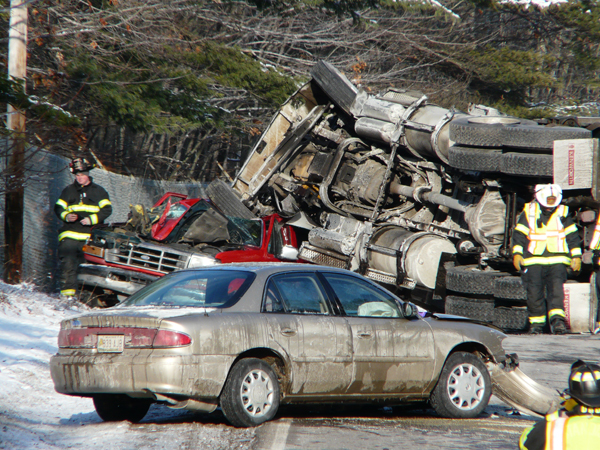 Matt Sabasteanski of Raymond managed to escape a three-vehicle
accident on Route 35 in Standish two Decembers ago by pulling
himself out the passenger door as a fully loaded tractor trailer
came crashing down on the roof of his red Ford F-250, shown crushed
at back left. (File photo)
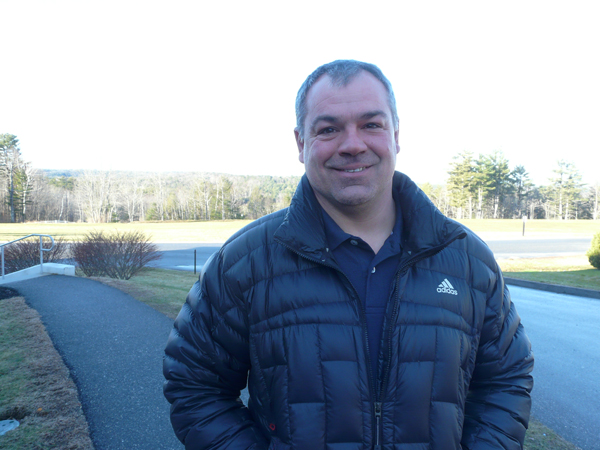 Matt Sabasteanski, now
 Chris DeSorbo, of Gorham-based Biodiversity Research Institute,
checks the transmitter attached to Gho just before the great-horned
owl was released into the wild in October. Gho, pronounced
“Gee-ho,” suffered head trauma that has left her blind in her right
eye. Nevertheless, the transmitter has shown that she is doing just
fine in the wild. (Courtesy photo from the Center for Wildlife)
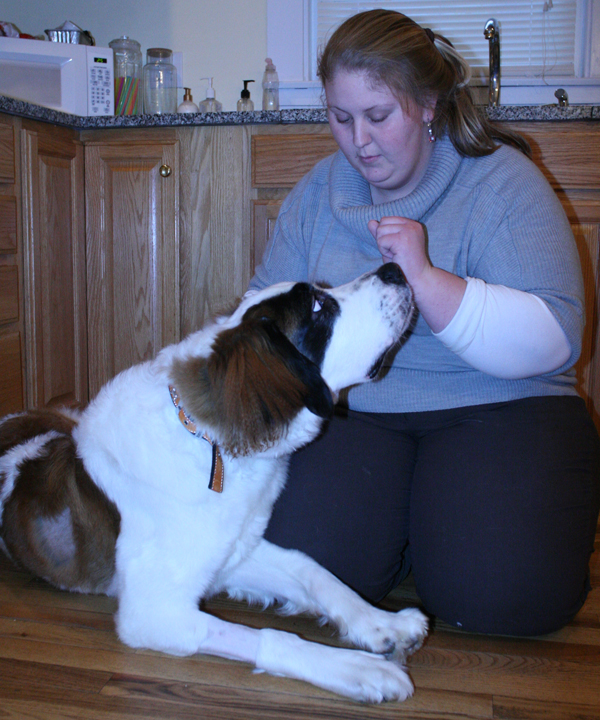 Benny, a year-old St. Bernard, is well on the way to recovery
after being hit by a tractor-trailer truck on Main Street in
Westbrook, according to his owner, Michelle Coro. (Staff photo by
Sean Murphy)
Comments are no longer available on this story