
GRAY – Adam Copp, owner of Howell’s Gun & Archery Center on Route 115 in Gray, literally grew up in the family’s shop, and in all that time he’s never seen gun sales so brisk.
The recent mass shootings, coupled with fear that America is growing more dangerous and government will soon clamp down on gun laws, are helping to drive sales at gun shops like Howell’s. The same fears are leading to an increase in concealed weapons permits in Maine, creating a backlog of applications ready for review by the state police.
The leading sector in the gun-buying frenzy is handguns, which make up about 60 percent of Howell’s sales. Handguns, Copp said, are easier to use, can be carried easily, and pack a defensive punch for personal protection.
Since the Newtown school massacre, tightening of gun-control laws in New York and President Barack Obama’s issuance of 23 executive orders concerning gun control, Howell’s has been “crazy busy,” Copp said. “There’s more demand than there is supply for sure.”
Copp is keeping his prices steady, despite having trouble acquiring AR-15s, the type of gun preferred by the modern gun buyer for its versatility as a hunting rifle and home defense and target shooting. It was also one of the weapons reportedly carried by the gunmen in the Colorado and Connecticut shootings, and it has been a particular target of proponents of restricting gun control.
“We haven’t seen too much of a price increase across the board,” Copp said. “Some stuff is going up, some stuff isn’t. It’s more availability. They can’t keep up with the demand for handguns, long guns [shotguns, rifles], and ammo.”
Howell’s is one of six sites in southern Maine that offer officially sanctioned handgun safety courses, required by all those wishing to acquire a concealed weapons permit. Copp, an instructor certified by the National Rifle Association, teaches the course, entitled “A Gun in the House.” He said the courses, which take place 9 a.m.-3 p.m. on Saturdays, are packed with all sorts of people wishing to carry concealed handguns.
Copp goes over handgun safety as well as the rules and regulations regarding where permit holders are allowed to carry. Schools, courthouses and any private establishment that bans guns are off limits, he said. He also talks about gun users’ rights regarding the use deadly force to defend themselves or others against attack. The classes, as of late, have been reaching upward of 50 people. Several months ago, 35-40 people were attending, Copp said.
“It’s nuts,” he said. “Customers probably look at the parking lot and say, ‘Oh, they’re packed,’ but everyone’s in the classroom. I need to get a sign out front that says, ‘Class today.’”
The kind of people taking the classes as of late has also surprised Copp.
“There’s more left-wing Democrat people coming in and taking that class than you’d think,” he said. “Every third car in the concealed carry course has an Obama sticker on it. And they’re like, ‘Well, it’s my right to have one, and I want one.’ So, it’s interesting.”
Asked what’s motivating the people that take the course, Copp said, “They’re worried that they’re not going to be able to get it soon.”
Brisk sales
Local gun shops aren’t the only ones working extra to assuage the gun-buying public. Town clerks and police chiefs in the Lakes Region are busy dealing with an influx of concealed weapons permit applications.
In Windham, Town Clerk Linda Morrell said 28 applications crossed her desk in December 2012, nearly double the number of applications in December 2011, when 16 people applied for permits. By Jan. 17, 23 applications had been received for this month. In total, Windham has 696 active concealed weapons permit holders, said Police Chief Rick Lewsen, who gives final approval after conducting a background check. The checks, which can be performed by state police, local police or gun shop owners, all tap into the National Instant Criminal Background Check System operated by the FBI.
While Windham has its own police department, smaller towns without their own force usually forward concealed weapons applications to the Maine State Police, which conducts a background check on all applicants. Standish, Raymond, Naples and Sebago, according to the town clerks, each enlist the services of the state police.
Standish Town Clerk Mary Chapman said the town used to approve permits up until the 1990s when Standish still had its own police force, but since the town began contracting policing with the Cumberland County Sheriff’s Office, the Town Council decided to forward concealed weapons permits to the state police.
“We do get a list of names to see if we know anything about them, but other than that everything is handled through Maine State Police,” Chapman said.
Raymond used to have the Board of Selectmen approve the permits, but shifted to the state police about 15 years ago, Town Clerk Louise Lester said, because “they didn’t want the responsibility.”
In Naples, Town Clerk Judy Whynot said the town shifted to state police about 15 years ago as well. The state police, once it has conducted its investigation of the applicant – a process that used to take about 30 days but now can take up to 90 days due to the volume of applicants – will send the application for final review back to Naples “for the town manager or selectmen to sign the actual permit, to see if they know them or know of any reason why they shouldn’t have one. And then we send it back,” Whynot said of the process.
Casco and Bridgton, similar to Windham, approve their own concealed weapons permits. In Casco, the town manager will approve or deny the permits based on a background check. If there is any question, the application the manager will consult selectmen, according to Town Clerk Lucille Griffin.
In Bridgton, Police Chief Kevin Schofield reviews applications. He said he has received a “steady” three to four applications a week for the past two years.
Long process
Lt. Scott Ireland, commander of the Maine State Police Special Investigations Unit, which oversees concealed weapons permits and performs background checks in consultation with the FBI, said application requests for 2012 reached 7,500, about 2,000 more than the previous year.
“Right now we’re dealing with a backlog so it takes about 90 days to be able to get one turned around because recently, we’ve been receiving over 150 applications per day, and we’ve only got a couple of people working on these,” Ireland said.
While there are many people who “touch the process,” which involves investigating an applicant’s criminal background as well as mental health background and whether they’ve completed the requisite handgun safety course, “there are only two people who put the whole thing together. So it’s very time-consuming because there’s a lot to it,” Ireland said.
If an applicant meets all the criteria, a permit is issued for four years at a cost of $35. After the four years, applicants must apply for a renewal, which costs $20. The permit allows the person to carry a loaded handgun only, Ireland said. They can conceal as many weapons as they want, since a permit doesn’t limit the amount of weapons. The permit also allows for storage of the concealed weapon in the person’s vehicle, he said.
The Maine Legislature draws up the rules regulating the permitting process. While no reason needs to be given for why a person is applying for the permit, the six-page application, which is considered a signed affidavit and could draw penalties if the applicant provides false information, is filled with questions asking applicants to verify their criminal history, drug use, mental disorders and military background. If an applicant fails to meet any of the preconditions in the application, the permit is denied, Ireland said.
Ireland said permitting process is set to receive some attention in the coming Legislative session.
“I know it’s going to be heavily scrutinized, and I know there are several bills being introduced in the Legislature right now as it relates to this, and we’re going to have to wait to see how they come together,” Ireland said. “Until they’re out there, it’s hard to speak to it a lot yet.”
Ireland said recent tragic events could impact the process.
“Obviously when tragedies happen, you have to step back and evaluate and make sure we’re doing things appropriately,” he said. “I know we’re putting together a good work product, but it’s always good to revisit and to analyze to see how you’re doing.”
Potential changes
Each firearm purchase from a store requires an FBI background check. Copp, of Howell’s in Gray, said once a person has decided to buy a gun, the person must fill out a “firearms transaction record” form on the spot. The questionnaire asks similar questions to a concealed handgun permit regarding criminal history, drug use and citizenship status. As the customer waits, Copp will call the FBI and when prompted will read through the customer’s answers. The FBI will then issue a “deny,” “proceed” or “delay” decision. A delay could be caused when someone with a common name, such as John Smith, applies without giving his Social Security number. Copp said the process can take between five and 20 minutes to complete.
Copp says background checks are a good safeguard to keep guns out of criminals’ hands, but he said there could be more safety protocols put in place. An important one, he said, is mandating background checks for private sales.
“Most of us wouldn’t have a problem having background checks for all private gun sales,” Copp said. “If we go to a gun show, we have to run background checks, but if Joe Schmo wants to have a table or even conduct a sale out in the parking lot, he doesn’t need to do a background check. Most of our customers and us wouldn’t have a problem seeing that kind of change.”
Copp has had some scrupulous private sellers come into his shop with a prospective buyer so Copp can conduct a background check. It’s not a legal requirement, but Copp applauds private sellers who take the extra step.
Copp would also like to see mental health play more of a role in the background check.
“If someone is on a mood-altering drug, which requires them not to operate a motor vehicle or heavy equipment, that doesn’t come up on one of these questionnaires,” he said. “So it just makes sense that if you can’t drive or operate a piece of equipment, you shouldn’t be buying a gun.”
Copp also recommends sharing of criminal records between states. He said there are eight states that don’t completely share criminal records with other states.
“I think that should be shared, because if the guy is a bad guy there, he’s probably going to be a bad guy here,” he said.
Lewsen, Windham’s longtime police chief, is also supportive of changing the mental-health aspect governing background checks.
“Somebody could be mentally ill and send themselves up to a private hospital, and I couldn’t get those records at all. I can only get records from state hospitals,” he said, referring to Riverview Psychiatric Center in Augusta and Dorothea Dix Psychiatric Center in Bangor.
State Sen. Gary Plummer, R-Windham, a member of the Criminal Justice and Public Safety Committee, says the committee is already discussing that aspect of the law saying changes will likely be made. An obvious change, he said, would delineate among those who have sought counseling for temporary bouts of depression versus those who have serious mental illness.
“We’ve got to have a way to separate those out so that we don’t take someone who has had a one-time incident where they recognize they were having problems and say you can never own a firearm,” Plummer said. “But, the other side of that is the people who have demonstrated a pattern of mental problems. We definitely don’t want them to own firearms.”
Lewsen said another failing of the law regulating who can have firearms, concealed or otherwise, pertains to access to juvenile criminal records. While the background check asks for a person’s juvenile criminal history, officials can’t access the information to confirm the applicant’s statements.
“A person that commits a felony crime at age 18, the court still has jurisdiction over them under age 21, and then you can’t access that record. When they’re 22 years old, [and apply for a weapon’s permit], they could have committed a felony burglary, been convicted for it and served time, and I still can’t get that information,” he said.
On the street
While Copp, the private storeowner, and Lewsen, who are both part of the system that ensures guns go to law-abiding residents, agree changes are needed, Copp and some customers at Howell’s say guns will still make it into the hands of the bad guys, no matter what government does to expand gun laws. They want to make sure law-abiding residents have access to guns, as well.
“Most people that come in here are seeking an equalizer. They want to have a gun, concealed or otherwise, for that just-in-case moment. It’s not that day-to-day thing, you get it for that maybe one-time use that may be life or death,” Copp said, adding that so-called high-capacity magazines of 10 or more rounds allow for responsible gun owners to take on several assailants or home intruders in a panic situation.
Howell’s customer Kelly Meggison, of Cornish, who served four tours in Iraq, said those in government seeking a solution to the mass shootings are off-target in their proposals to limit the number of bullets in a magazine or putting limits on so-called assault rifles.
“They’re living in their agenda. It does nothing. The only thing that stops a bad guy with a gun is a good guy with a gun,” Meggison said. “Homeland security starts in your house. People would rather be standing or sitting in their bedroom with equal force with a burglar in their kitchen, rather than calling a dispatcher on a phone and hearing, ‘I’ll get someone on the way.’ By then it’s too late.”
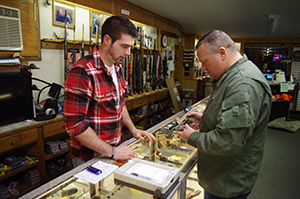 Howell’s Gun & Archery Center owner, Adam Copp, left, helps customer Kelly Meggison of Cornish with a handgun purchase. Copp said Howell’s has seen a “crazy” increase in handgun purchases since mass shootings – and the political reactions – have dominated media coverage in recent months.
Comments are no longer available on this story