
For Julia Skalina the horror of the Holocaust are all too real. Skalina was imprisoned in two concentration camps and lost 20 members of her family and more than three-quarters of her hometown.
Skalina shared her story Friday with Scarborough Middle School students, who, until then, had only read about the Holocaust in a book.
Skalina has been speaking about her experiences since the mid 1990s when she decided to step forward to let people know what happened and speak for those who don’t have the chance.
Since that time, she has told her story 99 times to students at different schools in Maine. She has told them about her time at Auschwitz and Allendorf, a sub camp of Buchenwald. On Friday, she spoke with two Scarborough Middle School classes who were studying the Holocaust.
“No matter where we are, what we are doing, the scars of the Holocaust will be with us for the rest of our lives,” she said.
Skalina grew-up in Czechoslovakia, in what today is southern Slovakia. In 1938, when she was 13, her country was annexed to Hungary, and slowly life began changing for the nation’s Jewish population. The annexation to Hungary would eventually lead to their deportation, imprisonment in concentration camps and, for many, death.
Sealed fate
Beginning in 1938, Skalina said the rights of Jews started to erode. While the Jewish population there did not have to wear yellow stars or live in ghettos as they did in Germany, it was difficult for Jewish people to make a living. Gradually, all of the restrictions became more and more strict and severe, she said.
Still her family tried to live as normal a life as possible, but that became increasingly difficult. With the German occupation of Hungary in March of 1944, “the fate of the Jews was sealed,” Skalina said.
Jews were forced into central locations called ghettos and the deportation of Jews to concentration camps was beginning. The experiences of Skalina and her family were not different.
They were forced into a ghetto in her hometown. Fortunately, the enclosed area was the portion of the street where they lived, and they did not have to move. But they had five other people move in, doubling the size of her household.
By the beginning of June, the German occupiers had taken anything of value from her family, including wedding rings and jewelry. These searches were thorough and Skalina said on one occasion a German soldier stepped on some clay figures she had been playing with to see if there were any valuables hidden inside.
On June 6, 1944, as Allies were landing in Normandy, Skalina’s family was moved to a barracks outside of town to wait for deportation and “for the first time we were deprived of
everything,” she said.
A look that said ‘good bye’
She said it was a sad picture with friends, relatives, old and young people sitting on the bare ground of the barracks, made even worse the following day when her father died after an interrogation.
“My father had been the first victim of the persecution of our town,” she said.
After a second interrogation, Skalina and her mother were ordered to be deported. While waiting, they were told by a Hungarian police officer not to step onto the train, but Skalina stayed with her mother, a decision she did not regret.
“I don’t regret for one second that I was there with my mother as long as I could” be, she said.
They were placed on cattle cars bound for Auschwitz, which were so overcrowded that the people could not move.
“The air was unbelievable. You couldn’t breathe,” she said. “I can still hear the moans of the old people, the crying of children.”
On June 14, after traveling for several days, the train arrived at Auschwitz. After debarking from the train, Skalina and her mother were separated, and she was told she would see her mother again, which she never did.
“There was fear and sadness and her look said ‘good-bye’ to me,” she said.
Liberty at last
When she entered the camp, a group of bald women with a “strange insane look in their eyes” watched them as they walked toward a barracks where they showered and were given a dress from a large pile.
“As we looked at each other, we realized that we left civilization behind, and we realized we looked just the same as those strange people in the camp,” she said.
She spent nine weeks in Auschwitz, before being order to leave the camp. While she was not sure where she was going, she figured it could not be worse than where they were.
After traveling three or four days, the train arrived at Allendorf, which she said had better conditions. While the prisoners were cut off from the outside world they knew, they knew the war coming close because they could hear explosions off in the distance.
On March 26, the guards ordered the camp’s inhabitants to start marching. They marched all night, until they arrived at a large field with a barn. The soldiers and some 1,000 prisoners stayed there during the day and marched that evening.
However, Skalina said the soldiers seemed nervous and not attentive and soon realized that some of the group had left the march. She too decided to take the risk and fled back to the barn.
She remained hidden there for several days, until an American soldier found them. Finally, her imprisonment had ended. She felt relieved.
“We needed time to feel happy again to enjoy our freedom and realize we survived,” she said. “All of us will be forever grateful to the American soldiers who risked their lives for our liberty.”
The effects of the Holocaust were enormous for the Jewish population of Skalina’s hometown. Of the 24 members of her family, just four survived. Of the 900 Jews from her town, about 120 survived the war, she said.
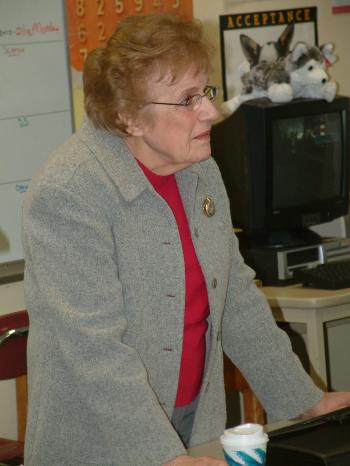 Julia Skalina
Comments are no longer available on this story