
Historic preservationists and wildlife advocates don’t see eye to eye over the future of a section of the Crooked River and whether it should flow freely or help produce lumber.
Members of Scribner’s Mill Preservation Inc., a nonprofit organization founded in 1975 by John and Marilyn Hatch, have found themselves fighting some environmental groups and state agencies to restore a historic mill and harness its original power source.
The preservation group contends that putting in a dam and fish passage system on the Crooked River in Harrison would not significantly impact habitat or block the salmon from moving up and down the river to spawn.
The Department of Environmental Protection is expected to respond to the permit application for the dam in January.
“It’s a wonderful opportunity to tell people about Maine lumbering history,” said Marilyn Hatch of the restoration project. “It’s our cultural heritage.”
Scott Hatch, the son of John and Marilyn, said history bears out the argument that the proposed dam will not harm salmon.
“It’s not fair for our opponents to say we are destroying the habitat,” he said. “There were five dams on the Crooked River for 125 years.” During those years the salmon population in Sebago Lake was healthy.
Representatives of the Maine Department of Inland Fisheries and Wildlife and some other groups advocating for landlocked salmon say the dam could negatively impact the population of the fish in Sebago Lake, where the Crooked River drains.
Francis Brautigam, regional fisheries biologist for Maine Inland Fisheries and Wildlife, has expressed concern about the impact of the proposed project on the salmon, as the Crooked River is the primary spawning habitat for landlocked salmon that live in Sebago Lake.
“It’s a really valuable fishery in terms of public interest and in terms of unique genetics,” Brautigam said, citing competition and predation from introduced species such as lake trout and pike as some of the other challenges facing the salmon population.
“Providing passage for all life stages is pretty critical,” Brautigam said, adding that he didn’t think the proposed fish passage system would provide for movement of all adult and juvenile salmon over the proposed Scribner’s mill dam.
“We believe we are giving the fish access to all their potential,” Scott Hatch said, pointing to the proposed fish passage ramp designed by Lakeside Engineering Inc. to let all size salmon cross the dam.
Dana Murch, the hydro supervisor at the Maine Department of Environmental Protection, now has the task of weighing public benefit against environmental impact to approve or deny the permit. Hatch said Murch is the right man for the job.
“We want the facts to stand for themselves and a decision made based on the facts,” Hatch said.
A different lifestyle
The Scribner family bought the mill in 1849, two years after wood cutting began. Daniel Scribner, 75, who still lives nearby, remembered the mill lifestyle from his childhood and young adulthood.
“It was a good life,” Scribner said, adding that it could also be wet and cold work. “It was our living.”
Now that sawmills can produce 150,000 square feet per day, mills that produced 1,000 square feet per day like Scribner’s are virtually nonexistent. Restoring the mill would teach people, who might not know otherwise, how trees become lumber, Scribner said.
“Now it’s all go to the store and buy it,” Scribner said. “It is a life that is gone. Now people would like to know how you’ve done those things.”
Scribner’s grandfather closed the mill in 1962 when he was 92 years old because he couldn’t compete with modernization. Before closing, the Scribners made and sold barrel staves, shingles and box parts, among other products.
A working sawmill museum
“If we can get water power, it will be a complete operation of the way it used to be,” Marilyn Hatch said. “People are amazed by how the parts of a barrel are made. Where can you go to learn that?”
Hatch said there is only one other demonstration sawmill in Maine.
The ultimate plan would be to turn the Scribner’s Mill site into a working sawmill museum, Hatch said, and sell the materials to individuals and groups looking for authentic lumber for historic building restorations. The site would be open seven days a week for four to five months a year with full-time paid staff. Scott Hatch said he would expect the site to bring tourists to the area.
“People don’t really understand how important Scribner’s Mill is in the big picture,” Scott Hatch said. “We are quite possibly one of the top five mill site restorations in the world in terms of our potential.” Hatch said few mill sites have survived.
The mill building was destroyed in 1977 when high water caused chunks of ice to knock down the mill pilings. The preservation group finished rebuilding the mill in 2002. The group has also restored the homestead across the street from the mill as a museum documenting community and family life during the time period the mill was active.
Currently the mill machinery, powered by an antique tractor, can produce barrels from raw wood to completion. The preservation group sells the barrels to support the restoration effort. Without yet being fully operational, Hatch said they probably got more than 1,000 visitors in the last year, including school groups and visitors of their annual summer Back to the Past Festival. Scribner’s Mill Preservation Inc. has 300-350 members, with around a dozen active volunteers.
The next step after building the dam would be adding another 80 feet on to the mill building to house machinery now stored in a shed. Hatch and others collected historic mill machinery from other mills as they closed around the state.
Hatch has been interested in historic preservation for his whole life, and remembers visiting restoration projects with his family as a young child. He has his own business, called Barn Wright Inc., restoring barns and stone foundations.
“It’s just always been part of what I am and who I am,” Scott Hatch said. “It’s been part of my family right from the get-go.”
Professional studies
Hatch and others have put a lot of effort into the project, including the permit application for the dam.
Before submitting the dam application to the DEP, the preservation group worked with two consulting companies to design a rock ramp fish passage system and assess the dam’s potential impact on fisheries.
Lakeside Engineering Inc. designed a 180-foot-long rock ramp with a 2.6 percent grade, which Scott Hatch said would allow passage of adult and juvenile salmon.
To allow fish to make their way over the ramp, Lakeside Engineering consultants looked at the minimum and maximum flow rates and the success rate for fish swimming up a concrete slope to determine how many resting points to include in the plan. With one resting point, 100 percent of adult 20-inch salmon could traverse the ramp, Hatch said.
Juvenile 3-inch fish would have more difficulty traversing the ramp, if they had nowhere to rest, Hatch said. With six arc-shaped strings of boulders set on the ramp, even young salmon could pass the dam 100 percent of the time, Hatch said.
Hatch estimates constructing the fish passage and dam would cost $50-60,000 utilizing volunteer labor and materials already on site.
Woodlot Alternatives Inc. wrote a fisheries report for the preservation group to assess potential impact on the salmon fishery. The firm looked at habitat change throughout the 1.1-mile project area. The dam would raise the water level by 3 inches throughout that area, Hatch said, and create a mill pond just behind the dam, changes that Hatch said would be relatively minor in the large picture of a 50-mile long river.
Reclassification a threat
In addition to the dam application before the Department of Environmental Protection, there is ongoing discussion about the classification of the river, Hatch said. When the river was last reclassified in 1982, the area around Scribner’s Mill was the only section of the river set as Class A, with the rest of the river Class AA. If the Scribner’s Mill site were Class AA, the dam would not be allowed.
The state has four classes for freshwater rivers, establishing designated uses and protecting those uses. Class AA is the highest classification, and is designated to rivers containing valuable ecosystems. Class AA rivers allow for aquatic life, drinking water, fishing and recreation. Class A rivers also allow for navigation, hydropower and industrial discharge.
The Board of Environmental Protection, which makes recommendations to the Legislature about river reclassifications, is looking at the Crooked River now, Hatch said. If the board reclassified the whole river as Class AA and made it retroactive, the dam project would be impossible.
“It would be a shame from a historical perspective to lose the potential of this site,” Scott Hatch said. “We are not just some roadside attraction and curio shop.”
 Scott Hatch and approximately 300 other supporters hope to restore the historic Scribner’s Mill, which is located on the Crooked River in Harrison.To rebuild the dam they will need DEP approval, which is in question because of concerns about the damn blocking salmon passage.
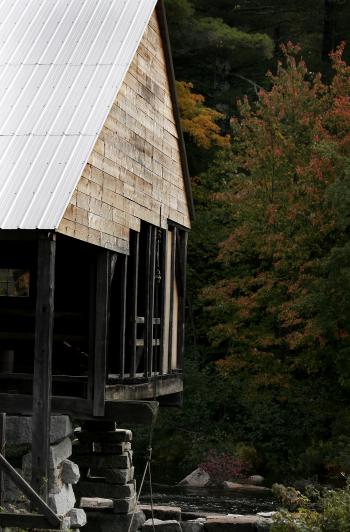 After the Department of Environmental Protection made an initial rejection to an application to rebuild a dam to power Scribner’s Mill on Crooked River in Harrison, members of the preservation group vowed to contest the decision. Comments on the decison can be filed until Nov. 26.
Comments are no longer available on this story