
GORHAM – A local trails group is taking steps to halt state spraying to poison weeds along an inactive portion of the Mountain Division rail line, where hikers, bicyclists, nature enthusiasts and pets all enjoy the rail trail from Gorham and Windham to Standish.
Friends of Rails to Trails is concerned about potential health and environmental risks associated with the state’s annual spraying of the rail line to kill weeds.
“Hundreds of people use this trail,” group member Den Morton said Tuesday. “Stop the spray.”
Morton, a former cancer patient who has been declared cured, said Tuesday, as he and his dog Trekker walked the trail, herbicides and pesticides are toxic chemicals. Morton said Maine has the fourth-highest cancer rate in the country.
But the Maine Department of Transportation cites safety as a need to continue the spraying program on state-controlled railroad systems, including the inactive Mountain Division line.
In a January letter to the local Legislative delegation, Friends of the Rails to Trails said the Maine Department of Transportation uses glyphosate and imazapyr on rail corridors adjacent to trails. Their letter claimed, “These herbicides are toxic and harm more than just the intended target such as weeds and grasses.”
The letter also said, “We have reviewed Environmental Protection Agency information which shows that there is concern about tumor growth in animals and kidney disorders, potential endocrine disruption, neurological abnormalities, and local allergic reactions in humans upon exposure to the herbicides.”
Members of Friends of Rails to Trails met with Maine Department of Transportation officials in Augusta in April and hold a written note that says the state wouldn’t spray this year if the five-mile trail is weed free. Morton, a member of the trails group, is organizing a force of volunteers to pluck the weeds next month.
But Morton wants spraying stopped permanently.
“We really want a no-spray policy,” he said.
Last year, the group collected 1,200 signatures of Gorham residents opposing the spraying. But Morton said Tuesday the Maine Department of Transportation showed “little or no concern about the residents of Gorham being concerned about the spraying.”
“I told them I’m not going away,” said Morton, who plans to meet with transportation officials again in September.
To assist with the local group’s campaign this year, Green Corps, a Boston-based organization that trains future environmental leaders, is sending several young people to Gorham next month. “I’m excited to be involved with some young environmentalists,” Morton said.
With plans to circulate another petition, the group hopes to collect 10,000 signatures, including people from surrounding communities who enjoy the trail. The trailheads are Shaw Park, which has a beach, playground and ballfield off Sebago Lake Road in Gorham, and Johnson Field on Route 35 in Standish.
“We’re going to be visible,” Morton said about the effort to gather signatures.
The walking trail is scenic and paved as far as the Otter Ponds in Standish. “Lengths of our trail have both berries, which are picked and eaten by children and birds, and endangered plant species, which are obviously killed by these herbicides as well,” the dozen members of the trail group wrote last year to David Cole, then the state commissioner of transportation.
Martha Scott, a member of the trails group who walks her dogs on the trail year-round, said she worries what the spraying will do to her pets, and the land around the trail.
“It is incredibly sad for me to see all the vegetation and foliage around the tracks shriveled, brown and dead. Then it makes you think about how this affects all the animals that live there,” said Scott, of Gorham. “My husband recently found an article that said it has been shown that the chemical glyphosate creates birth defects in animals for up to seven years. And what is it doing to our domesticated animals who like to eat grass or just running through it, digging in the area?”
Nate Moulton, director of the rail program at the Maine Department of Transportation, said Wednesday spraying rail lines is necessary for safety of maintenance employees and the Forest Service personnel who inspect rail lines. “It’s a safety issue as well as a fire hazard,” Moulton said.
The Mountain Division railroad line from Baldwin to Fryeburg was sprayed the week of June 20, upsetting a Hiram resident, Dana Roffler, who lives adjacent to the tracks and who wasn’t notified of the spraying.
“Since I did not know they sprayed, I was out on my daily walk with my dogs the next morning,” Roffler said by email.
Moulton said Wednesday the contractor, who sprays for the state, sends notices to the towns regarding where spraying is to be done and the notices are posted publicly.
“He follows all Board of Pesticides rules,” Moulton said.
Moulton said the contractor also places advertisements in area newspapers, although that is not required. For trails, Moulton said notices of spraying are posted in advance at all access points.
In a statement released June 13 before last month’s spraying, the department said, “Maine DOT researches all vegetation control materials and approves only those with the lowest environmental risks, as well as the lowest health risks for applicators. The materials scheduled for use on the rail lines in June include Razor (glyphosate) and Oust Extra (sulfometuron methyl and metsulfuron methyl). As part of its commitment to environmental and worker protection, the department uses the lowest rates possible for control of vegetation.”
“By using these materials in combination, we are able to reduce rates of application to the lowest possible rate and still get control of vegetation,” said Bob Moosmann, the transportation department’s statewide vegetation manager.
The DOT statement also said, “in addition to these herbicides, the department will use a product that will help to keep the materials in place and inhibit lateral movement away from the zone of application and downward movement into the soil.”
Moosmann explained in the statement that, “the use of a sticker-extender allows us to ‘glue’ the herbicides to the soil which not only keeps the products from moving even when it rains but also improves the performance by keeping the materials in place longer.”
Moulton said there is no spraying on windy days or in the rain.
But Morton said last year on June 23 the Mountain Division rail line along the trail through White Rock in Gorham was sprayed. “It’s a fact the town of Gorham had a quarter-inch of rain that day,” he said.
Morton said two women witnessed the spraying that day and were upset. “They were ticked off, to say the least,” Morton said.
Roffler said that in 2006 heavy spraying killed trees on her property and that a transportation official in 2008 saw the damage that was done.
“There was no compensation for the dead trees – not even a sorry,” Roffler said.
This week, the railroad trestle over the Presumpscot River had vegetation in spots, suggesting it hadn’t been sprayed. Moulton said areas near streams are not sprayed “because they don’t want chemicals falling into the river.”
Areas of the rail line close to Sebago Lake, which provides drinking water for Greater Portland, are also not sprayed.
“Areas in close proximity to the lake, or sensitive areas such as trestles that cross over waterways are not sprayed. As part of the Portland Water District’s agreement with Maine Department of Transportation, we have agreed to maintain the growth of vegetation in these areas by using mechanical equipment to clear it on a periodic basis,” said a statement this week from Michelle Clements, spokeswoman for the water district.
Some other places of the railroad line farther from the lake are sprayed, but on a limited basis, and spraying is monitored by water district personnel, according to the water district statement.
Morton said spraying the abandoned railroad is a waste of taxpayer money. Morton, who lives in the vicinity of the railroad line, said spraying the inactive Mountain Division line doesn’t make economic sense. “They’re spending $7-10,000 a year to spray the abandoned rail line,” Morton said.
An effort is now under way to bring the rail line back. Workers have been placing a new rail line on a section of the trail from Westbrook to Windham. Funding is on hold for a least a year, but a proposal has been put forward to re-open the rail, which stretches west to Fryeburg. The proposal would maintain a trail next to the rail line.
Even if the rail line was re-opened, Morton said, pointing to decaying railroad ties, it needs rebuilding. “Why waste money putting toxic chemicals on it,” Morton said.
“Our point is leave it alone until you get ready to rebuild it,” Morton said.
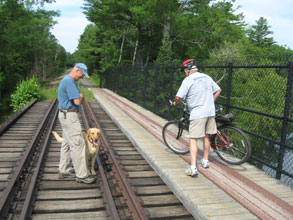 Walking the Mountain Division Trail Tuesday, Den Morton, of
Comments are no longer available on this story