
Alfred Fogg, who turned 100 this week, served during the American invasion of Iwo Jima.
Alfred Fogg would rather talk about his daughters’ accomplishments in the 4-H Club than his bravery in World War II.
Fogg, a Purple Heart recipient for the head injury he suffered during the American invasion of Iwo Jima in February 1945, remembers the battle, all right – right up until the day when tremors from a heavy artillery shell rendered him unconscious. He woke up on the ship that carried him to the island on the Japanese coast, where the victorious Americans would create a base.
Fogg’s service is especially compelling this week, as he celebrates his 100th birthday and the nation observes Memorial Day.
As a member of the Seabees (the United States Naval Construction Forces, or NCF), Fogg worked on construction projects, and was in Iwo Jima to install telephone wires to hook up to the lead American ship bringing artillery in for the invasion.
But the 6-foot-4 Fogg, who turned 100 on May 19, has many, many more things he can talk about.
“The first two years after I got back to Freeport, this nurse, who was also in the Seabees, and I led the Memorial Day parade,” Fogg said recently from his residence at Freeport Nursing and Rehabilitation Facility. “Since then, no parades. I wanted to forget. I dream about it, and that’s enough. I had a wonderful wife and three wonderful daughters.”
Fogg, born in Freeport, married Bertha Ann Manter in 1943, and they enjoyed 71 years of married life until she died at 96 in March 2014 at the nursing home, where they had lived for two years.
A lifelong Mason, Fogg also worked the family farm – after he got home from his “day job” at Bath Iron Works. The Foggs brought up three daughters, Merry Damone and her twin sister, Judy Lively, of Conway, N.H., and Eileen Damone of Lewiston, Mont. Fogg was a 4-H leader and, somehow, found the time to make and sell Adirondack chairs. And, living on Wolfe’s Neck, he took advantage of what Casco Bay had to offer and went clamming when he could.
Upon retirement from BIW, Alfred and Bertha traveled.
“We traveled all over the United States by camper,” Fogg said. “Montana was our favorite, because we got to see Eileen.”
Travel was one thing Fogg liked about being in the military, and he got plenty of it. Fogg enlisted into the Seabees at the age of 29 in 1943. He trained in Virginia, and then headed for Hawaii, to help rebuild the airstrip in Hawaii following the Japanese air strike on Pearl Harbor.
“We made an airstrip out of live coral, pumped out of the ocean,” Fogg said. “I’m going to tell you, it took something to hold those planes up. Then we went to another island and joined the Marine Corps there.”
Then, it was on to Iwo Jima, the location of the iconic photograph showing the U.S. flag raised in victory, following a month of fighting. Three U.S. Marine divisions, including the 4th Division in which Fogg served, landed on the island in February 1945.
“It was 6 miles long and 2 miles wide and looked like a pork chop,” Fogg recalled.
The Japanese were entrenched in bunkers and caves, and ready to fight.
“We were there longer than I wanted to be, I can tell you that,” he said. “We took artillery shells that put us out of action. I lost more friends, and friends on top of that. That artillery blast hit me in the head like a baseball bat. They sent me back to Pearl Harbor, and then it was all over.”
Merry Damone, who visits her father regularly, knows the story.
“He landed on the beach and got shell-shocked,” Damone said. “He was knocked cold. He got back to the ship, somehow. People were dying all around him. Our mother didn’t see him for over two years.”
Fogg hadn’t seen the end of the horrors of war. He was sent to Nagasaki, one of the two Japanese cities hit by American atomic bombs in August that ended the war. He was with a group of soldiers sent to tend to the survivors, and protect the milk supply.
“It was just like you’d slit that city right down the middle,” Fogg said.
Fogg grew up in Freeport, the son of Thomas and Evelyn Fogg, but he lived in several towns, as his father bought and remodeled properties as a carpenter. Following graduation from Portland High School, Fogg worked at the A&P grocery store as a young man,
Following their marriage, the Foggs purchased the farm on Wolfe’s Neck in Freeport.
“He was Foggy the Fisherman,” Damone said. “He’d go into Portland. He had a truck and he’d go into the neighborhoods with fruit and vegetables and fish.”
Fogg built an apartment at the farmhouse for Damone and her husband, Jake, in 1980, and together they maintained the farm.
“Basically, we kind of combined households for 35 years until my folks needed to move to the nursing home,” Damone said. “I’m proud that we grew up in a setting that meant a lot to him and meant a lot to us. He worked all day long and then came home and took care of the animals and the farm. We had milk, beef and vegetables for the family. My mother made butter.”
Damone takes her father for a ride around town weekly.
“His health isn’t too bad,” she said.
“I like to see the changes in Freeport,” Fogg said. “When I was a kid it was all horse-and-buggy.”
Fogg’s family and staff at Freeport Nursing and Rehabilitation Facility threw him a big early birthday party on Sunday, May 17. Tamantha Wilson, one of Fogg’s caretakers, made him a birthday cake topped with a rural scene.
Marilyn Dubois, another one of Fogg’s favorite caretakers, gets him ready for his weekly rides.
“He’s very nice. He loves to talk. He’d keep you all day in his room if he could,” Dubois said.
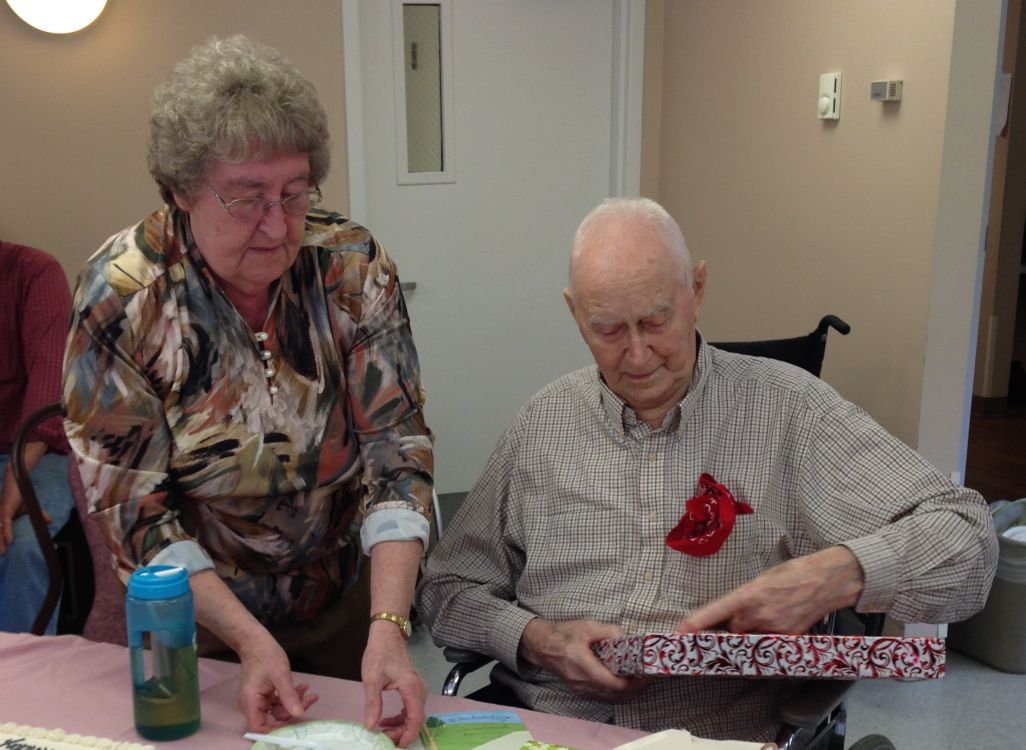 Maddie Dubois, caregiver at Freeport Nursing and Rehabilitation Facility, helps Alfred Fogg open one of his presents at his 100th birthday party Sunday. Fogg is a World War II veteran. Courtesy photo
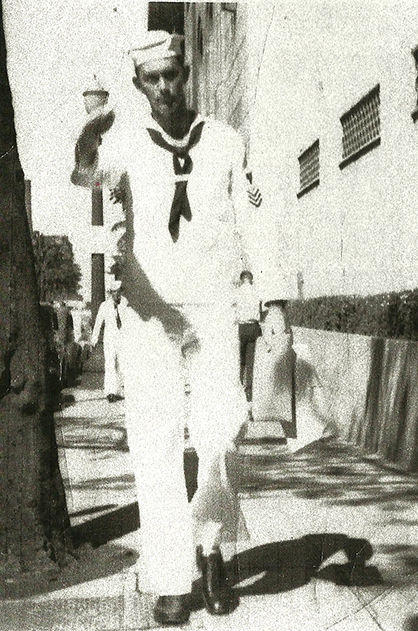 Alfred Fogg, who was a Seabee, wears his Navy uniform in a photo taken on Jan. 19, 1944, in Honolulu. Courtesy photo
Comments are no longer available on this story