
Cape resident Janet Zimmerman held up a science book from 1983 for the town council and more than 100 spectators to see. A transplant from Dallas, Texas, Zimmerman said she moved to Maine for the schools.
However, when she realized her sixth-grader was learning from a science book published in 1983, she was appalled. “I think a few more discoveries have been added” since then, she said.
Zimmerman was one of about 30 Cape residents who aired their gripes, observations and suggestions for how Cape’s council should treat the school budget. The public discussion last week at Cape Town Hall was part of an ongoing debate about whether or not to increase Cape’s school budget above a spending limit the Town Council adopted in 2004.
The majority of speakers, including school board members, teachers and parents, favored spending above the 3.4 percent spending limit, and many recommended the council give the school board the 7 percent increase they requested.
Discussion about population growth resurfaced, pervading the meeting.
Two years ago, the council included a provision within the spending cap that said if population increased, spending would also increase above the cap according to population growth. However, some councilors feel the school board population projections don’t validate a necessary increase in spending above the cap.
Councilors Anne Swift-Kayatta, Mary Ann Lynch and Carol Fritz have all stated publicly they oppose increasing spending above the cap and would not consider an increase for population adjustment, while Mike Mowles, Cynthia Dill, David Backer and Paul McKenney favor an increase for population.
Some residents agreed that spending above the limit was not best for Cape Elizabeth. Charlie McCarthy spoke for the retired constituency who live on a slim budget. “We have rising costs the same as the schools. Keep that in mind when spending our money,” he said.
Others suggested increasing revenue by charging an entrance fee at Fort Williams Park. Resident Anne Gale said if fees from Fort Williams were used to supplement the town budget, the town might avoid an annual debate over school spending.
Many speakers argued that the council imposed cap should be reconsidered because it was instated in a time of fear, when towns and cities were worried a statewide tax cap initiative (Palesky) would gouge out spending for all town budgets including the schools. The Palesky initiative was defeated in Cape by a margin of 70 percent to 30 percent.
“It is completely illogical to claim that because we rejected a tax cap, we favor a tax cap,” said Daniel Fishbein. Councilors have argued the tax cap was imposed as an alternative to Palesky. This tax cap, they theorize, helped convince Capers to oppose the Palesky initiative. Many Cape residents are unswayed by this rationale.
“I voted no on Palesky. I did not vote yes to a spending cap,” said Sue Pierce, who favored increasing school spending above the cap. Pierce argued that the debate isn’t about enrollment numbers or even the cap. “It’s about adequately funding our schools,” she said.
But Catherine Kent felt as though the schools had adequate financial support and will continue to have it, even under a 3.4 percent cap. Kent compared the services at Cape to a prep school. After rattling off numerous school services including clubs and sports, she closed with, “we have so much, it’s hard to see how a 3.4 percent increase will compromise the quality of our education.”
Laura Grassin-Drake argued that increasing spending would eventually force lower budget Capers outside Cape’s borders. “We have well-to-do people, but we also have people who struggle…I would not want to see our society become more singular.”
Single mother Janet Andrews, originally from Alabama, works two jobs to support her family. Andrews said she moved to Cape after living in Scarborough for a year because the school’s reputation was sparkling. She wants to maintain the quality of education in Cape.
“If I needed to I would go out and get a third job,” to pay taxes and support the schools, she said.
The Town Council is scheduled to vote on the combined town and school budget on May 15. The proposed $28.3 million budget would increase taxes by 63 cents for every $1,000 of property value, that’s a 1 percent increase in taxes over last year’s budget.
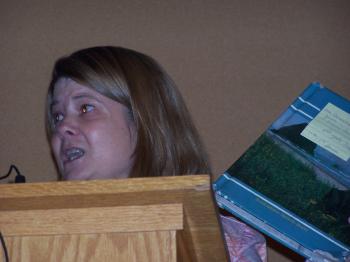 Janet Zimmerman, holds up a science book from 1983 still used in Cape Elizabeth classrooms today. Zimmerman appealed to Cape’s town council to allow spending for schools above the imposed 3.4 percent limit.
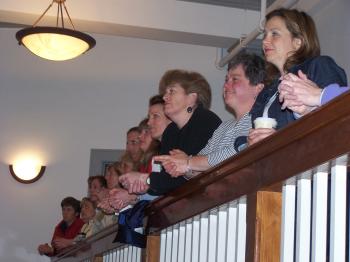 Over 100 people attended the final public discussion for Cape Elizabeth’s upcoming budget last week.
Comments are no longer available on this story