
At first glance, it looks like any other dorm room. Two small mattresses line the side walls, resting atop metal frames. The closets are portable, set up next to the beds, and one is topped with a stack of DVDs ready to fill the hours between class and bedtime.
But the average dorm room does not share a building with ladder trucks and turnout gear. And the average college student at 4 a.m. may be returning from a night on the town, not heading out and hearing sirens blaring, to deal with a fully involved structure fire.
Anthony Smith and Travis Frith are not average college students. They live in a small room on the second floor of the Gray Fire and Rescue building, responding to calls with firefighters twice their age, and holding their own.
The two teenagers, students in Southern Maine Community College’s Fire Science program, will spend the next two years in Gray learning their chosen career while giving the department crucial personnel at a time when extra volunteers are scarce.
The arrival of Smith, 18, of Nashua, N.H., and Frith, 19, of Washington, is already paying dividends for the department, and providing the students with some intense hands-on training courtesy of a large house fire last week on the North Raymond Road.
No drill
The call came in just after 4 a.m., while Smith and Frith were fast asleep.
“We heard the tone at 4 in the morning and we thought, this is it,” said Smith, reliving the moment with his new bunkmate.
There were no qualifiers in the call from the dispatcher, no “maybe” or “possibly,” the students said.
“That’s one sign to us that it is a live burn,” said Frith.
It was a structure fire, with reports of explosions. At the first alarm, they were out of bed, into their clothes and downstairs, working their way into the turnout gear. As they methodically but quickly put on the gear, they both thought of the month-long rookie school that they took with their fellow live-in students.
During the drills, when one student failed to get their gear on correctly and on time, all the students had to repeat the task. What felt like punishment before now made sense, the students said.
“It pretty much becomes second nature after a while,” said Frith.
When they arrived on scene, they knew this was no drill.
“When we got there, we could see through the house,” said Smith.
They were each assigned a position, with Frith holding a nozzle, spraying one corner of the house, and Smith helping out around the back. Eventually, the students fell into line with the other, more experienced fire fighters.
“You fall back on your instincts, to the basics,” said Smith, adding that each call just reinforces his career decision.
“I was pretty pumped,” he said.
Ready to go
The pair has fit in quickly with the rest of the members of Gray Fire and Rescue. There were 30 SMCC students who applied for the school’s live in student firefighter program, which places fire science majors in stations across the region, including Windham, Scarborough and Cumberland. But just over half had experience, said Gray Fire Chief Ricky Plummer.
“Some of them had never been in a fire station in their life,” said Plummer, who also used the live-in program when he was the fire chief in Standish.
In Smith and Frith, Gray was fortunate to get two students who were active in junior firefighter programs and can immediately contribute to the department, said Plummer and Capt. Mike Barter, who oversees the two students. Departments like Gray’s are staffed largely by volunteers, and federal training requirements have drastically increased the commitment those volunteers must make in order to stay active firefighters.
“Twenty years ago, you signed up and you showed up when there was a call. We only had training every few weeks,” said Plummer. “Now we have training every Monday night.”
As fewer and fewer volunteers are able to balance firefighting with their regular jobs and family life, it becomes harder to fill shifts and field an adequate force, they said.
“It’s a pretty big strain, and it becomes worse and worse every year,” said Barter.
But with Smith and Frith in the mix, Gray’s fire and rescue capabilities are enhanced. The extra bodies give the department much needed back up in the case of multiple emergencies. Last week, Gray emergency personnel responded to two bad accidents, which usually would have left the station empty and vulnerable should another call come in.
The added personnel also helps in the event of a large fire, Plummer said. Firefighters on the scene have to follow the “two in, two out” policy, a safety system that ensures firefighters who enter a building have backup outside. Sometimes, the first firefighters who arrive at a scene must wait for others to arrive in order to have the necessary backup, Plummer said. Because the two students live at the station, they can quickly get to a fire, which may allow firefighters to act more quickly, he said.
“Two people to us is a lot,” said Plummer, who supervises a force of 35 volunteers, both for fire and emergency response, but only three full-time officers. “It makes or breaks whether we have enough people or not.”
The students are not in Gray just to buttress the force, but also to learn. Their school responsibilities come first, Plummer said, and Frith is taking four classes and Smith five.
At the end of their two-year program, Smith and Frith, both of who would like to find a spot in a big city fire department, will have a leg up on others when applying for positions in a field that values experience above all else, Plummer said.
“It’s hard as a young firefighter to get a full-time job right off the bat,” he said.
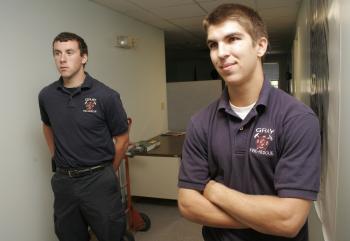 Travis Frith, left, and Anthony Smith, are training as firefighters by living above the Gray Fire and Rescue headquarters, training with the department and studying at Southern Maine Community College in South Portland. The pair was tested for the first time at a house fire on North Raymond Road Sept. 4.
Comments are no longer available on this story