
////Erica,
This is good story so far. I like your lead. You have plenty of good detail in here. You obviously had a good interview with Hagerman and took careful notes. However, I think you could have taken this a little further.
I think the story lacks a little in that Hagerman is the only source. The story could use a bit more scene setting in Guayaquil, outside of the hospital. It would lend context to the hospital she was working in and help readers visualize what’s going on in this country. Also, leprosy – Is it still a common disease around the world, and to what extent?
Also, I’m wondering if this story is just about Hagerman’s trip. Or, is it about her? We could use a little bit more information about her. Lee describes her as a pretty remarkable person. The reader doesn’t get that, though, although she seems to be doing something pretty remarkable. What else has she done in her life? Why has she always wanted to do this? How has it changed her life? At the end of this story, her character remains a bit undeveloped./////
When Cathy Hagerman first walked into the operating room of the hospital in Guayaquil, Ecuador, she saw chipping paint and equipment she remembered from her medical training 22 years earlier.
She was afraid.
“You get there, and there are armed guards – so you get a little nervous about it,” said Hagerman, a ////certified registered nurse anesthesiologist.///// “Anesthesia is so safe in this country. Here we have two tanks of backup oxygen. In Guayaquil there were none. You’re just kind of out there,” she added. “That was all scary to me. There was a lot to think about I don’t have to think about here.”
By the second day during her week in Ecuador as a part of a group of doctors, nurses and volunteers treating residents with Hansen’s Disease, or leprosy, Hagerman’s fears slipped away. “My comfort level came back,” said Hagerman, 49. “Then I enjoyed myself.”
Hagerman, a 16-year Scarborough resident who normally works at York Hospital, joined Damien House in November to help perform nerve surgery on about 30 patients to return sensation in their feet and hands. Damien House is a foundation with a mission of helping patients with Hansen’s Disease – a chronic illness, caused by a bacterium, that can cause nerve damage, skin lesions, weak muscles and bone deterioration.
According to the Centers for Disease Control and Prevention, about 500,000 cases of Hansen’s Disease are identified each year. Most of those come from equatorial or tropical areas such as South America, Africa and parts of Asia. In 2002 only 96 cases were reported in the United States. Though curable, without treatment it can cause problems from paralysis to amputation.
Hagerman’s group, led by Sister Ann Credidio, helped educate patients and give them medical care they likely could never receive otherwise.
Hagerman, a mother of three, always wanted to work with an international group like Damien House, but until recently, never found the right time.
“It’s the first time I’ve ever done anything like this,” said Hagerman. “There’s always some risk involved, so I never wanted to expose my family to that.”
Programs like the Damien House are fairly common in the medical profession, said Hagerman. After years of watching her colleagues travel to different countries on aid trips, she wanted to help. With two children in college and another in high school, Hagerman decided it was finally time.
“I like the humanitarian part of it,” said Hagerman. “It’s a payback, I’ve been very fortunate – you just want to share your talents.”
Hagerman had much to share with the volunteers and staff at the hospital in Guayaquil. After growing up in Kittery, in 1979 she graduated with a bachelors degree in nursing from Saint Joseph’s College in Windham. After two years of working as a surgical nurse, a friend told her about the nurse anesthesiologist program at Mercy Hospital. In 1984 she received her certificate from the Mercy Hospital School of Nurse Anesthetics, completing her masters degree at New England University soon after.
“It’s something I’ve always wanted to do from the get go,” said Hagerman of her chosen field.
Once in Ecuador, her skills as a nurse anesthesiologist were put to the test.
The group arrived in Guayaquil with 125 pieces of luggage filled with medical supplies, crutches, walkers and 55 quilts handmade by a quilting group at York Hospital. In Guayaquil, said Hagerman, the patients and their families are responsible for their own blankets, medicines and any extra care. Without the quilts, said Hagerman, many of the patients would go without.
Many in Guayaquil who need medical help go without it, said Hagerman.
“Here, it doesn’t matter if you can pay or not, you get the same level of care,” said Hagerman. “That doesn’t happen there.”
Nine people canceled their surgeries, said Hagerman, because they couldn’t afford to miss work. Sister Credidio called each one and paid them a month’s salary – $100 a piece.
“The homes next to the hospital were just really poor,” said Hagerman. “There was just lots of poverty.”
The U.S. Department of State advises against any travel along the northern border of Ecuador due to growing organized crime, drug trafficking and Columbian terrorist organizations. In many cities, including Guayaquil, political demonstrators often block major streets and set off small explosives that release pamphlets.
To Hagerman, parts of Guayaquil, a large city on the south west coast, felt as though they could be in a city like Miami.
“A lot of it was just like here,” said Hagerman. The hotels, large highways and fast food chains like McDonald’s, said Hagerman, reminded her of any American city.
The hospital though, said Hagerman, was years behind current technology. Hagerman had to adapt to older and sometimes improvised equipment. One wheelchair consisted of a lawn chair attached to bicycle wheels. Back home, said Hagerman, she could track all of a patient’s vital signs on one monitor. In Guayaquil, she stacked older monitors on top of each other, each tracking a different vital sign.
Hagerman had to adapt to a number of things while in Guayaquil. Not only was everything locked, gated and guarded – including a Toys ‘R Us across the street from the hotel – but also the group was constantly under the watch and protection of three armed guards. At the time the group was in Ecuador, said Hagerman, the presidential elections were causing political tension. In the hospital, moving a patient through the halls reminded her of a jail. Every door had to be unlocked and then relocked immediately after they passed through.
In just a few days, Hagerman was in surgery with 16 of the 29 patients. Though the surgeries were not complex, said Hagerman, the quality of her patients lives was vastly improved.
“The results were excellent,” said Hagerman. “The payoff was huge. A lot of these people were getting sensation back – they were thrilled.” Two teams of doctors would often work on the same patient, one on a hand and the other on a leg. Some patients were in their second year with the program, said Hagerman, returning to have another hand or leg repaired.
Hagerman remembers one man with two young children, who awoke from surgery crying. When a translator asked why, he said because he was so happy – this was his second and last year of surgery.
“I came home having a hard time not talking about it,” said Hagerman. “It was just a life-changing experience. I went through a lot of emotion.”
Now, said Hagerman, she realizes how many things she took for granted.
“I see how lucky we really are,” said Hagerman. “Everything is new, clean and reliable.”
One of the best feelings, said Hagerman, is the knowledge that every member of the group added something valuable.
“It takes everyone to make it work,” she added. “You start thinking about that, and it’s just amazing. I’m glad to have been a part of it. I feel like I can’t not go back.”
She hopes to return to Guayaquil with Damien House rather than find a new program.
“The reason I want to go back is because I learned so much about that hospital – its ins and outs,” said Hagerman.” “I feel invested in it – I feel like I have more to offer now.”
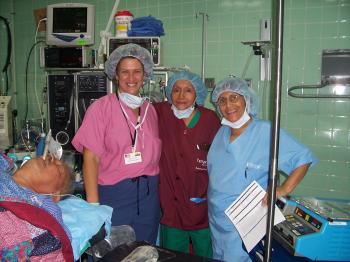 Cathy Hagerman, left, with Liddia and Susie, two Ecuadorian anesthesiologists who stopped in to check out the airway technique during a surgery in Guayaquil.
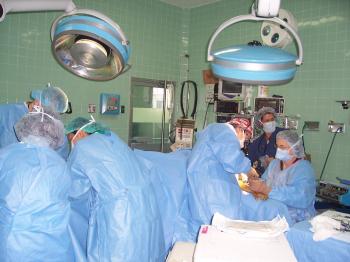 Cathy Hagerman, back right, during one of the 16 surgeries she participated in during her week in Ecuador.
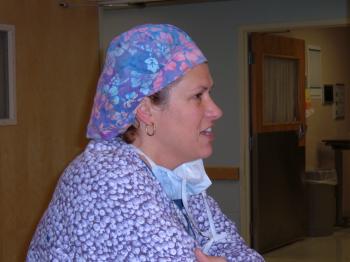 Cathy Hagerman, a Scarborough resident and certified registered nurse anesthesiologist, recently traveled with a group of doctors, nurses and volunteers to Ecuador to help treat patient’s with Hansen’s disease.
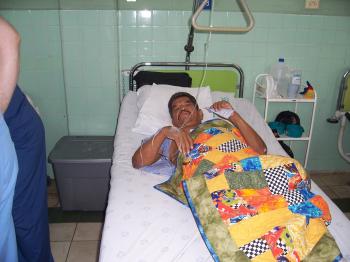 Hagerman’s group brough 55 quilts made by a quilting group from York Hospital. Without the quilts, said Hagerman, the patients would have gone without.
Comments are no longer available on this story