
RAYMOND – Last Thursday’s dramatic accident in Raymond, in which a 6-month-old baby survived being thrown 25 feet from a vehicle, has caught the attention of a Windham-based group dedicated to teaching parents the correct way to use child safety seats.
The accident is still under investigation by the Cumberland County Sheriff’s Office, and investigators are unclear as to how the baby survived. According to Capt. Don Goulet, “We don’t know and we may not ever know” how the child, who was belted into a rear-facing child safety seat, managed to fly out of the safety seat, landing on soft snow on the side of the road. Investigators have asked the National Highway Traffic Safety Administration for help in making a determination, but Goulet expects finding an answer will be difficult.
Goulet said initial investigation indicates the car seat was properly installed with the seat firmly attached in the middle of the back seat with the child securely buckled into the seat. But the force of the collision, which occurred Thursday, Jan. 3, at 4:40 p.m. at the corner of Ledge Hill and North Raymond roads, ripped the safety seat loose from the back seat, Goulet said. The baby was also ejected from the safety seat.
According to the director of the Safe Kids Maine, child safety seats are nearly always misused by the driving public.
Suzanne Grace, a resident of Highland Shore Road in Windham who has six kids of her own, operates the nonprofit organization out of her home. Among the many kid-focused programs, Grace organizes five monthly child safety seat checks throughout Maine, in North Windham, Falmouth, South Portland, Augusta and Waterville.
“We see over 90 percent of car seats are misused,” Grace said. “I know the police say they believe the seat was used correctly; however, our statistics would show otherwise. It reminds us that we need to take car seat safety seriously. That these are safety devices that can save a child’s life.”
In last week’s accident, the driver of the vehicle, Chynna Blaney, 19, of Raymond, and her infant son had been traveling eastbound on Ledge Hill Road in a 1999 Toyota Corolla when Blaney ran the stop sign at the intersection of North Raymond Road, Goulet said. Blaney, who was not familiar with the area, was on her way to a family member’s home in Raymond when the accident occurred. According to Goulet, Blaney was adjusting the GPS unit in her car and failed to stop for the stop sign at the intersection.
As Blaney crossed through the intersection she was struck by a 2003 Ford F-150 pickup driven by Angie Horler, 35, of New Gloucester, who was traveling southbound on North Raymond Road toward Gray with her two young children in the vehicle.
The child was located in the woods by Horler, who told police she had observed something being ejected during the impact of the two vehicles and heard the baby crying nearby as she exited her vehicle, something she initially thought was a car radio.
Fire and EMS personnel from Raymond, Gray and Poland responded to the scene. Blaney and her baby were transported to Maine Medical Center by Raymond Rescue for serious injuries. Horler was transported to Mercy Hospital for minor injury and a complaint of pain. Horler’s two children, ages 2 and 5, sustained no injury.
Grace, who saw the tragic results of improperly adjusted child safety seats during her three years as a Windham firefighter/EMT, is motivated to teach parents who arrive at the safety seat checks how to properly install and use child car seats.
When she heard about last Thursday’s accident in Raymond, Grace said her “heart went out to the family and we’re just thankful that everyone is OK.”
Grace said the most important thing for parents is to read the instruction manual that comes with their child safety seat, “and make sure they use it correctly every single time,” she added.
Grace said while most parents know how to attach the safety seat to the rear seat of the vehicle, most don’t properly buckle the child to the seat.
In released photographs of the Raymond collision, Grace said she observed that the safety harness that holds the baby to the safety seat was still buckled after the crash, meaning the child slipped out during the violent action caused by the collision.
“That leads us to believe the straps were loose, allowing him to be ejected out of the seat, which is the No. 1 misuse when it comes to putting a child into the seat. So that’s not surprising,” she said.
At the North Windham child safety seat checks, which take place the third Saturday of each month from 10 a.m.-1 p.m. at the North Windham Fire Station, Grace said an average of 10-15 families arrive and nearly all have their child improperly situated in the seat.
“We educate them about the safest way to transport their child and make any changes necessary teaching the parents along the way,” Grace said. “So they’re the ones actually installing the seat. We’re just guiding them.”
Grace said she and at least two other trained inspectors are present during the inspection to provide quality assurance “because we certainly want to make sure they’re installed properly,” she said.
The Windham-based Safe Kids Maine, one of 600 Safe Kids coalitions throughout the country and the only one in Maine, was formed in 1988 and Grace has headed it for 12 years. She’s always looking for volunteers to help with safety inspections or open new inspection sites.
One volunteer, who has undergone the 30 hours of training to become a seat-inspection technician, is Marcie Whidden of Gray. Whidden has two small children and describes herself as “very passionate” about making sure her and other little passengers are protected in an accident.
“So many folks are not informed, and there is very little information,” Whidden said. “When you go home with your new baby, you’re inundated with information. They will check the child in the seat in the hospital but after that you’re on your own. And I feel like I need to help educate people and spread the word, because unless you seek it out and you go to the inspection at the fire station it doesn’t come to you.”
Whidden said a 10-pound baby, not properly buckled, becomes the equivalent of a 300-pound projectile when ejected in a 30 mph collision. She said the Raymond collision, where the baby broke free of the seat and landed on soft snow after exiting the vehicle, was a lucky break since the outside environment can be deadly.
In the winter, Whidden said, the mostly likely culprit causing a failed inspection is loose-fitting clothing and a parent’s reluctance to firmly attach the safety harness for fear of making the child uncomfortable.
“Folks really need to have the child wearing no more than a thin fleece, and the harness needs to be snug because you’re not supposed to be able to pinch more than an inch of the webbing on the harness,” Whidden said. “But what people do is load them up with bulky clothing. Well, that bulky clothing compresses in a crash, causing slack in the harness causing children to be ejected.”
The No. 1 thing to remember, she said, is to picture what would happen if a crash did occur and whether the child would manage to break free from the harness.
“People think they’re tight, but they don’t realize that fabric compresses in a crash, and I don’t think people realize the magnitude of a crash,” Whidden said. “Any object that is not secured is going to become a projectile.”
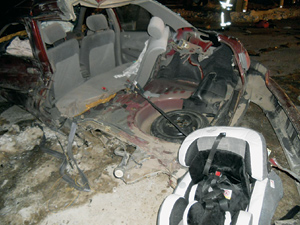 A 6-month-old baby was thrown from a vehicle and dislodged from its safety seat, during an accident in Raymond last week. Though investigators have yet to determine whether the safety seat was being used correctly in the crash, it has drawn the attention of a statewide organization based in Windham dedicated to showing proper use of the devices.
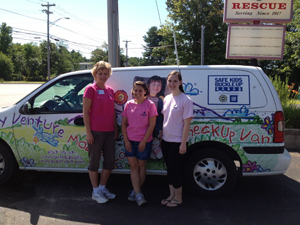 Suzanne Grace and two child seat inspectors, Jamie Gilbert of Gray and Tia Nielsen of North Waterboro, stand in front of Safe Kids Maine’s van in front of the North Windham Fire Station, one of five free safety seat inspection sites in Maine.
Comments are no longer available on this story