
CAPE ELIZABETH – Cape Elizabeth officials will weigh continuing the ban on political signs in traffic medians after they learned from a lawyer that the local sign ordinance might not hold up in court if challenged.
The town does allow other types of non-political signs on traffic islands and other town-owned property.
“We looked at the ordinance and saw that the provisions in the sign ordinance do allow some types of signs, but prohibit other types of signs,” Town Manager Michael McGovern said. “For that reason, knowing about the Portland court case, we decided to ask the attorney for an opinion.”
Attorney John J. Wall III of the Portland law firm Monaghan Leahy cited a February ruling in federal court that deemed Portland’s ban of panhandling in traffic islands unconstitutional. Wall wrote in a letter to Cape Elizabeth Assistant Town Manager and Clerk Debra Lane on Sept. 25, that, similar to the Portland case, “It is likely that the sign ordinance, as it pertains to placement of signs on traffic islands, would not hold up to constitutional scrutiny.”
“Basically what (his) opinion said was that (allowing political signs in traffic islands) was an exercise of free speech, and it didn’t matter that it was unsafe,” said McGovern.
At its meeting Monday, the Town Council referred the matter to its ordinance subcommittee for review.
According to the ordinance, signs authorized by the town that advertise election dates, times and polling places are allowed in traffic islands. The ordinance also limits the size of political signs to 4-by-31?2 feet.
McGovern said that political signs will be allowed in traffic islands until the Nov. 4 election and the medians will not be mowed until after the election, unless “that sign is a clear danger to traffic movement.”
“I am not going to ask staff to remove signs when the town attorney tells me it’s not constitutional to do so,” McGovern said. “The (U.S.) Constitution trumps the local ordinance.”
In his Sept. 25 letter to Lane, Wall recommended that the Cape Elizabeth sign ordinance be amended to either ban all signs from traffic islands, or allow all signs, both political and non-political in nature.
Temporary signs, which are non-political and announce an activity, educational or philanthropic event, or agricultural signs advertising a nearby farm stand operation, are allowed in Cape Elizabeth’s traffic islands.
According to Wall, banning political signs but allowing non-political and commercial signs on traffic islands and on other town-owned property, “would likely be found to be a restraint of free speech that violates the First Amendment.
“The sign ordinance, as it relates to the prohibition of political signs on traffic islands and other public rights of way, would likely not hold up to constitutional scrutiny as it impermissibly restrains political speech protected by the First Amendment by favoring nonpolitical speech,” Wall said.
“If we can’t ask the farm stand to remove its sign, we can’t (force) other forms of political speech, such as political signs, to be removed,” McGovern said.
South Portland and Scarborough both follow state laws regarding placement of signs.
But Scarborough also has local ordinances, as well. Political signs relating to a local election cannot be placed in a public right of way prior to 20 days before an election and must be removed 48 hours after an election. Campaign signs are not allowed on the grounds of town-owned properties including schools, fire stations, municipal buildings and community parks, according to the town’s ordinance.
Under state law, Scarborough and South Portland prohibit signs on telephone poles, trees, or painted or drawn on rocks and other natural features.
According to Scarborough’s ordinance, “Traffic safety should be of the utmost consideration in placement of political signs or posters.”
Wall recommended that if Cape Elizabeth is concerned about safety and aesthetics, then all signs should be banned from town traffic islands.
Though not often, Lane said, political signs have been seen in the traffic islands, and those who put them there in the first place often remove the signs within a couple of days.
“There are certainly good reasons to not have signs on traffic islands,” including safety and maintenance reasons, Lane said. “If any type of sign appears on a traffic island, unless of course it blocks traffic, we aren’t going to touch it at this point.”
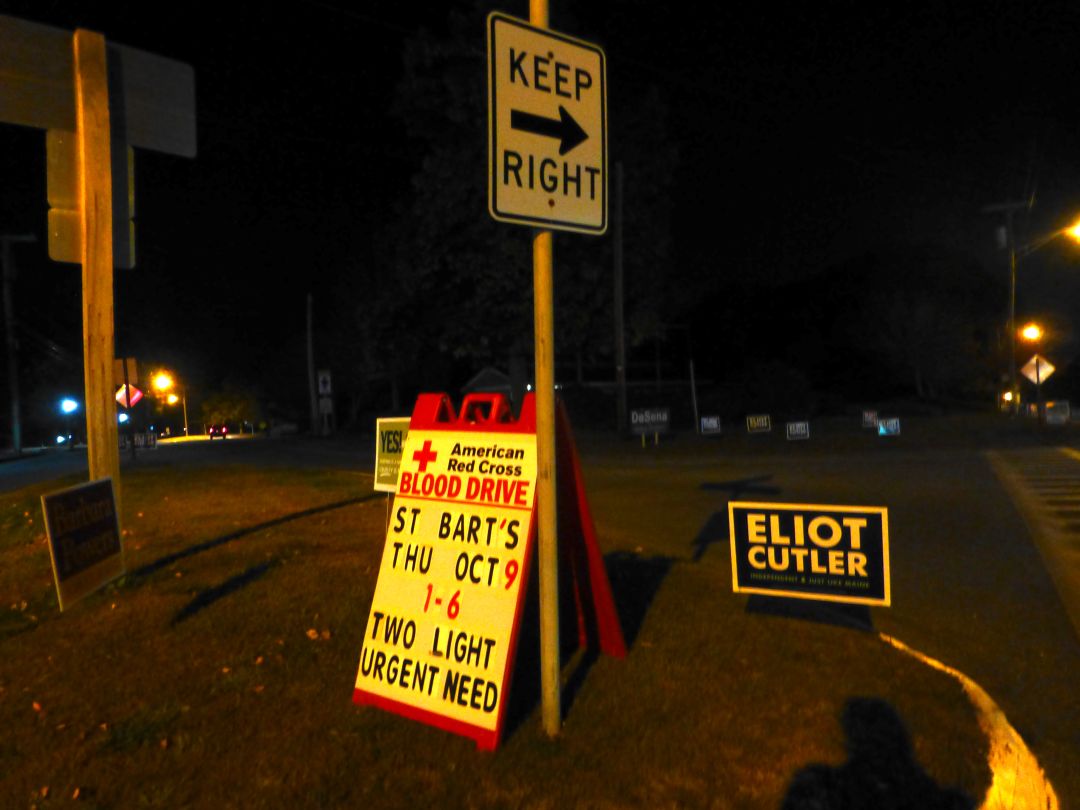 Cape Elizabeth is studying whether the town should ban all signs or allow all signs, including political and non-political, on traffic islands.
Comments are no longer available on this story