
Aeron Hurley, of Windham, is a college student who’s passionate about the future of New England’s energy needs.
A senior at Hobart and William Smith College in New York, 21-year-old Hurley spent the beginning half of this summer studying wind power on mountain ranges in upstate New York.
The purpose of his independent study was to assess the viability of wind power as a renewable energy source for the region.
Hurley, an advocate for wind power, doesn’t tie the need for renewable energy to the global warming debate or the political climate surrounding oil in the Middle East.
Rather, he said, the United States is behind the times in its use of renewable energies and, while the nation does have an abundance of coal on hand, its exponential consumption of fossil fuels and reliance on oil for power is quickly draining what’s left of this resource.
“Energy demand is increasing dramatically and we’re getting careless with the way we use energy in America,” Hurley said.
Hurley said he awoke to this reality through a class taught by Professor Thomas Drennen, chair of the environmental science department at Hobart College. In this class, Drennen presented the history and projected future of the nation’s energy demand and need.
Inspired by the class, Hurley decided to conduct an independent study of wind power in New York this summer.
He visited two existing wind farms and one proposed site for new wind turbines: Fenner Wind Farm where 20 turbines spin atop scattered mountain ridges to generate 30 megawatts of power; the rural town of Cohocton where a developer has proposed 48 wind turbines each with a 2-megawatt capacity; and Tug Hill, the biggest wind farm in New York, where 140 turbines now generate 231 megawatts of power.
Come October, an additional 55 turbines will be built on Tug Hill to generate enough power for more than 90,000 households at peak conditions.
With sound and atmospheric devices, Hurley tested these sites to scientifically assess whether they were appropriate for wind power by judging wind velocity, environmental impacts of the turbines and how the wind farms fit in with surrounding towns.
In doing so, he and a research assistant camped out underneath the turbines at Tug Hill to either prove or disprove a constant complaint of wind power, that the spinning blades create disruptive noise and vibrations.
“We wanted to stay overnight to either prove them right or prove them wrong,” Hurley said. “So we wanted to see them for ourselves.”
Aside from a low swishing sound, Hurley detected little vibration and noise. At least, not enough to affect his sleep below the large turbines.
Larger turbines seem to create less noise pollution and have less effect on the environment, Hurley said, and the technology has improved to overcome many of the problems that plagued the first experimental wind farms built in California.
Wind power is the fastest growing renewable energy source and is gaining national popularity as power companies in many states, including Maine with its Mars Hill project, are beginning to experiment with the technology.
Last fall, the U.S. Department of Energy reported there is enough wind capacity off U.S. coasts – an estimated 900,000 megawatts – to rival the power created by all existing power plants in the United States.
Off the coast of Cape Cod, the debate continues over the creation of wind farms near Nantucket Sound. The wind project, called Cape Wind, is estimated to generate enough power for 500,000 homes. But many have come out in opposition to the project, arguing that it would disrupt the lives of coastal residents, commerce and the environment.
Hurley heard landowners’ complaints about wind power during his study of the proposed wind power project near Cohocton. Many residents there believed wind turbines would bring down property values and disturb the environment.
Hurley attended Cohocton town meetings and talked with both sides of the debate before drawing his final conclusion on wind power potential in the town.
Wind power is most effective on mountain ranges that overlook farmland pasture and open fields, Hurley said.
For this reason, he decided Cohocton was not a good location for wind power because of the highly wooded ridges and low wind capacity except on the mountain summits.
However, Hurley did give both existing wind farms in Tug Hill and Fenner a “thumbs up,” asserting that their success shows that upstate New York is ripe for wind power.
Professor Drennen is proud of Hurley’s hard work, though surprised by his conclusions.
Drennen is an open advocate of renewable energies because of the pollution created by fossil fuels, but he keeps these opinions out of discussion in class about the nation’s energy needs and demands. He just lays out the facts and allows the students to make up their minds.
“The idea is to show students that we’re our current energy comes from,” Drennen said, “to understand that there are trade off with each energy source out there.”
Hurley is optimistic about the future of renewable energy and plans to expand his study on wind power potential to other locations in New York.
“There’s not many resources out there that people are taking the full advantage of,” Hurley said. “If we’re smart about it, we can go through with these renewable energy sources.”
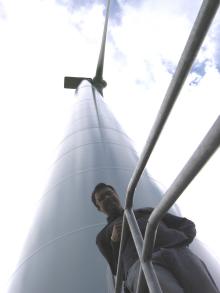 Aeron Hurley, of Windham, stands below the spinning blades of a wind turbine in Tug Hill, New York. Hurley camped out below these turbines and studied several other wind farms in upstate New York as part of an independent study.
Comments are no longer available on this story