
The South Portland Land Trust expects to receive by this fall a conservation easement to Barberry Creek Woods, marking a significant step to guarantee the 17 acres will stay undeveloped for recreational use by residents.
Located off Broadway, the urban forest largely is hidden from view, although it is located in one of the busier sections of South Portland, behind a vacant Irving filling station off Evans Street.
The city of Portland has owned Barberry Creek Woods since the 1850s, but has no plans to develop the property, which contains wetlands and the meandering creek.
Portland officials acquired the land as they developed the neighboring Forest City Cemetery.
Councilor Tom Blake, a founder of the private land trust, said Portland officials recently agreed to grant the conservation easement after the land trust approached them about it.
In addition, the city of South Portland and the land trust have partnered to request money from the Maine Department of Conservation to improve public access to the property.
The state funding is available through court-ordered private damages paid after the 1996 oil spill from the Julie N, an oil tanker.
The city has applied for $60,000 of $250,000 available for preserving land and waterways affected by the oil spill. Blake said a decision on the fund’s distribution is expected soon.
The land trust considers public access to Barberry Creek Woods vital, because the site is among a dwindling number of undeveloped properties left in South Portland that may be used for open space.
The 17 acres of sandy soils and wetlands are forested with birch, oak, maple and cherry trees. There is an upland wooded section where the trails will go and then a steep drop-off to the creek itself.
Blake anticipates the public will use the woods for urban hiking, picnicking and bird watching. “We want the public to be able to enjoy this beautiful piece of land right in the middle of our community,” he said.
The land trust has enlisted the help of the Maine Conservation Corps to design a trail system through the woods. A trail designer will walk the site on July 10, and Blake said there are several options for the public to access the site.
The trail system will be next to the city’s greenbelt as it runs along Broadway and Evans Street.
Blake said he expects the designer will follow existing trails residents have used in the woods over the years. Children in the neighborhood once played in Barberry Creek Woods, digging forts there in the sandy soil in the 1950s and ’60s.
Barberry Creek has a long and storied history. South Portland historian Kathy DiPhilippo has described Barberry Creek as “a world all its own… hidden away from the masses and home to a wide variety of birds, muskrats and other wildlife.”
DiPhilippo notes on the South Portland Historical Society’s Web page that the “history of those woods goes back to the early settlers of this area.”
In the 1680s, there was a grist mill on Barberry Creek. A saw mill was constructed there in 1728. In the early 1840s, a train station was built on the site where the closed Irving station is now located.
There also was an ice house on Barberry Creek, where Global Oil is located today.
A dam that was installed in Barberry Creek killed the alewives that once spawned there. The fish had traveled up the Fore River to spawn in the fresh water.
Barberry Creek is one of the city’s five watersheds. Most of the watersheds are polluted by oil, grease and sediment. Blake said at least three tributaries in South Portland drain into Barberry Creek.
Storm water from surrounding neighborhoods pours into Barberry Creek, making it uninhabitable for fish and other wildlife.
The Environmental Protection Agency is expected to eventually force communities to clean up their watersheds.
Barberry Creek is 786 acres, and extends for 1.3 miles, much of it underground. It starts at Wainwright ball field and Rigby Yard and then follows the greenbelt to Evans Street and South Portland High School.
“One of the problems the high school has is water. The water that comes down that portion of Highland Avenue drains into Barberry Creek. But the creek itself is underground there,” Blake said.
Barberry Creek connects to the Fore River, which was polluted by the spill.
The woods face continuing pressure from development. Hannaford plans a major parking lot for its trucks and warehouse on the banks of Barberry Creek. The site is off of Pleasant Street, but the company will have to meet updated standards by the Department of Environmental Protection for water protection.
“Hannaford has a smaller parking lot there now, but with the new development and a treatment system, the water is likely to be cleaner there,” Blake said.
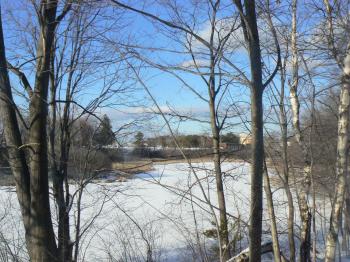 Storm water from surrounding neighborhoods pours into Barberry Creek, making it uninhabitable for fish and other wildlife.
Comments are no longer available on this story