
RAYMOND – Raymond residents Howard and Eileen Stiles are warning area homeowners on private wells to check their water for uranium.
After hearing from some of their neighbors who found high uranium content in their well water, the longtime residents of Raymond’s Deep Cove Road, located off Jordan Bay, had their water tested twice. Both tests came back with nearly identical results: 68 micrograms of uranium per milliliter, more than twice the federal Environmental Protection Agency standard of 30 mg/l.
While the human body can eliminate excess uranium from the system within a matter of weeks, according to the World Health Organization, ingestion of uranium over long periods can result in cancerous mutation of kidney cells due to uranium build-up.
As a result of their water tests last month, the active and healthy Raymond couple is now drinking bottled water and planning to install a reverse osmosis water treatment system, which can cost as little as $200 for point-of-source installations at the tap or upward of $2,000 for whole-house systems.
“We have a new grandchild and they spent three weeks here last summer, and what really bothers me is that we just found out,” said Eileen Stiles. “We want people to check their water. People need to know.”
And her neighbors, those she comes in contact with on daily walks in the neighborhood or at the store, are listening to Stiles’ advice.
One neighbor, Dick Lindell, who rents his home on Deep Cove Road in winter, installed a reverse osmosis system to remove uranium and radon, another radioactive gas that is known to cause cancer. Neighbors Dick and Judy Day did the same, and Arlene Briard of nearby Misery Gore Road is awaiting water test results.
“Howard and Eileen alerted us, so I think it’s a good idea to get it checked,” Briard said.
That’s what the Stiles want everyone to do: get their water checked, not only for uranium but radon, arsenic, and other heavy metals that can cause health problems if ingested in high quantities.
Naturally occuring
According to Mike Gelberg, owner of Air & Water Quality Inc. based in Freeport, a company that installs systems for contaminated groundwater supplies, uranium is a naturally occurring metal and is prevalent through the Lakes Region, not just Raymond.
“It’s an issue all throughout the Lakes Region up into Poland,” Gelberg said. “There are high levels over the whole area; it’s not just a clustered problem.”
Jay Hyland, radiation control program manager at Maine Center for Disease Control, confirms that the Sebago Lake area is home to higher-than-average levels of radon and uranium.
“Throughout Maine, 30 percent of homes have elevated radon levels, and it wouldn’t surprise me if uranium had similar levels,” Hyland said. “In the Sebago Lake area, that number is more like 50 percent.”
The state is taking the issue of groundwater contaminants seriously. Mike Foley, a senior geologist at Maine Geological Survey, is currently analyzing about 15,000 soil and water samples taken throughout Maine for uranium, fluoride, nitrates and other toxins. He began the analysis in January and expects to wrap up testing in June. At that time, he will release the results.
“If it’s high in a town, we’ll alert that town,” Foley said.
Hyland explained that radon, which is a gas that can be trapped in water as well as the air inside a poorly ventilated home, goes hand-in-hand with uranium since uranium is a further decayed form of radon. Radon, he explained, has more radioactivity than uranium and is therefore more dangerous to human health than uranium.
“Uranium, like radon, is radioactive, but it’s not very radioactive. It has an unstable nucleus. At certain levels, however, it is a known kidney toxin,” Hyland said.
Radon became a public health problem in the 1970s when higher oil prices caused homeowners to become more energy efficient by tightening up their homes. As homes became less ventilated, radon gas seeped up from the ground and became trapped inside homes. Radon and uranium, Hyland said, are more prevalent in areas lacking in topsoil, such as the northeastern United States, where the bedrock is located closer to the surface due to glacier movement in the last Ice Age.
“You find the higher radon and uranium levels in areas with rocky outcroppings or areas where the bedrock isn’t very far down since glaciation pushed all the soil away,” Hyland said.
Though the Northeast is higher than the U.S. average for groundwater uranium, Gelberg, owner of Air & Water Quality, said levels can vary greatly even within a certain area. For example, while the Stiles may have high uranium, a home next door may have adequate levels, Gelberg said.
“Unlike iron, which can smell and mark a sink or tub, there is no manifestation of radon or uranium. No color, no smell,” Gelberg said. “And there’s also no telling where it crops up. You don’t have to be on ledge to have high uranium. Sand is just ground-up rock, right?”
Kevin Kaserman, president of Dunbar Water based in Wells, which also installs water treatment systems, said his company has been busy installing systems that filter uranium and other contaminants from well water.
“Uranium is a big issue,” Kaserman said. “It’s really starting to pop up not only in Raymond but we’ve done systems in Windham, Gray and Naples, other towns as well. My advice is to test it and see if you have it. It just makes sense.”
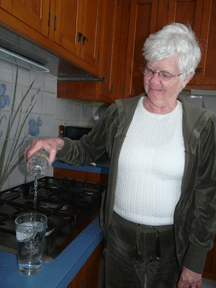 Eileen Stiles of Deep Cove Road in Raymond is now drinking bottled water after discovering high uranium content in her well water. Several of her neighbors have found high uranium levels, as well. Experts say the Lakes Region as a whole has higher-than-average uranium and radon levels. (Staff photo by John Balentine)
Comments are no longer available on this story